Shade sail sizing and tension
A sagging sail is not a fabric defect. It is one of three things, all fixable, and all decided before or during installation rather than afterwards.
By Ryder M. · Published · Last updated
We compare published manufacturer specifications, warranty terms and owner-reported failure modes. We have not physically tested these structures. How we judge shade structures
Slat & Shade earns a commission on qualifying purchases made through links on this page. It costs you nothing extra and never changes what we recommend. Full disclosure
Part of Shade Sails
The short answer
Size the sail 8-10% smaller than the span to leave room for hardware. A sail sags for one of three reasons: the fabric stretched and there is no turnbuckle to take it up, all four corners were set level so there is no twist in it, or an attachment point moved.
Our picks at a glance
| # | Structure | Best for | Fabric | Price |
|---|---|---|---|---|
| 01 | 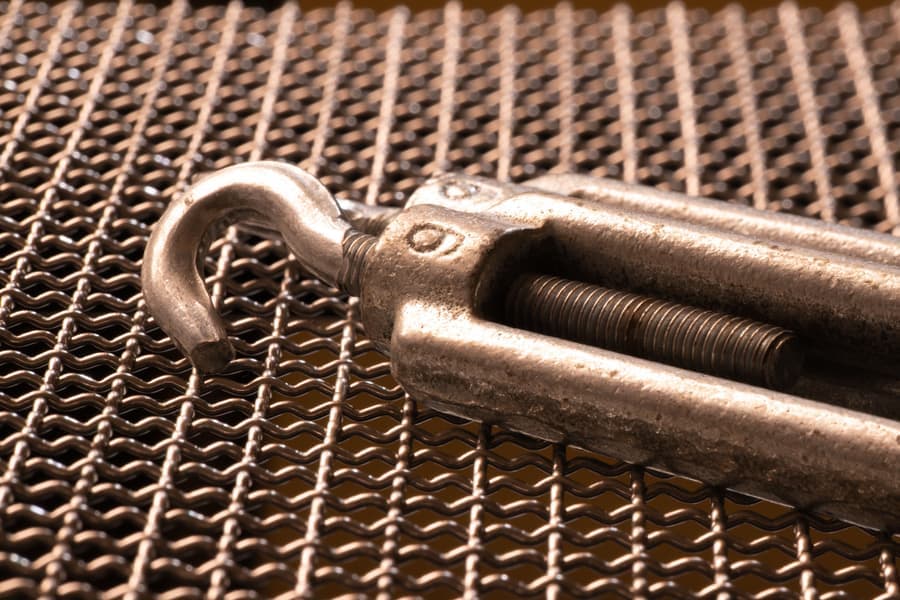 SUNNY GUARD Shade Sail Hardware Kit, 316 Stainless316 marine-grade stainless rather than 304 — the difference that decides whether your fixings survive a coastal or pool-side install. | The fix for the most common cause | Not published by manufacturer | Check price on Amazon |
| 02 | 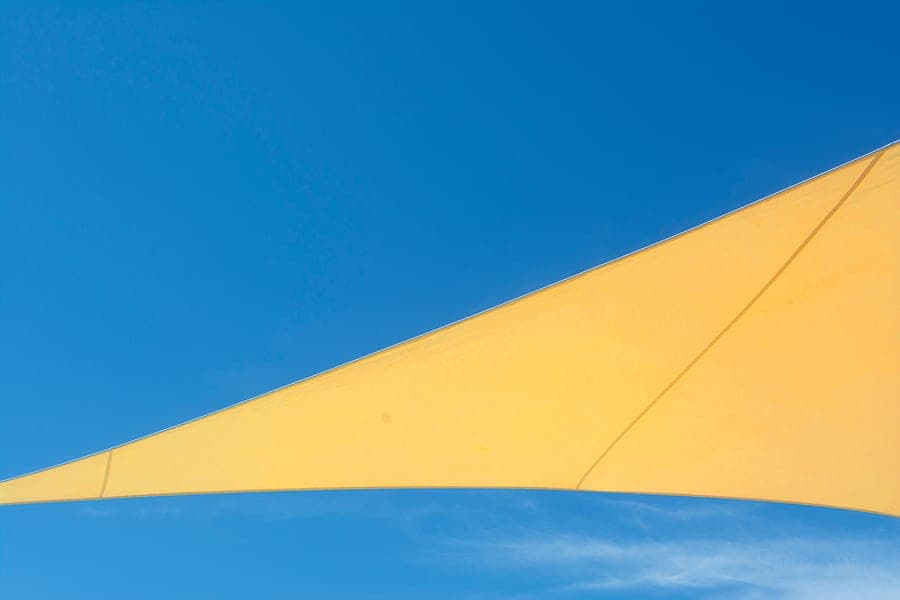 ColourTree Triangle Sun Shade Sail, 200 GSMA heavier 200 GSM fabric in the shape that tensions most predictably — three anchor points cannot fight each other the way four can. | The shape that cannot sag in the middle | 200 GSM HDPE, 95% UV block | Check price on Amazon |
| 03 | 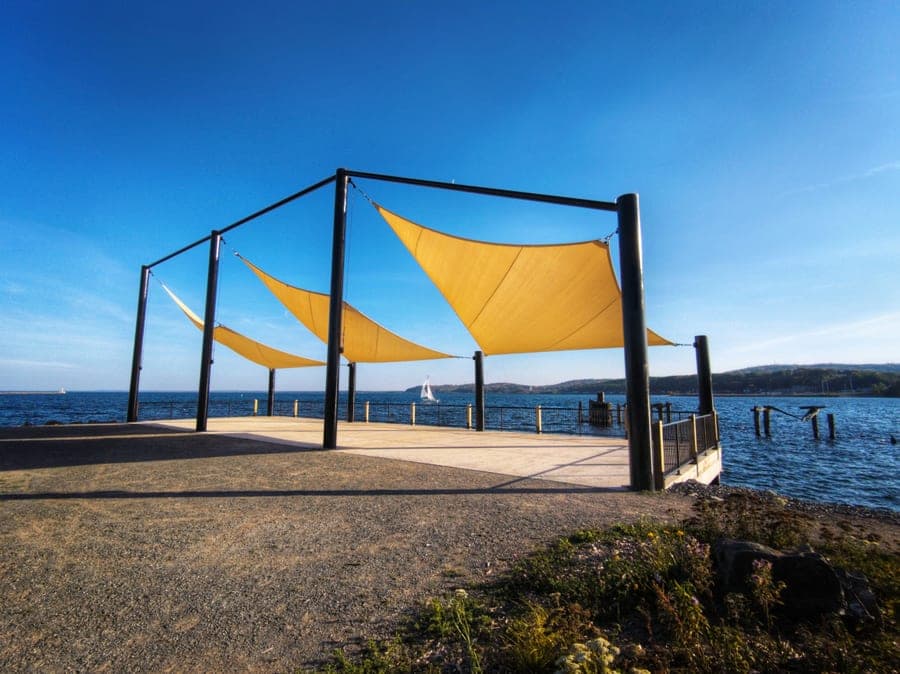 Windscreen4less Cable Shade Sail, 260 GSMThe heaviest fabric and the longest warranty of any sail here — seven years — and the only one with a galvanized cable sewn through the perimeter. | Best at holding its shape | 260 GSM high-density polyethylene, UV 95 | Check price on Amazon |
| 04 |  ColourTree Rectangle Sun Shade Sail, 190 GSMThe clearest published fabric spec in the category — 190 GSM virgin HDPE, 95% UV block, three-year warranty — with the hardware sold separately. | Widest sizing choice | 190 GSM HDPE mesh, 95% UV block, breathable | Check price on Amazon |
The durability table
Every published figure we could source for these structures, in one place, with the manufacturer page each number came from. Where a cell reads "Not published by manufacturer", that figure does not exist in the manufacturer's own material — we do not estimate it and we do not copy one from another site.
| Model | Wind rating (mph) | Snow load | Frame | Roof | Anchoring required | Warranty | Spec source |
|---|---|---|---|---|---|---|---|
| SUNNY GUARD Shade Sail Hardware Kit, 316 StainlessTop pick | Not published by manufacturer | Not published by manufacturer | 316 marine-grade stainless steel | Not published by manufacturer | Turnbuckles, pad eyes, snap hooks, screws and expansion anchors; sized for triangle sails under 161 sq ft | Not published by manufacturer | SUNNY GUARD hardware kit product pageChecked 2026-09-26 |
| ColourTree Triangle Sun Shade Sail, 200 GSM | Not published by manufacturer | Not published by manufacturer | No frame — breathable HDPE fabric | 200 GSM HDPE, 95% UV block | Stainless steel D-rings at the corners; hardware sold separately | 3 years | ColourTree triangle shade sail product pageChecked 2026-09-26 |
| Windscreen4less Cable Shade Sail, 260 GSM | Not published by manufacturer | Not published by manufacturer | Steel-wired perimeter with galvanized cable and A-ring reinforcement | 260 GSM high-density polyethylene, UV 95 | Strengthened A-rings at the corners, steel wire reinforced edges | 7 years under normal weather conditions | Windscreen4less shade sails pageChecked 2026-09-26 |
| ColourTree Rectangle Sun Shade Sail, 190 GSM | Not published by manufacturer | Not published by manufacturer | No frame — 100% virgin (non-recycled) HDPE fabric, reinforced stitched seams | 190 GSM HDPE mesh, 95% UV block, breathable | Stainless steel D-ring at each corner; cable rope and hardware kits sold separately | 3 years under normal weather and usage | ColourTree rectangle shade sail product pageChecked 2026-09-26 |
Every pick in full
The fix for the most common cause
SUNNY GUARD Shade Sail Hardware Kit, 316 Stainless
316 marine-grade stainless rather than 304 — the difference that decides whether your fixings survive a coastal or pool-side install.
- Wind rating
- Not published by manufacturer
- Snow load
- Not published by manufacturer
- Frame
- 316 marine-grade stainless steel
- Roof
- Not published by manufacturer
- Anchoring
- Turnbuckles, pad eyes, snap hooks, screws and expansion anchors; sized for triangle sails under 161 sq ft
- Warranty
- Not published by manufacturer
- Sizes
- M6 turnbuckles, 6 in. to 8 in. adjustable range
If your sail sags, this is most likely the answer — and if you are about to install one, buying it now prevents the problem.
Fabric stretches. A turnbuckle is the only way to take that stretch back out. A sail hung on fixed hooks has whatever tension it had on installation day, declining from then on: by the end of the first summer it is slack, and a slack sail flogs in wind and works its own corner rings until something tears.
M6 turnbuckles adjustable from 6 to 8 inches is the working specification — two inches of take-up per corner, which is enough for the initial stretch and then some. Plus pad eyes, snap hooks, screws and expansion anchors, all in 316 marine-grade stainless.
316 rather than 304 matters at the corner, because that is where the whole load sits and where chloride pitting starts near salt air or a pool.
Sized for triangle sails under 161 sq ft. A larger sail needs proportionally heavier hardware, and hardware working at its limit is the weakest link in the installation.
Skip it if: Your sail is larger than about 161 sq ft — size the hardware up rather than using this at its limit.
#ad Price shown as of September 26, 2026. How this site is funded
Specifications from SUNNY GUARD hardware kit product page, checked 2026-09-26.
The shape that cannot sag in the middle
ColourTree Triangle Sun Shade Sail, 200 GSM
A heavier 200 GSM fabric in the shape that tensions most predictably — three anchor points cannot fight each other the way four can.
- Wind rating
- Not published by manufacturer
- Snow load
- Not published by manufacturer
- Frame
- No frame — breathable HDPE fabric
- Roof
- 200 GSM HDPE, 95% UV block
- Anchoring
- Stainless steel D-rings at the corners; hardware sold separately
- Warranty
- 3 years
- Sizes
- Not published by manufacturer
The geometric answer to the second most common cause of sag, and the reason we recommend a triangle for any first installation.
A three-point sail is always a flat plane. Three points define a plane — it is not a design choice, it is geometry. So all three corners can be tensioned hard and the fabric sits taut, with no possibility of slack in the middle.
A four-point sail is not necessarily planar, and that is the whole problem. Tension all four corners level and the fabric between them has no defined surface to sit on: it sags in the middle, and the sag is exactly what wind gets hold of. Fixing it means deliberately setting two diagonally opposite corners high and two low, which builds a twist into the fabric and makes the surface stiff.
200 GSM HDPE with 95% UV block, stainless D-rings at the corners, three-year warranty. Breathable, so it cannot pool.
Three corners also means three turnbuckles rather than four, which makes stepping up to 316 stainless easier to justify.
Skip it if: You need to cover a rectangular area efficiently — you will need two triangles, and six fixings.
#ad Price shown as of September 26, 2026. How this site is funded
Specifications from ColourTree triangle shade sail product page, checked 2026-09-26.
Best at holding its shape
Windscreen4less Cable Shade Sail, 260 GSM
The heaviest fabric and the longest warranty of any sail here — seven years — and the only one with a galvanized cable sewn through the perimeter.
- Wind rating
- Not published by manufacturer
- Snow load
- Not published by manufacturer
- Frame
- Steel-wired perimeter with galvanized cable and A-ring reinforcement
- Roof
- 260 GSM high-density polyethylene, UV 95
- Anchoring
- Strengthened A-rings at the corners, steel wire reinforced edges
- Warranty
- 7 years under normal weather conditions
- Sizes
- Not published by manufacturer
If the sag you are worried about is the edge rather than the middle, edge construction is the specification that addresses it.
A galvanized cable runs through the perimeter hem, terminated into strengthened A-rings at the corners. A webbing-edged sail carries edge tension through stitched tape, which distorts under load — and a distorted edge puts a wave into the sail that no amount of corner tensioning removes. A cable edge stays straight, and it spreads corner load along the perimeter rather than concentrating it at a ring.
260 GSM is also the heaviest fabric in the category, and heavier fabric stretches less and later. That directly reduces the sag you have to keep taking up.
Seven-year warranty, against three on the same manufacturer's 180 GSM line — which is the clearest available statement about what the weight and the cable edge buy you.
It is heavy to handle and tension, and it is a two-person installation. Tension it in rotation rather than one corner at a time, because uneven tensioning on a cable edge can put a permanent distortion into the perimeter.
Skip it if: You are installing alone, or the span is short enough that a stitched edge is adequate.
#ad Price shown as of September 26, 2026. How this site is funded
Specifications from Windscreen4less shade sails page, checked 2026-09-26.
Widest sizing choice
ColourTree Rectangle Sun Shade Sail, 190 GSM
The clearest published fabric spec in the category — 190 GSM virgin HDPE, 95% UV block, three-year warranty — with the hardware sold separately.
- Wind rating
- Not published by manufacturer
- Snow load
- Not published by manufacturer
- Frame
- No frame — 100% virgin (non-recycled) HDPE fabric, reinforced stitched seams
- Roof
- 190 GSM HDPE mesh, 95% UV block, breathable
- Anchoring
- Stainless steel D-ring at each corner; cable rope and hardware kits sold separately
- Warranty
- 3 years under normal weather and usage
- Sizes
- 14 sizes, 8 x 10 ft to 16 x 20 ft
On a sizing page, having fourteen sizes to choose from is the practically useful specification: 8 x 10 ft to 16 x 20 ft.
That matters because you are sizing to your spans, not to the area you want shaded — and after subtracting the 8-10% hardware allowance, the size you need is rarely a round number. A wide range means you are more likely to find one that fits without over-spanning or leaving a gap.
190 GSM 100% virgin non-recycled HDPE with 95% UV block, reinforced stitched seams, stainless steel D-rings, three-year warranty.
One sizing note specific to rectangles: plan the twist before you order. Setting two diagonally opposite corners high and two low changes the effective diagonal between fixings, so the heights have to be decided during planning rather than after the sail is on the ground.
Skip it if: The span is long and exposed — a cable-edged sail holds its shape better under sustained load.
#ad Price shown as of September 26, 2026. How this site is funded
Specifications from ColourTree rectangle shade sail product page, checked 2026-09-26.
Sizing: the sail is smaller than the span
This is the arithmetic that catches most first-time buyers, and getting it wrong means a sail you physically cannot tension.
Allow roughly 8-10% of each span for hardware. The turnbuckle, the snap hook and the corner ring all occupy length, and you need the turnbuckle to start well short of its travel limit so there is room to take up stretch later. A sail sized to the exact distance between your fixings will not reach, and a sail sized to reach exactly cannot be tightened.
- 01Measure between your attachment points, at the heights you intend to fix them — not at ground level, because the pitch changes the distance.
- 02Decide the pitch and, on a four-point sail, the twist, then re-measure the effective diagonals at those heights. Two corners high and two low makes the diagonals longer than a level layout.
- 03Subtract 8-10% from each measured span. That is your target sail dimension.
- 04Choose the nearest available size at or below that, rather than above it. Slightly small is tensionable; slightly large is not.
- 05Check the shaded footprint against what you want covered, at the time of day you actually want shade. A sail sized for the span may not shade what you assumed.
- 06And check head clearance at the low corner, which the pitch reduces.
Why four-point sails sag and three-point sails do not
This is the most useful piece of geometry in the whole category and almost nobody explains it.
Three points define a plane. Always, unavoidably. So a triangular sail tensioned at all three corners has a single flat surface to sit on, and hard tension produces a taut sail. There is no configuration in which it sags in the middle.
Four points do not define a plane unless they happen to be coplanar. Set all four corners at the same height and you have asked the fabric to be flat between four points with nothing defining the surface between them — so it sags, and the sag deepens as the fabric stretches.
The fix is a twist. Set two diagonally opposite corners high and the other two low. Now the four points describe a genuinely three-dimensional surface — a hyperbolic shape, the same form used on commercial shade structures — and the fabric has a defined surface to sit on. The result is dramatically stiffer: it holds tension better, sheds water decisively, and spills wind from more directions.
This is why professional installations never look flat. The twist is not styling; it is what makes a four-point sail work. If your rectangular sail sags in the middle and all four corners are level, that is the cause and re-rigging the heights is the fix.
The three reasons a sail sags
In order of how often each is the cause.
- The fabric stretched and there is no turnbuckle. By far the most common. Fabric stretches under load and in heat, most of it in the first few weeks, and without a turnbuckle at each corner there is nothing to take it back out. The fix is fitting turnbuckles; the prevention is buying them with the sail.
- All four corners were set level, so there is no twist. The geometric cause above. The fix is re-rigging two diagonally opposite corners higher — which usually means moving or extending fixings, so it is worth getting right first time.
- An attachment point moved. A post leaning under tension, a wall fixing pulling, a fascia board flexing, a tree growing or swaying. This one presents as sag and is actually a structural problem — and it is the one to investigate first, because the others are cosmetic until they are not. How to install a shade sail covers what an attachment point has to take.
- And a fourth, less common: the sail was over-sized. A sail sized to the exact span, or larger, cannot be tensioned because the hardware has no room to work. If the turnbuckles are wound fully closed and it is still slack, this is why.
Why sag matters more than it looks like it should
A slack sail is not just untidy. It is the beginning of a failure sequence, and understanding the sequence is what makes the maintenance worth doing.
Slack fabric flogs in wind. A taut surface deflects air; a loose one flaps, and each flap is a shock load on the corner rings and the stitching beside them.
Flogging destroys the corner, not the field. Shade sails almost never tear in the middle. They tear at or beside a corner ring, because that is where the whole load concentrates and where flogging works hardest. Look at the stitching next to each ring on any sail that has been up for a few seasons — fraying there is the early warning.
And on a waterproof sail, sag causes pooling, which is a second, faster failure loop: water collects in the sag, the weight deepens the sag, more water collects. That is why re-tensioning a waterproof sail is structural maintenance rather than cosmetic. HDPE vs waterproof shade fabric covers the difference.
The whole sequence is prevented by one component and one habit: a turnbuckle at every corner, re-tensioned after the first few weeks and then annually.
The re-tensioning schedule
- 01Two to four weeks after installation. This is the important one and the one people miss. Fabric does most of its initial stretching early, so the first re-tension recovers most of the total stretch the sail will ever develop.
- 02Annually thereafter, at the start of the season when you put it back up.
- 03Whenever it looks slack, without waiting for the schedule. If you can see give in it, it needs tensioning.
- 04Check the turnbuckles have travel left each time. One wound out to its limit is no longer a tensioner, and that is the signal to re-rig — shorten a cable, move a fixing, or accept the sail has stretched past its useful size.
- 05Check the stitching beside each corner ring while you are there. That is where it will fail, and fraying is visible well before anything tears.
- 06And check the attachment points, not just the sail. A post leaning a couple of degrees under years of tension is easy to miss and it is the structural version of this problem.
The hardware side of all of this is in shade sail hardware guide, and the fabric side — why heavier fabric stretches less — is in GSM and shade percentage explained.
Questions people ask
Why does my shade sail sag?
What size shade sail do I need for my span?
How tight should a shade sail be?
Why do four-point shade sails sag in the middle?
Do I need turnbuckles on a shade sail?
How often should I re-tension a shade sail?
Where do shade sails tear?
Does heavier fabric sag less?
Where these figures came from
- SUNNY GUARD shade sail hardware kit — M6 turnbuckles adjustable 6-8 in., 316 marine-grade stainless, kit contents and sizing
- ColourTree triangle shade sail — 200 GSM HDPE, 95% UV block, stainless D-rings, 3-year warranty
- ColourTree rectangle shade sail — 190 GSM virgin HDPE, 14 sizes from 8x10 to 16x20 ft, reinforced stitched seams
- Windscreen4less shade sails — 260 GSM cable line with galvanized cable and A-ring reinforcement at 7 years, versus 180 GSM webbing at 3 years
Found an error? Tell us and we will correct it within seven days and note the change on the page with a dated line — see our editorial policy.