How to anchor a pergola
This is the part of the project that decides whether the wind rating you paid for applies to your pergola. It is also the part the kit usually leaves to you.
By Ryder M. · Published · Last updated
We compare published manufacturer specifications, warranty terms and owner-reported failure modes. We have not physically tested these structures. How we judge shade structures
Part of Wind, Snow & Anchoring
The short answer
Anchor every post, into the structure beneath the surface rather than the surface itself. Concrete takes wedge or sleeve anchors through the post base. Pavers need lifting so you can reach the slab or pour a footing. Decks need blocking or a joist, never just the boards. Grass needs a poured footing or a driven ground anchor.
Why this is not optional
Backyard Discovery states that the Beaumont must be anchored as specified in its instruction manual, and publishes its 100 mph wind rating as applying when properly anchored. PURPLE LEAF publishes 72 mph for the Athena when it is fully secured with expansion screws on a hardened floor. Domi instructs you to anchor with M6 expansion bolts immediately after assembly.
Those are three manufacturers telling you the same thing in three ways: the rating and the anchor are one specification. An unanchored pergola has no wind rating, because the figure was never measured in that condition — see wind ratings explained for why.
There is a warranty consequence too. Inadequate anchoring is the most common exclusion in this category, which means an unanchored structure that fails in wind is usually also an uncovered one.
The eight steps, whatever your surface
The surface changes the fixing, not the method. Do these in order.
- 01Identify what is actually under the surface before you buy anything. A 4 in. concrete slab, a paver on sand over compacted base, deck boards over joists at 16 in. centers and bare soil are four different problems with four different answers.
- 02Read the manufacturer's manual for the required fixing and the post-base pattern. Some kits specify anchor diameter and embedment depth; those specifications are the ones the rating was tested against.
- 03Position the whole frame and check it square before drilling anything. Measure both diagonals — they must match. A pergola drilled out of square cannot be corrected without new holes.
- 04Mark every hole through the post base plates while the frame is in position, then move the frame clear to drill.
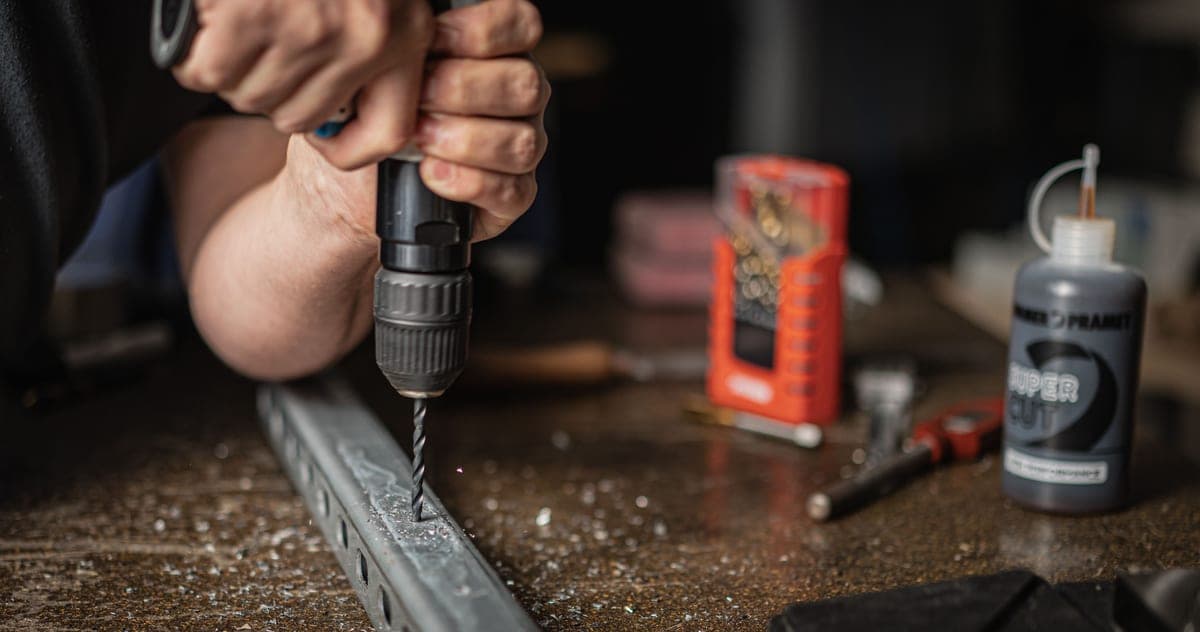
- 05Drill to the specified diameter and depth, with a hammer drill and a masonry bit for concrete. Drill deeper than the anchor needs so debris has somewhere to go, and clear the dust out of the hole — dust is the usual reason an anchor fails to reach its rated hold.
- 06Set the anchors and tighten to the manufacturer's spec. Do not over-torque: in concrete an over-tightened wedge anchor can spall the hole and lose most of its capacity.
- 07Check the frame is still square and plumb, then go round every structural fastener in the kit and confirm it is tight. A correctly anchored pergola with loose beam bolts is not the structure that was tested.
- 08Re-check the anchors after the first season, and then annually. Freeze-thaw cycles and seasonal movement back fasteners out, and the base is the position where that matters most.
Concrete — the best case
An existing concrete patio at a genuine 4 in. or more is the surface every published wind rating assumes, and the fixing is straightforward.
Wedge anchors (sometimes sold as expansion anchors) are the usual answer: a sleeve that flares against the hole wall as the bolt tightens. They are strong, cheap and permanent — removing one means cutting it flush. Sleeve anchors hold slightly less but can be backed out, which matters if you might ever move the structure. Concrete screws are the quickest to install and the weakest of the three; they are fine for a light structure on a sheltered site and not what you want holding a 14 ft pergola in exposed wind.
Two things to check before you commit. Slab thickness, because an anchor needs its specified embedment and a decorative 2 in. topping will not give it — drill a test hole in an inconspicuous spot if you are unsure. And edge distance: an anchor set too close to the slab edge will crack it out rather than hold. Keep the post base in from the edge by several times the anchor diameter, and further if the concrete is old.
Use stainless or hot-dip galvanized fixings even when plated steel is cheaper. The base of a post is the wettest place on the whole structure and stays wet longest; plated bolts there are the most predictable corrosion point on any of these kits.
Pavers — lift them
A paver patio looks like a hard surface and behaves like a loose one. Pavers sit on sand over a compacted base; they are held in place by friction and edge restraint, and a single paver bolted to a post base will lift out with the post attached to it.
There are two real options, and both start with lifting pavers.
- Reach the slab beneath. If the pavers were laid over concrete, lift the pavers at each post position, anchor into the slab as above, and cut the pavers to fit back around the base. This gives you the concrete case and the full rating.
- Pour a footing. If there is no slab, excavate at each post position, pour a concrete footing below the frost line for your region, and anchor into that once it has cured. This is more work than the rest of the installation combined and it is the only method that gives a paver patio genuine holding.
- What does not work: bolting through a single paver, bedding a post base in sand, or relying on the surrounding pavers to hold a base plate down. All three feel solid when you push on them by hand and none of them resists uplift.
If lifting pavers is genuinely not possible, treat the site as a no-drill case and read that section below — including its honest limits.
Wood and composite decks
A deck can carry a pergola well, and the fixing has nothing to do with the deck boards. Boards are a walking surface; they are fastened to resist being stepped on, not to resist a post trying to lift off.
Anchor into a joist, a beam or purpose-added blocking. That means locating the framing under each post position — often by going underneath with a light, sometimes by lifting a board — and then through-bolting the post base into solid framing with carriage bolts, not lag screws into the face of a board. Where a post lands between joists, add blocking between them specifically to take the base, sized to spread the load across both.
Composite decking needs one extra consideration. The boards themselves have less fastener holding power than wood and are more prone to crushing under a clamped base plate, so getting the load into the framing matters more, not less. Use a washer or plate to spread the clamping force, and check the decking manufacturer's own guidance — some explicitly address point loads and structure attachment.
And ask whether the deck can take it. A pergola adds dead weight and, in wind, adds uplift and lateral load that the deck framing was probably not designed for. On an older deck, or a raised one, this is worth a conversation with someone who can assess the framing. Deck shade solutions goes into the options where the deck cannot take a fixed structure.
Grass and bare soil
Soil is the hardest case, because there is nothing to bolt to and the holding has to come from what you put in the ground.
Poured footings are the right answer and they are real work: a hole per post, excavated below the frost line for your region, filled with concrete, with an anchor bolt or post base set into the wet pour. Done properly this gives you better holding than an existing thin slab, because you controlled the depth. Frost depth varies enormously by region — your local building department has the figure, and getting it wrong means the footing heaves.
Driven ground anchors — augers, screw anchors, arrow-head anchors on cable — are the quickest route and the honest thing to say is that their holding depends entirely on the soil. In dense, well-drained soil a properly driven auger anchor holds a surprising amount. In sand, in loose fill, or in ground that saturates, it holds much less, and it holds least in exactly the wet, windy conditions where you need it. If you use them, use more than you think you need, and understand that you are trading capacity for convenience.
Ballast alone is not anchoring on soil or anywhere else. A weighted base resists sliding and does very little against the uplift that actually takes structures apart.
The no-drill options, honestly
People ask about anchoring a pergola without drilling for good reasons — a rental, an HOA restriction, a slab they do not want to damage, a surface they cannot lift. The options exist and it is worth being straight about what they give you.
- Ballasted post bases — a heavy base, often a concrete-filled planter or a purpose-made weighted foot. Real, and genuinely useful against sliding. Weak against uplift, because nothing ties the structure to the ground; it simply has to be heavier than the force trying to lift it. Effective weights run far higher than most people use.
- Planter anchoring — the pergola posts set into large planters filled with concrete or compacted soil. Same physics as ballast with better aesthetics. Requires genuinely large planters to matter, and the fill has to be dense: potting soil weighs a fraction of what concrete does.
- Tension guys — cables from the frame to ground anchors set outside the structure. Structurally the most effective no-drill option because it resists uplift directly rather than opposing it with weight. Visually intrusive and a trip hazard, which is why almost nobody uses it on a patio.
- Attaching to the house instead of the ground, for a lean-to or wall-mounted pergola. This moves the problem rather than solving it: you are now fixing into the building, which is often exactly what triggers a permit requirement. See pergola permits and HOA.
The blunt summary: no no-drill method gives you the published wind rating, because none of them is the condition the rating was tested in. On a sheltered site with a light structure they are reasonable. On an exposed site, or with a solid or closed-louver roof, they are not — and the right decision there may be a smaller structure, or a shade sail that comes down, rather than a big pergola held down by hope.
What fails, and where
Anchoring failures are predictable and they cluster in four places.
- The anchor pulling out of thin or old concrete. Almost always insufficient embedment, a dust-filled hole, or an anchor set too near an edge. This is why slab thickness is worth checking before you buy the anchors.
- Corrosion at the base plate. The wettest position on the structure, and the one most often fitted with plated steel because it came in the box. Stainless or hot-dip galvanized here is the cheapest meaningful upgrade available on any of these kits.
- Deck boards tearing out. The failure mode of anchoring to the surface instead of the framing. It looks fine for a season and then a gust takes the base plate and a strip of decking with it.
- Fasteners backing out over seasons. Not dramatic, and the reason the eighth step above exists. Freeze-thaw and thermal cycling loosen base fixings first, and a loose base turns a rigid frame into a hinged one.
For gazebos the surfaces are the same and the details differ — a solid roof loads the anchors far harder, and most gazebo kits provide ground plates rather than post bases. How to anchor a gazebo covers it separately. The structures whose ratings most depend on getting this right are in best pergolas for high winds and most durable pergolas.
Questions people ask
Should a pergola be anchored?
How do I anchor a pergola to concrete?
Can I anchor a pergola to pavers?
How do I anchor a pergola on grass?
Can I anchor a pergola without drilling?
Can I anchor a pergola with planters?
How do I anchor a pergola to a deck?
Is the anchoring hardware included with a pergola kit?
How often should I check the anchors?
Where these figures came from
- Backyard Discovery Beaumont — anchoring mandatory per the manual, concealed concrete anchors, 100 mph when anchored
- PURPLE LEAF louvered pergola collection — 72 mph conditional on expansion screws into a hardened floor
- Domi Outdoor Living louvered pergola — M6 expansion bolts into deck or concrete, immediately after assembly
- Yardistry Meridian 12x14 — post mounting brackets supplied, anchoring hardware not, because surfaces vary
Found an error? Tell us and we will correct it within seven days and note the change on the page with a dated line — see our editorial policy.