Gazebo vs pavilion
Three words, used almost interchangeably by retailers, describing structures that behave completely differently in weather. Here is what each one actually is.
By Ryder M. · Published · Last updated
We compare published manufacturer specifications, warranty terms and owner-reported failure modes. We have not physically tested these structures. How we judge shade structures
Slat & Shade earns a commission on qualifying purchases made through links on this page. It costs you nothing extra and never changes what we recommend. Full disclosure
Part of Hardtop Gazebos
The short answer
A gazebo is an enclosed or semi-enclosed structure with a solid roof, traditionally with sides or netting. A pavilion is an open-sided shelter with a solid roof — same roof, no walls. A pergola has an open or louvered roof and no walls at all. The roof is what decides wind behavior; the sides decide everything else.
Our picks at a glance
| # | Structure | Best for | Wind rating | Price |
|---|---|---|---|---|
| 01 | Yardistry Meridian 12 x 14 Cedar GazeboThe only structure here with 6x6 cedar posts and a five-year rot warranty — and it publishes no wind or snow figure at all. | The pavilion-style option | Not published by manufacturer | Check price on Amazon |
| 02 | 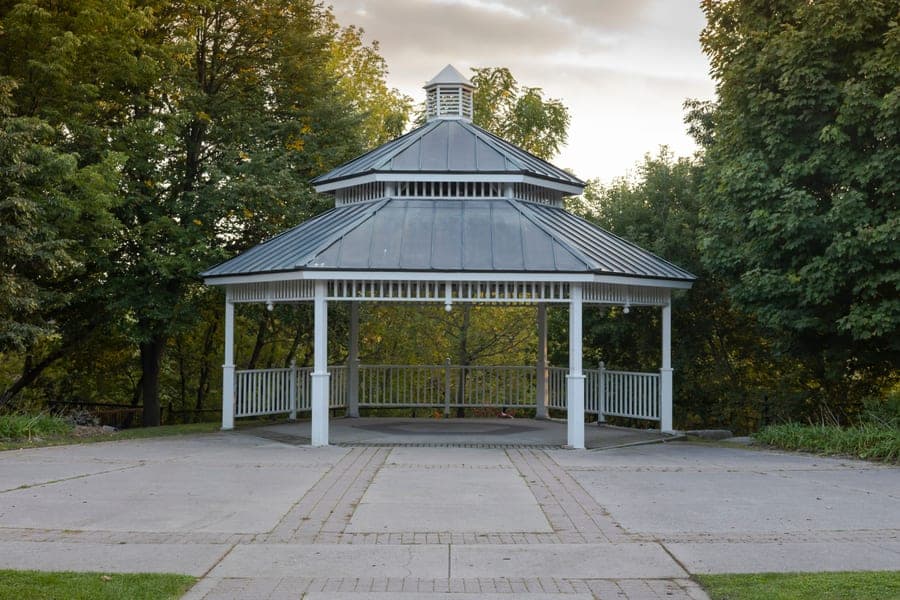 Sojag Messina Hardtop GazeboThe strongest warranty structure in the category — limited lifetime on the frame and 15 years on the finish — paired with wind and snow ratings the manufacturer describes but does not print. | The gazebo proper | Not published by manufacturer | Check price on Amazon |
| 03 | 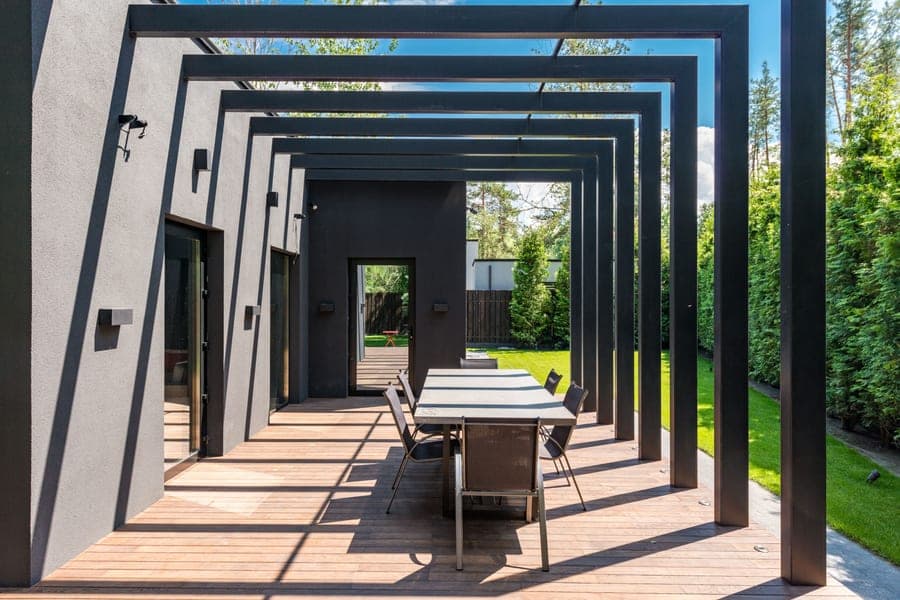 PURPLE LEAF Athena Louvered PergolaThe highest wind figure any louvered pergola in this class publishes, and the only one that ties the number to a specific anchoring condition. | The pergola, for comparison | 72 (fully secured with expansion screws on a hardened floor) | Check price on Amazon |
The durability table
Every published figure we could source for these structures, in one place, with the manufacturer page each number came from. Where a cell reads "Not published by manufacturer", that figure does not exist in the manufacturer's own material — we do not estimate it and we do not copy one from another site.
| Model | Wind rating (mph) | Snow load | Frame | Roof | Anchoring required | Warranty | Spec source |
|---|---|---|---|---|---|---|---|
| Yardistry Meridian 12 x 14 Cedar GazeboTop pick | Not published by manufacturer | Not published by manufacturer | 100% premium cedar, 6 in. x 6 in. posts with heavy corner gussets | Rust-proof coffee-brown aluminum | Post mounting brackets supplied; anchoring hardware is not, because mounting surfaces vary | 1 year on materials and workmanship; 5 years on lumber against rot and decay | Yardistry Meridian 12x14 product pageChecked 2026-09-26 |
| Sojag Messina Hardtop Gazebo | Not published by manufacturer | Not published by manufacturer | Powder-coated aluminum | Galvanized steel panels | Not published by manufacturer | 1 year limited on the gazebo; limited lifetime on the aluminum/steel frame; 15 years on the powder-coated finish | Sojag hardtop gazebo collectionChecked 2026-09-26 |
| PURPLE LEAF Athena Louvered Pergola | 72 (fully secured with expansion screws on a hardened floor) | Not published by manufacturer | Powder-coated aluminum, 1.5 mm wall, 4.33 in. x 4.33 in. crossbeams | Adjustable aluminum louvers with integrated drainage | Expansion screws into a hardened floor — the published wind figure assumes it | 1 year | PURPLE LEAF louvered pergola collectionChecked 2026-09-26 |
Every pick in full
The pavilion-style option
Yardistry Meridian 12 x 14 Cedar Gazebo
The only structure here with 6x6 cedar posts and a five-year rot warranty — and it publishes no wind or snow figure at all.
- Wind rating
- Not published by manufacturer
- Snow load
- Not published by manufacturer
- Frame
- 100% premium cedar, 6 in. x 6 in. posts with heavy corner gussets
- Roof
- Rust-proof coffee-brown aluminum
- Anchoring
- Post mounting brackets supplied; anchoring hardware is not, because mounting surfaces vary
- Warranty
- 1 year on materials and workmanship; 5 years on lumber against rot and decay
- Sizes
- Roof 12 x 14 ft; base 10 ft 10⅜ in. x 12 ft 10⅜ in.
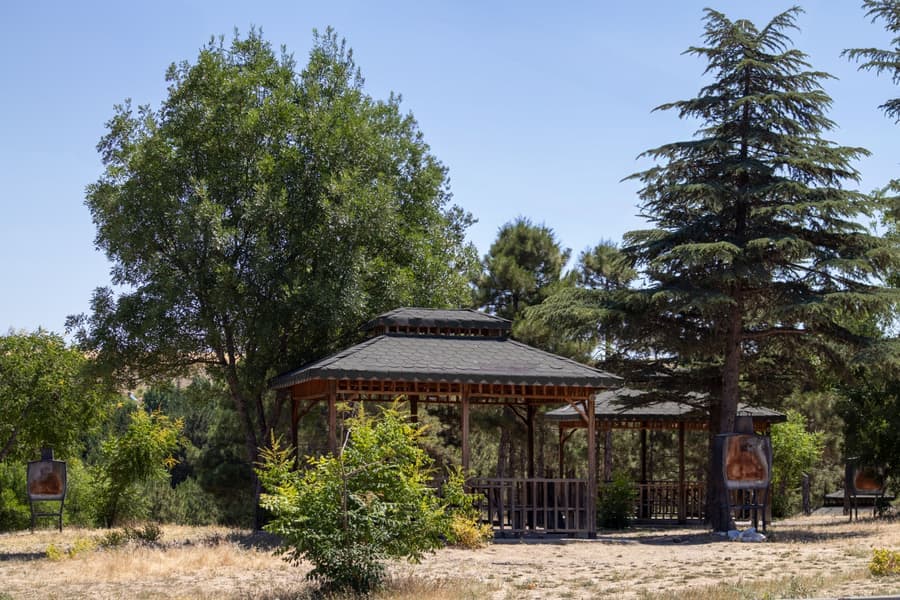
Yardistry markets the Meridian as both a gazebo and a pavilion, which is a fair illustration of how loosely these terms are used — and it is genuinely closer to a pavilion in form: an open-sided structure with a solid roof and heavy posts, with no walls and no netting as standard.
The construction is what makes it read as a pavilion rather than a gazebo: 100% premium cedar with 6 in. x 6 in. posts and heavy corner gussets under a rust-proof aluminum roof. Pavilions traditionally emphasize the frame — visible structure, substantial posts, an architectural presence — where gazebos emphasize enclosure.
What that form gives you: rain cover, airflow, and sightlines. An open-sided structure stays cool because air moves through it, and it does not feel like a room in the garden. What you give up is insect protection and any wind break at all.
Warranty: one year on materials and workmanship, five years on the lumber against rot and decay. No wind or snow figures published. Post mounting brackets supplied; anchoring hardware not.
Skip it if: You want insect protection or a wind break — an open-sided structure gives you neither, and retrofitting sides is not straightforward on a cedar frame.
#ad Price shown as of September 26, 2026. How this site is funded
Specifications from Yardistry Meridian 12x14 product page, checked 2026-09-26.
The gazebo proper
Sojag Messina Hardtop Gazebo
The strongest warranty structure in the category — limited lifetime on the frame and 15 years on the finish — paired with wind and snow ratings the manufacturer describes but does not print.
- Wind rating
- Not published by manufacturer
- Snow load
- Not published by manufacturer
- Frame
- Powder-coated aluminum
- Roof
- Galvanized steel panels
- Anchoring
- Not published by manufacturer
- Warranty
- 1 year limited on the gazebo; limited lifetime on the aluminum/steel frame; 15 years on the powder-coated finish
- Sizes
- 10 x 10 ft through 12 x 20 ft
The structure the word gazebo actually describes: a solid galvanized steel roof on a powder-coated aluminum frame, with the track system for adding mosquito netting and curtains that turns it from a shelter into a semi-enclosed space.
That enclosure is the defining feature and the reason people buy gazebos over pavilions. Netting makes the space usable at dusk in insect season, which is exactly when most people want to be outside; curtains add privacy and a wind break. Neither is available on an open pavilion without building something.
The cost of enclosure is wind loading. Sidewalls, netting and curtains convert an open-sided structure into a far larger sail, which is why the standing advice throughout this site is to take them down before weather. An enclosed gazebo in wind is the worst case in this comparison.
Warranty is the category's best: one year limited on the gazebo, limited lifetime on the aluminum and steel frame, fifteen years on the powder-coated finish. Wind and snow figures are not published.
Skip it if: You want maximum airflow and sightlines rather than an enclosable space — a pavilion form does that better.
#ad Price shown as of September 26, 2026. How this site is funded
Specifications from Sojag hardtop gazebo collection, checked 2026-09-26.
The pergola, for comparison
PURPLE LEAF Athena Louvered Pergola
The highest wind figure any louvered pergola in this class publishes, and the only one that ties the number to a specific anchoring condition.
- Wind rating
- 72 (fully secured with expansion screws on a hardened floor)
- Snow load
- Not published by manufacturer
- Frame
- Powder-coated aluminum, 1.5 mm wall, 4.33 in. x 4.33 in. crossbeams
- Roof
- Adjustable aluminum louvers with integrated drainage
- Anchoring
- Expansion screws into a hardened floor — the published wind figure assumes it
- Warranty
- 1 year
- Sizes
- 10 x 12 ft to 14 x 24 ft
The third term, and the one that behaves most differently. A pergola has an open or louvered roof and no walls, which changes its relationship with wind entirely — and with a modern louvered pergola it also gives you something neither a gazebo nor a pavilion can: a roof you can change.
The specification shows what that buys: 72 mph published wind rating when fully secured with expansion screws on a hardened floor, against 40-50 mph for aluminum-framed hardtop gazebos. Air passes between the louvers instead of loading the roof plane. Close the louvers and you get rain cover with integrated drainage in the beams; open them before a storm and the roof stops being a sail.
Frame is powder-coated aluminum with a 1.5 mm wall and 4.33 in. x 4.33 in. crossbeams, in sizes from 10 x 12 to 14 x 24 ft. One-year warranty, and no published snow figure — which is the gap.
When a pergola is the right answer to this question: when you want the best wind behavior, when you want sun in spring and shade in August, or when a solid roof would make the space too dark. Pergola vs gazebo is the full comparison.
Skip it if: You want guaranteed rain cover without touching anything, or you want to enclose the space — a pergola does neither.
#ad Price shown as of September 26, 2026. How this site is funded
Specifications from PURPLE LEAF louvered pergola collection, checked 2026-09-26.
What each word actually means
Retailers use these interchangeably and the confusion is understandable, because the boundaries genuinely blur — Yardistry sells the same product as both a gazebo and a pavilion. But the underlying distinctions are real and they matter for how the structure behaves.
| Gazebo | Pavilion | Pergola | |
|---|---|---|---|
| Roof | Solid — steel, polycarbonate or fabric | Solid — steel, aluminum, shingle or timber | Open slats or adjustable louvers |
| Sides | Often enclosable: netting, curtains, sometimes half-walls | Open. That is the defining feature | Open |
| Rain cover | Full | Full | Only with louvers closed; none on a fixed-slat roof |
| Wind behavior | Worst of the three. A solid roof plus sides is a large sail. Published ratings 40-50 mph on aluminum frames, up to 100 mph on heavy cedar | Better than a gazebo — solid roof, no sides to catch wind | Best. Published ratings 70-100 mph. Open the louvers and it improves further |
| Snow | Accumulates. Some models publish a figure; clear it regardless | Accumulates. Same rules | An open roof does not accumulate; a closed louvered roof does |
| Shade quality | Full and constant, and often quite dark | Full and constant | Dappled on a fixed roof; adjustable on a louvered one |
| Airflow | Reduced when enclosed; good with sides off | Excellent | Excellent |
| Insect protection | Available — the main practical reason to choose one | None | None |
| Typical form | Square, hexagonal or rectangular, often with a two-tier roof | Rectangular, emphasizing the frame and posts | Rectangular, emphasizing the roof structure |
| Best for | A usable outdoor room, especially in insect season | Rain cover with airflow and open sightlines | Adjustable shade and the best wind behavior |
The distinction that actually matters: roof, then sides
If you strip away the vocabulary, there are two independent decisions and the words just bundle them differently.
Decision one is the roof: open or solid. This decides rain cover and wind behavior, and it is by far the bigger of the two. A solid roof gives you reliable rain cover and collects wind load; an open or louvered roof gives you no rain cover (or adjustable rain cover) and lets wind through. The published figures make it stark within a frame material: 40-50 mph for aluminum solid-roof gazebos against 70-72 mph for aluminum open-roof pergolas — and PURPLE LEAF publishing 40 mph for its gazebos and 72 for its louvered pergolas, same brand and same aluminum, isolates the variable perfectly.
Decision two is the sides: open or enclosable. This decides insect protection, privacy and how much the structure feels like a room. It also decides how much extra sail area you are carrying in wind, which is why sidewalls and netting should come off before weather.
So: solid roof plus enclosable sides is a gazebo. Solid roof plus open sides is a pavilion. Open or louvered roof plus open sides is a pergola. The words are downstream of those two choices, and making the choices directly is more useful than arguing about the labels.
Buy a gazebo if...
- Insect season is the reason you do not use your yard. Netting is the single practical advantage a gazebo has over a pavilion, and for a lot of people it is decisive. Nothing else on this page offers it.
- You want the space to feel like a room. Curtains and netting make an outdoor space genuinely separate, which changes how it gets used.
- You want privacy from neighbors. Side curtains do it; open structures do not.
- You will take the sides off before weather. This is the condition on the above, and it is the most commonly skipped precaution in the category.
Buy a pavilion if...
- You want rain cover and airflow together. An open-sided solid-roof structure stays much cooler than an enclosed one, because air moves through rather than sitting under the roof.
- Sightlines matter. A pavilion does not visually close off part of the garden the way an enclosed gazebo does.
- You want the frame to be the feature. Pavilions emphasize structure — heavy posts, visible beams, corner gussets — which is why cedar pavilions read as architecture and aluminum gazebos read as product.
- You are in a windier spot but still want a solid roof. Removing the sides removes a lot of sail area. It does not solve the solid-roof problem, but it helps.
Buy a pergola if...
- Wind is your binding constraint. 70-100 mph published for pergolas against 40-50 mph for aluminum-framed gazebos is not a marginal difference, and a louvered pergola with the louvers opened before a storm is better again.
- You want sun in spring and shade in August. A louvered roof is the only adjustable option here, and a fixed solid roof means permanent shade whether you want it or not.
- A solid roof would make the space too dark, which is a common problem on small footprints against a house wall.
- You get heavy snow and will not clear a roof. An open roof does not accumulate. Close the louvers and it does — so open them for the winter.
- You want the structure to read as part of the house rather than as an object in the garden. Pergolas is the hub.
Where each one disappoints people
The honest failure-to-expectation list, which is usually more useful than the specifications.
Gazebos disappoint on darkness and on heat. An enclosed structure with a steel roof is dim, and with the netting and curtains up on a still day it can be warmer inside than out. The fix is taking the sides down, which people then leave down, at which point they have bought a pavilion.
Pavilions disappoint on insects and on wind-driven rain. Open sides mean rain comes in sideways, which on an exposed site makes the shelter less useful than it looks in photographs. And there is no retrofitting netting onto an open cedar frame without a project.
Pergolas disappoint on rain, unless they are louvered. A fixed-slat pergola provides dappled shade and no shelter, and the gap between what buyers expect from "pergola" and what a slatted roof delivers is the most common disappointment in the whole category — see do pergolas provide shade. A louvered pergola solves it and costs considerably more.
All three disappoint if they are not anchored, and all three are usually sold with hardware for the wrong surface. That is the one thing this comparison cannot change: how to anchor a gazebo and how to anchor a pergola apply regardless of which word is on the box.
For the full shortlists: best hardtop gazebos for the enclosed option, most durable gazebos for the cedar pavilion form, and best louvered pergolas for the adjustable roof.
Questions people ask
What is the difference between a gazebo and a pavilion?
What is the difference between a pergola and a pavilion?
Is a hardtop gazebo the same as a pavilion?
Which is better for wind, a gazebo or a pavilion?
Do pavilions provide better shade than pergolas?
Which is more expensive?
Can I add sides to a pavilion later?
Where these figures came from
- Yardistry Meridian 12x14 — cedar post dimensions, corner gussets, aluminum roof, marketed as gazebo and pavilion
- Sojag hardtop gazebo collection — roof materials, netting and curtain track system, warranty structure
- PURPLE LEAF louvered pergola collection — 72 mph rating, frame specification, adjustable louvers with drainage
- PURPLE LEAF hardtop gazebo collection — 40 mph rating, the same-brand comparison this page turns on
Found an error? Tell us and we will correct it within seven days and note the change on the page with a dated line — see our editorial policy.