Gazebo vs patio cover
A gazebo stands on its own four posts. A patio cover hangs off your house. That single structural difference drives everything else — the permit, the rating, the cost and whether it is still yours when you move.
By Ryder M. · Published · Last updated
We compare published manufacturer specifications, warranty terms and owner-reported failure modes. We have not physically tested these structures. How we judge shade structures
Slat & Shade earns a commission on qualifying purchases made through links on this page. It costs you nothing extra and never changes what we recommend. Full disclosure
Part of Hardtop Gazebos
The short answer
Choose a gazebo if you want a rated, anchored structure you can site anywhere and take with you, with a published wind figure. Choose a patio cover if you want a roof continuous with the house over a space right outside the back door — it is usually a permitted build, it adds to the house, and it cannot be moved.
Our picks at a glance
| # | Structure | Best for | Wind rating | Price |
|---|---|---|---|---|
| 01 | 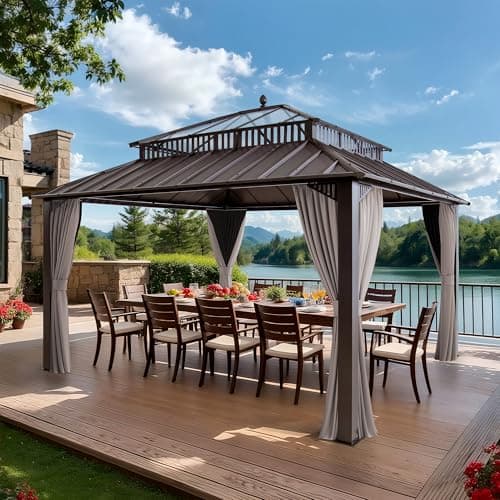 Sunjoy Kingston 12 x 14 Aluminum Gazebo with Steel RoofPublishes both a wind rating and a snow figure — but the snow figure is a whole-roof total, not a per-square-foot load, so it is not directly comparable to anyone else's. | The gazebo case, with a number attached | 50 | $1,017.00 · View on Amazon |
| 02 | 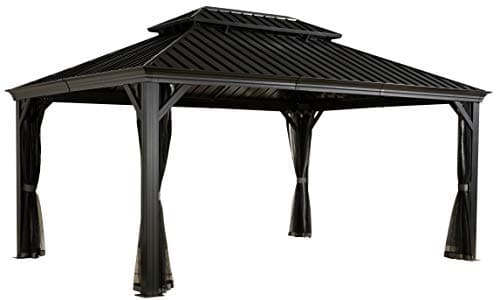 Sojag Messina Hardtop GazeboThe strongest warranty structure in the category — limited lifetime on the frame and 15 years on the finish — paired with wind and snow ratings the manufacturer describes but does not print. | The gazebo case over fifteen years | Not published by manufacturer | $2,749.99 · View on Amazon |
| 03 |  Outsunny Hardtop Polycarbonate PergolaA solid-roof aluminum pergola that publishes a roof load figure instead of a wind rating — useful for rain, unproven for wind. | The patio-cover case you can actually buy | Not published by manufacturer | Check price on Amazon |
The durability table
Every published figure we could source for these structures, in one place, with the manufacturer page each number came from. Where a cell reads "Not published by manufacturer", that figure does not exist in the manufacturer's own material — we do not estimate it and we do not copy one from another site.
| Model | Wind rating (mph) | Snow load | Frame | Roof | Anchoring required | Warranty | Spec source |
|---|---|---|---|---|---|---|---|
| Sunjoy Kingston 12 x 14 Aluminum Gazebo with Steel RoofTop pick | 50 | 3,000 lb across the entire roof (not a per-square-foot rating) | Aluminum and steel | Galvanized steel, two-tier vented | Pre-drilled ground plates: included stakes for soft ground, expansion bolts for hard surfaces (bolts not included) | Not published by manufacturer | Sunjoy Kingston product pageChecked 2026-09-26 |
| Sojag Messina Hardtop Gazebo | Not published by manufacturer | Not published by manufacturer | Powder-coated aluminum | Galvanized steel panels | Not published by manufacturer | 1 year limited on the gazebo; limited lifetime on the aluminum/steel frame; 15 years on the powder-coated finish | Sojag hardtop gazebo collectionChecked 2026-09-26 |
| Outsunny Hardtop Polycarbonate Pergola | Not published by manufacturer | Roof weight capacity 10 lb/ft² (50 kg/m²) | Aluminum | Solid polycarbonate with drainage holes | Not published by manufacturer | 1 year | Outsunny hardtop pergola product pageChecked 2026-09-26 |
Every pick in full
The gazebo case, with a number attached
Sunjoy Kingston 12 x 14 Aluminum Gazebo with Steel Roof
Publishes both a wind rating and a snow figure — but the snow figure is a whole-roof total, not a per-square-foot load, so it is not directly comparable to anyone else's.
- Wind rating
- 50
- Snow load
- 3,000 lb across the entire roof (not a per-square-foot rating)
- Frame
- Aluminum and steel
- Roof
- Galvanized steel, two-tier vented
- Anchoring
- Pre-drilled ground plates: included stakes for soft ground, expansion bolts for hard surfaces (bolts not included)
- Warranty
- Not published by manufacturer
- Sizes
- Roof 12 x 14 ft; base 11 x 13 ft; height 11.02 ft
The strongest argument for a freestanding gazebo is that it arrives as a characterised product rather than as a construction project.
50 mph published wind rating, and 3,000 lb across the entire roof. You can read these before you buy. A site-built patio cover has no equivalent — its performance is whatever your contractor's framing and your local code produced, and nobody hands you a tested figure for it.
Roof 12 x 14 ft; base 11 x 13 ft; height 11.02 ft. Fixed, published dimensions. A patio cover is cut to fit your house, which is its advantage and the reason it cannot be specified in advance the way this can.
Pre-drilled ground plates with stakes for soft ground and expansion bolts for hard surfaces. Four fixings into your own slab and it is standing. No wall penetrations, no flashing, nothing done to the house.
A galvanized steel two-tier vented roof. The vent is a wind feature a continuous attached roof usually does not have — a patio cover against a wall has nowhere for pressure to escape except the open edges.
Skip it if: You want the roof to be continuous with the house. A freestanding gazebo always reads as a separate object in the garden.
#ad Price shown as of November 11, 2026. How this site is funded
Specifications from Sunjoy Kingston product page, checked 2026-09-26.
The gazebo case over fifteen years
Sojag Messina Hardtop Gazebo
The strongest warranty structure in the category — limited lifetime on the frame and 15 years on the finish — paired with wind and snow ratings the manufacturer describes but does not print.
- Wind rating
- Not published by manufacturer
- Snow load
- Not published by manufacturer
- Frame
- Powder-coated aluminum
- Roof
- Galvanized steel panels
- Anchoring
- Not published by manufacturer
- Warranty
- 1 year limited on the gazebo; limited lifetime on the aluminum/steel frame; 15 years on the powder-coated finish
- Sizes
- 10 x 10 ft through 12 x 20 ft
Included because the usual argument for a patio cover is permanence, and the warranty structure here complicates that claim.
One year limited on the gazebo, limited lifetime on the aluminum and steel frame, and 15 years on the powder-coated finish. A manufacturer-backed lifetime frame term and a separate 15-year finish term. A patio cover's "warranty" is your builder's workmanship period, typically a year or two, plus whatever the material supplier offers.
Powder-coated aluminum with galvanized steel roof panels. No rust mechanism in the frame and a roof that sheds snow. Timber patio covers — still the most common build — are on a rot clock from the day they go up, especially at the wall junction.
Sizes 10 x 10 ft through 12 x 20 ft. The 12 x 20 covers 240 sq ft, which is most of what a typical attached patio cover spans. The gazebo version does it without touching the building.
No published wind or snow figure, which is Sojag's one weakness. The ratings are described rather than printed, so if a number matters to you the Kingston above is the one to shortlist.
Skip it if: The space you want covered is a 4 ft strip against the back wall. A gazebo needs room on all sides.
#ad Price shown as of November 11, 2026. How this site is funded
Specifications from Sojag hardtop gazebo collection, checked 2026-09-26.
The patio-cover case you can actually buy
Outsunny Hardtop Polycarbonate Pergola
A solid-roof aluminum pergola that publishes a roof load figure instead of a wind rating — useful for rain, unproven for wind.
- Wind rating
- Not published by manufacturer
- Snow load
- Roof weight capacity 10 lb/ft² (50 kg/m²)
- Frame
- Aluminum
- Roof
- Solid polycarbonate with drainage holes
- Anchoring
- Not published by manufacturer
- Warranty
- 1 year
- Sizes
- 12 x 10 ft, 14.5 x 10 ft, 16.5 x 10 ft
Most patio covers are built in place, which makes them hard to compare. This is the nearest thing to a kit version — a solid-roof structure sized to sit against a house.
Sizes 12 x 10 ft, 14.5 x 10 ft and 16.5 x 10 ft. All of them 10 ft deep and up to 16.5 ft long: exactly the long, shallow shape a patio cover wants, and a shape no gazebo is sold in.
Solid polycarbonate with drainage holes, on an aluminum frame. Translucent rather than opaque, which is the single biggest practical objection people raise about patio covers — a solid roof outside a window makes the room behind it dark. A translucent panel keeps the daylight and takes the rain.
Roof weight capacity 10 lb/ft², published as 50 kg/m². A figure, which a site-built cover will not give you. Ten pounds per square foot is light for snow country, so check your region — snow load explained covers how.
No published wind rating, and one year of warranty. The gap. A solid roof fixed near a wall with no published wind figure is the weakest characterisation on this page, and it is the honest reason a rated freestanding gazebo is the safer buy on an exposed plot.
Skip it if: You want a roof that matches the house roof. A kit structure in aluminum and polycarbonate will not, and a built cover will.
#ad Price shown as of November 11, 2026. How this site is funded
Specifications from Outsunny hardtop pergola product page, checked 2026-09-26.
The difference in one line each
A gazebo is a freestanding roofed structure on four or more posts, anchored to the ground and bought as a product. It comes with published dimensions and, on several models, a tested wind rating. Nothing is fixed to the house, and it can in principle be taken down and moved.
A patio cover is a roof attached to the building, usually built in place, covering a space immediately outside it. The house carries one edge; posts carry the other. It is continuous with the architecture, which is both the point and the complication.
The shapes are completely different, and that is the part people notice too late. Gazebos are sold square-ish: 10 x 10, 12 x 14, 12 x 20. Patio covers are long and shallow — 16 ft along the wall and 10 ft out. If the space you want covered is a strip against the back of the house, no gazebo footprint fits it.
And one of them involves your weather envelope. A patio cover means a ledger board bolted to the structure of your house and a flashed junction above it. Done well it lasts decades; done badly it is a water path into the wall, and that is a far bigger risk than anything a gazebo can do to you.
Side by side
On the terms that actually decide it. Gazebo figures are from the published specs of the models above; the patio-cover column describes the category, with figures only where a kit version publishes them.
| Freestanding gazebo | Attached patio cover | |
|---|---|---|
| Published wind rating | Up to 100 mph when anchored; 50 mph on a typical hardtop | None — site-built performance is not rated |
| Typical shape | Square-ish: 10 x 10 to 12 x 20 ft | Long and shallow: up to 16.5 x 10 ft on a kit |
| Fixed to the house | No — nothing penetrates the building | Yes — ledger bolted to structure, flashed |
| Permit | Often, on footprint and height | Almost always, as a structural alteration |
| Warranty | Up to limited lifetime on the frame | Builder's workmanship period, typically 1-2 years |
| Daylight into the house | Unaffected — it is out in the garden | Reduced, unless the roof is translucent |
| Can you take it with you | In principle yes — it is a product | No — it belongs to the house |
| Effect on the house | None | Adds covered square footage to the property |
The ratings row is the gazebo's strongest card and it is not close. You can buy a gazebo with a 100 mph tested figure and a stated anchoring condition. Nobody hands you a wind rating for a patio cover, because it was built rather than manufactured.
The last two rows are the patio cover's answer. It adds to the house, it reads as part of the house, and valuers treat it as improvement rather than as garden furniture. Whether that matters depends entirely on how long you are staying.
Which one to choose, by situation
- The space is a strip immediately outside the back door: patio cover. No gazebo footprint fits a 10 ft deep run along a wall, and a gazebo plonked two feet off the house looks like a mistake.
- The space is out in the garden: gazebo. It is a destination rather than an extension, it needs no wall, and it comes with a rating.
- The site is exposed: gazebo, and buy a rated one. 100 mph tested with mandatory anchoring is available — best shade structures for windy areas ranks the field.
- You are renting, or you expect to move within a few years: gazebo. It is yours, and it leaves four bolt holes rather than a structural alteration.
- You want the covered space to feel like a room off the house: patio cover. A continuous roof line is the thing a freestanding structure cannot fake.
- The room behind it is already dark: patio cover with a translucent roof, or a gazebo set away from the wall. A solid opaque cover outside a window is the most common regret in this category.
- Budget is the binding constraint: gazebo. A product you assemble and bolt down is a known number; a built cover is a quote, a permit and a contingency.
What we would actually do
Start with the shape of the space, not the merits of the structures. This comparison resolves itself for most people the moment they measure. A long shallow area against a wall is a patio cover problem; an open area with room around it is a gazebo problem. Everything else is secondary.
Then ask how long you are staying. A patio cover is capital spent on the house. A gazebo is capital spent on a product, and products hold less of their value but go where you go. Neither answer is wrong; they are different purchases.
Then get the permit question answered before you commit to either. A patio cover is a structural alteration and will almost always need one; a gazebo often does too, on footprint and height. Gazebo permits and HOA rules covers the questions to ask, and asking them is free.
And if you go attached, spend the money on the junction. Flashing at the ledger, not sealant. The roof is the easy part of a patio cover; the place where it meets your house is the part that either lasts thirty years or quietly rots the wall behind the siding.
If you go freestanding, buy the rating and honour its condition. The gazebo advantage is that someone tested it — and every published figure here is conditional on anchoring that most people skip. How to secure a gazebo covers each surface.
Questions people ask
What is the difference between a gazebo and a patio cover?
Is a gazebo or a patio cover cheaper?
Does a patio cover add value to a house?
Do you need a permit for a patio cover?
Which is better in wind, a gazebo or a patio cover?
Will a patio cover make my house darker?
Can you move a gazebo?
Can a pergola work as a patio cover?
Where these figures came from
- Sunjoy Kingston 12 x 14 aluminum gazebo — 50 mph wind rating, 3,000 lb across the entire roof, roof 12 x 14 ft on an 11 x 13 ft base at 11.02 ft, pre-drilled ground plates with stakes and expansion bolts, galvanized steel two-tier vented roof
- Sojag hardtop gazebo collection — powder-coated aluminum frame with galvanized steel roof panels, 1 year limited on the gazebo, limited lifetime on the frame, 15 years on the powder-coated finish, sizes 10 x 10 ft through 12 x 20 ft
- Outsunny hardtop polycarbonate pergola — sizes 12 x 10 ft, 14.5 x 10 ft and 16.5 x 10 ft, aluminum frame, solid polycarbonate roof with drainage holes, roof weight capacity 10 lb/ft² (50 kg/m²), 1 year
- Backyard Discovery Norwood cedar gazebo — 100 mph Pro-Tect tested with anchoring mandatory per the manual
Found an error? Tell us and we will correct it within seven days and note the change on the page with a dated line — see our editorial policy.