Best gazebos and pavilions
People shop these two together because they are the same purchase in two shapes. What separates them is roof geometry and how many posts you are putting into the lawn.
By Ryder M. · Published · Last updated
We compare published manufacturer specifications, warranty terms and owner-reported failure modes. We have not physically tested these structures. How we judge shade structures
Slat & Shade earns a commission on qualifying purchases made through links on this page. It costs you nothing extra and never changes what we recommend. Full disclosure
Part of Hardtop Gazebos
The short answer
If you want one structure that covers both shapes, the Backyard Discovery Norwood is the pick: a cedar-framed peak-roof structure rated to 100 mph anchored, sold from 10 x 10 ft up to 24 x 12 ft so it works as a square gazebo or a long pavilion. For a metal-framed alternative the Sojag Messina runs to 12 x 20 ft on a limited lifetime frame.
Our picks at a glance
| # | Structure | Best for | Wind rating | Price |
|---|---|---|---|---|
| 01 | 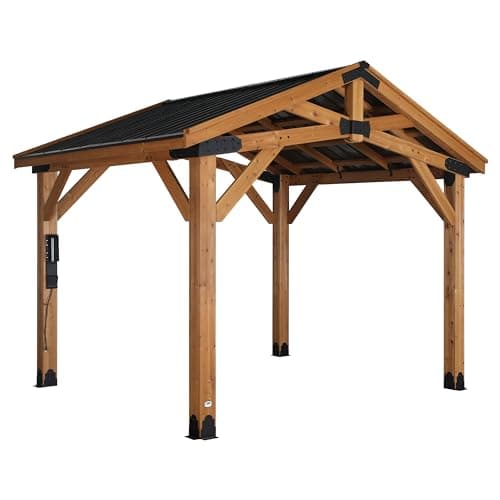 Backyard Discovery Norwood Cedar GazeboThe only gazebo we can find that publishes a 100 mph wind rating and a convertible snow figure — and it converts to roughly 56 lb/ft², several times any other hardtop here. | The one range that covers both shapes | 100 (Pro-Tect tested; product must be anchored per the manual) | $1,999.00 · View on Amazon |
| 02 | 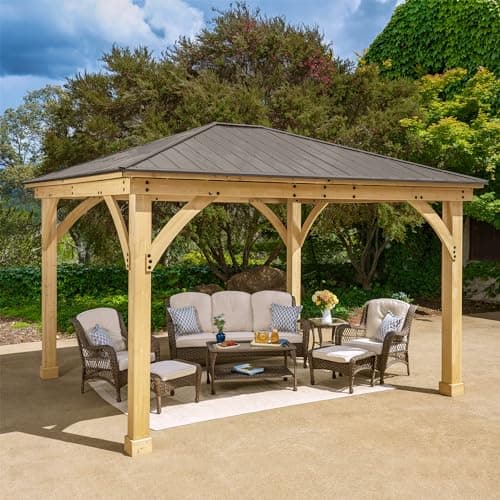 Yardistry Meridian 12 x 14 Cedar GazeboThe only structure here with 6x6 cedar posts and a five-year rot warranty — and it publishes no wind or snow figure at all. | The pavilion-proportioned cedar one | Not published by manufacturer | $2,124.99 · View on Amazon |
| 03 | 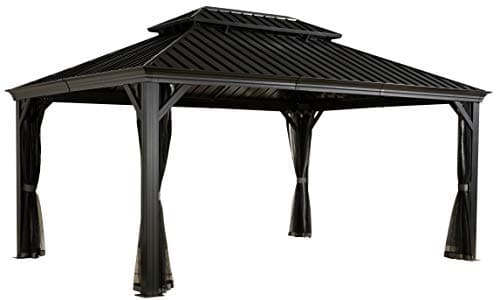 Sojag Messina Hardtop GazeboThe strongest warranty structure in the category — limited lifetime on the frame and 15 years on the finish — paired with wind and snow ratings the manufacturer describes but does not print. | The metal-framed long shape | Not published by manufacturer | $2,749.99 · View on Amazon |
The durability table
Every published figure we could source for these structures, in one place, with the manufacturer page each number came from. Where a cell reads "Not published by manufacturer", that figure does not exist in the manufacturer's own material — we do not estimate it and we do not copy one from another site.
| Model | Wind rating (mph) | Snow load | Frame | Roof | Anchoring required | Warranty | Spec source |
|---|---|---|---|---|---|---|---|
| Backyard Discovery Norwood Cedar GazeboTop pick | 100 (Pro-Tect tested; product must be anchored per the manual) | 6,700 lb across the roof, or up to 30 in. of snow (12 x 10 ft model — roughly 56 lb/ft²) | 100% cedar, 6 in. x 6 in. posts, galvanized steel hardware | 29-gauge galvanized steel peak roof, thermal insulated | Mandatory. Product must be anchored as specified in the instruction manual | 5 years | Backyard Discovery Norwood 12x10 product pageChecked 2026-09-26 |
| Yardistry Meridian 12 x 14 Cedar Gazebo | Not published by manufacturer | Not published by manufacturer | 100% premium cedar, 6 in. x 6 in. posts with heavy corner gussets | Rust-proof coffee-brown aluminum | Post mounting brackets supplied; anchoring hardware is not, because mounting surfaces vary | 1 year on materials and workmanship; 5 years on lumber against rot and decay | Yardistry Meridian 12x14 product pageChecked 2026-09-26 |
| Sojag Messina Hardtop Gazebo | Not published by manufacturer | Not published by manufacturer | Powder-coated aluminum | Galvanized steel panels | Not published by manufacturer | 1 year limited on the gazebo; limited lifetime on the aluminum/steel frame; 15 years on the powder-coated finish | Sojag hardtop gazebo collectionChecked 2026-09-26 |
Every pick in full
The one range that covers both shapes
Backyard Discovery Norwood Cedar Gazebo
The only gazebo we can find that publishes a 100 mph wind rating and a convertible snow figure — and it converts to roughly 56 lb/ft², several times any other hardtop here.
- Wind rating
- 100 (Pro-Tect tested; product must be anchored per the manual)
- Snow load
- 6,700 lb across the roof, or up to 30 in. of snow (12 x 10 ft model — roughly 56 lb/ft²)
- Frame
- 100% cedar, 6 in. x 6 in. posts, galvanized steel hardware
- Roof
- 29-gauge galvanized steel peak roof, thermal insulated
- Anchoring
- Mandatory. Product must be anchored as specified in the instruction manual
- Warranty
- 5 years
- Sizes
- 10 x 10, 12 x 10, 14 x 10, 14 x 12, 16 x 12, 20 x 12 and 24 x 12 ft
Sold from a square 10 x 10 ft all the way to a 24 x 12 ft run, which is the dimension at which the word people use switches from gazebo to pavilion.
10 x 10, 12 x 10, 14 x 10, 14 x 12, 16 x 12, 20 x 12 and 24 x 12 ft. Seven footprints on one structural system. That is the practical answer to the gazebos-and-pavilions question: the decision is a footprint, not two different products.
100 mph wind rating, Pro-Tect tested, anchored per the manual. The highest published wind figure of any structure on this site, and it holds across the range rather than applying to one size.
6,700 lb across the roof on the 12 x 10 ft model, or up to 30 in. of snow — roughly 56 lb/ft². Convertible, which is rare here. Most of the category publishes a whole-roof total with no roof area to divide it by.
100% cedar, 6 in. x 6 in. posts, galvanized steel hardware, 29-gauge insulated steel peak roof. The post section is what makes a long pavilion shape work without a forest of intermediate columns.
5 year warranty, and anchoring is mandatory rather than advisory. The manufacturer makes the rating conditional on it in writing, which is the honest way to publish a figure.
Skip it if: You want an open-roof structure you can see the sky through. This is a solid roof; a pergola is the other page.
#ad Price shown as of November 11, 2026. How this site is funded
Specifications from Backyard Discovery Norwood 12x10 product page, checked 2026-09-26.
The pavilion-proportioned cedar one
Yardistry Meridian 12 x 14 Cedar Gazebo
The only structure here with 6x6 cedar posts and a five-year rot warranty — and it publishes no wind or snow figure at all.
- Wind rating
- Not published by manufacturer
- Snow load
- Not published by manufacturer
- Frame
- 100% premium cedar, 6 in. x 6 in. posts with heavy corner gussets
- Roof
- Rust-proof coffee-brown aluminum
- Anchoring
- Post mounting brackets supplied; anchoring hardware is not, because mounting surfaces vary
- Warranty
- 1 year on materials and workmanship; 5 years on lumber against rot and decay
- Sizes
- Roof 12 x 14 ft; base 10 ft 10⅜ in. x 12 ft 10⅜ in.
A 12 x 14 ft cedar structure with the heaviest published post detail here, and the one that reads most like a pavilion in a backyard.
100% premium cedar, 6 in. x 6 in. posts with heavy corner gussets. Gussets at the post-to-beam joint are what stop a tall open structure racking, and they are the detail a pavilion needs more than a small gazebo does.
Roof 12 x 14 ft over a base of 10 ft 10⅜ in. by 12 ft 10⅜ in. Yardistry is one of the few manufacturers that publishes both, which makes it one of the few you can lay a slab for accurately.
Rust-proof coffee-brown aluminum roof. Lighter than steel and completely indifferent to wet — the sensible roof material for a structure with no walls to keep the weather off it.
1 year on materials and workmanship, 5 years on lumber against rot and decay. The rot term is the one that matters on cedar, and five years is the category norm here.
Post mounting brackets supplied; anchoring hardware is not, because mounting surfaces vary. Honest, and it means buying the fixings separately — best gazebo anchor kits covers what suits each surface.
No wind rating and no snow load published at all. The most significant gap on this page, and the reason this is the second pick rather than the first.
Skip it if: You are buying on published figures. Yardistry prints none for wind or snow.
#ad Price shown as of November 11, 2026. How this site is funded
Specifications from Yardistry Meridian 12x14 product page, checked 2026-09-26.
The metal-framed long shape
Sojag Messina Hardtop Gazebo
The strongest warranty structure in the category — limited lifetime on the frame and 15 years on the finish — paired with wind and snow ratings the manufacturer describes but does not print.
- Wind rating
- Not published by manufacturer
- Snow load
- Not published by manufacturer
- Frame
- Powder-coated aluminum
- Roof
- Galvanized steel panels
- Anchoring
- Not published by manufacturer
- Warranty
- 1 year limited on the gazebo; limited lifetime on the aluminum/steel frame; 15 years on the powder-coated finish
- Sizes
- 10 x 10 ft through 12 x 20 ft
The aluminum-and-steel answer to the same question, and the one that reaches a 12 x 20 ft pavilion footprint without any timber maintenance at all.
10 x 10 ft through 12 x 20 ft. The long end of that range is pavilion proportion — a covered run along a boundary or a house wall rather than a destination in the middle of a lawn.
Powder-coated aluminum frame with galvanized steel roof panels. Nothing to treat, nothing to re-stain, nothing to rot. For a buyer who wants the structure and not the project, this is the trade against cedar.
Limited lifetime on the aluminum and steel frame, 15 years on the powder-coated finish, 1 year on the gazebo. The strongest warranty structure in the category, and the strongest argument for this pick.
No wind rating, no snow load and no anchoring method published. As with every Sojag entry on this site, the warranty is excellent and the figures are absent.
Skip it if: The look matters as much as the structure. A powder-coated metal frame is not a cedar pavilion and will never read as one.
#ad Price shown as of November 11, 2026. How this site is funded
Specifications from Sojag hardtop gazebo collection, checked 2026-09-26.
What the two words actually describe
A gazebo is compact and usually peaked, with four or more posts around a roughly square or octagonal footprint. It is a destination — something you walk out to and sit inside. Most of the hardtop category is this shape, from 10 x 10 ft to about 12 x 14 ft.
A pavilion is long, open and proportionally shallower, with a roof that runs rather than peaks over a point. It covers a table, a run of seating or a cooking area, often against a boundary. In this category it is the same structural kit stretched: a 20 x 12 or 24 x 12 ft footprint on the same posts and the same roof system.
Which means the choice is usually a footprint decision rather than a product decision. Backyard Discovery sells both shapes off one system; Sojag's range reaches 12 x 20 ft off one frame. Gazebo vs pavilion works through the distinction in detail, including where each one disappoints people.
The structural consequence is post spacing. A long shape needs either heavier beams or more posts, which is why the pavilion-proportioned entries here are the ones with 6 in. x 6 in. timber or a published steel system — and why a 24 ft run on 4 in. posts should make you look twice.
And the practical consequence is where the rain lands. A peaked roof concentrates run-off at four corners; a long run sheds down two long eaves, which is a lot more water along the edge people sit at.
The two shapes, side by side
Published figures for the structures that reach each shape.
| Model | Sizes published | Frame | Wind rating |
|---|---|---|---|
| Backyard Discovery Norwood | 10 x 10 ft to 24 x 12 ft | Cedar, 6 x 6 in. posts | 100 mph (anchored per manual) |
| Sojag Messina | 10 x 10 ft to 12 x 20 ft | Powder-coated aluminum | Not published by manufacturer |
| Yardistry Meridian | Roof 12 x 14 ft; base under 11 x 13 ft | Cedar, 6 x 6 in. posts with gussets | Not published by manufacturer |
| PURPLE LEAF hardtop gazebo | 6 x 8 ft to 14 x 28 ft | Powder-coated aluminum alloy | 40 mph |
| Sunjoy Kingston | Roof 12 x 14 ft; base 11 x 13 ft | Aluminum and steel | 50 mph |
PURPLE LEAF reaches the longest footprint of anyone here and publishes the lowest wind rating on this site. 14 x 28 ft at 40 mph is a real combination worth knowing about before you fall for the size range.
Only two rows carry a wind figure at all. That is the state of this category, and it is why the Norwood tops a page about two shapes rather than one.
Choosing between them
- Covering a dining table and nothing else: gazebo. A 10 x 12 or 12 x 14 ft peaked structure puts the table in the middle with walking room, and the roof is small enough to be cheap.
- Covering a run — seating, a grill, a path between them: pavilion. 16 x 12 ft upwards. The long shape is what stops the cook standing in the dining area.
- Against a boundary or a house wall: pavilion, every time. A square gazebo pushed against a fence wastes its own geometry, and a long shallow roof is exactly what a wall-side run wants.
- In the middle of a lawn as a destination: gazebo. The peak is what makes it read as somewhere to go rather than as a carport.
- On a windy plot: whichever one publishes a figure. The Norwood's 100 mph anchored rating covers both shapes, which makes the decision purely about footprint. Best shade structures for windy areas ranks across the categories.
- If you want to see the sky through it, neither — buy a pergola. Pergola vs pavilion is the comparison that covers it.
What we would actually do
Pick the footprint first and let it name itself. Measure what has to be under cover, add a clear foot for chairs pushing back, and see which shape the number lands in. Whether the result gets called a gazebo or a pavilion follows from the dimensions rather than the other way round.
Then buy on published figures, because very few exist. Two of the five structures here print a wind rating. On a structure meant to stand for a decade in open ground, that is the discriminator worth paying for.
Then set out from the base dimension. Yardistry and Sunjoy both publish a roof that overhangs the base by around a foot in each direction. A slab laid to the roof figure leaves posts standing on grass.
Then anchor it properly, since the one real rating here is conditional on it. How to anchor a gazebo covers concrete, pavers, decks and soil.
And budget for the timber if you go cedar. Both cedar structures here carry a five-year rot warranty rather than an indefinite one, and that term assumes the finish gets maintained.
Questions people ask
What is the difference between a gazebo and a pavilion?
Are gazebos and pavilions the same thing?
Which is better, a gazebo or a pavilion?
What is the best gazebo or pavilion to buy?
Do pavilions need more posts than gazebos?
Which is more expensive, a gazebo or a pavilion?
Can a pavilion handle wind as well as a gazebo?
Does a pavilion need planning permission or a permit?
Where these figures came from
- Backyard Discovery Norwood 12 x 10 cedar gazebo — 100 mph Pro-Tect tested wind rating with anchoring mandatory per the manual, 6,700 lb across the roof or up to 30 in. of snow on the 12 x 10 model, 100% cedar with 6 in. x 6 in. posts, 29-gauge insulated galvanized steel peak roof, sizes 10 x 10, 12 x 10, 14 x 10, 14 x 12, 16 x 12, 20 x 12 and 24 x 12 ft, 5 year warranty
- Yardistry Meridian 12 x 14 cedar gazebo — 100% premium cedar with 6 in. x 6 in. posts and heavy corner gussets, rust-proof coffee-brown aluminum roof, roof 12 x 14 ft over a 10 ft 10⅜ in. x 12 ft 10⅜ in. base, post mounting brackets supplied without anchoring hardware, 1 year on materials and 5 years on lumber against rot and decay
- Sojag hardtop gazebo collection — Messina, powder-coated aluminum frame with galvanized steel roof panels, 10 x 10 ft through 12 x 20 ft, limited lifetime frame warranty and 15 years on the powder-coated finish
- PURPLE LEAF hardtop gazebo collection — 40 mph wind rating, 2,500 lb published as a total without a stated roof area, powder-coated aluminum alloy frame, galvanized steel single or double roof, 6 x 8 ft through 14 x 28 ft
- Sunjoy Kingston 12 x 14 — 50 mph wind rating, roof 12 x 14 ft over an 11 x 13 ft base at 11.02 ft, aluminum and steel frame
Found an error? Tell us and we will correct it within seven days and note the change on the page with a dated line — see our editorial policy.