The best shade sails for decks
A deck removes the thing every shade sail installation assumes: something solid to pull against. That moves the decision away from the fabric and onto the edge, the corner rings and what you fix them to.
By Ryder M. · Published · Last updated
We compare published manufacturer specifications, warranty terms and owner-reported failure modes. We have not physically tested these structures. How we judge shade structures
Slat & Shade earns a commission on qualifying purchases made through links on this page. It costs you nothing extra and never changes what we recommend. Full disclosure
Part of Shade Sails
The short answer
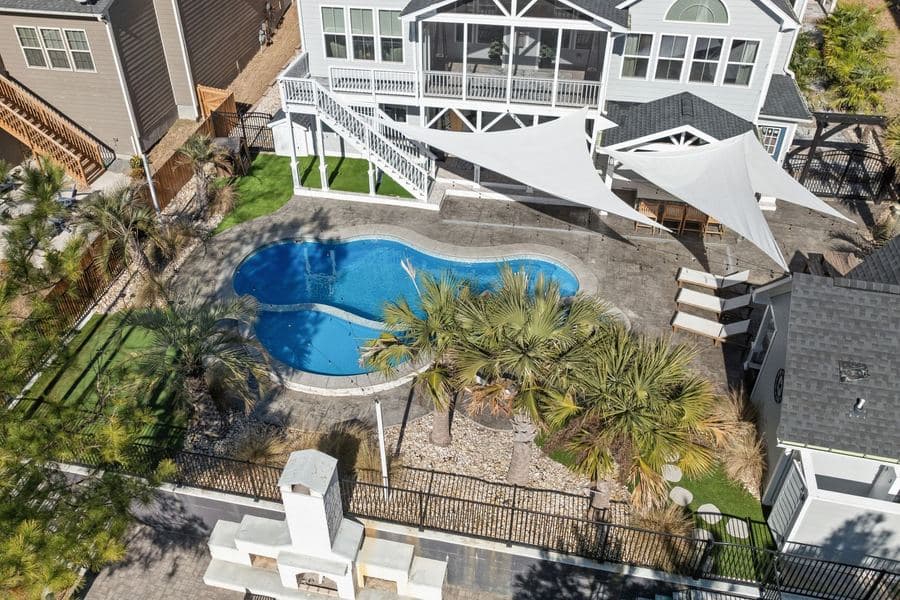
The ColourTree rectangle sail in 190 GSM virgin HDPE, 95% UV block, with a three-year warranty and stainless D-rings at every corner. Rectangles match deck geometry, and on a deck the sail is the easy part — budget for 316 stainless hardware and fixings that reach framing.
Our picks at a glance
| # | Structure | Best for | Fabric | Price |
|---|---|---|---|---|
| 01 | 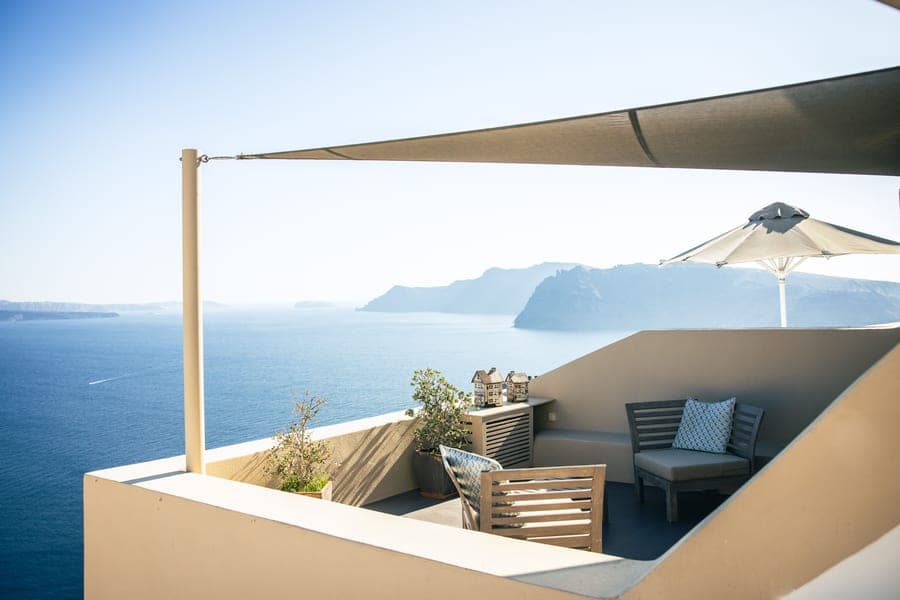 ColourTree Rectangle Sun Shade Sail, 190 GSMThe clearest published fabric spec in the category — 190 GSM virgin HDPE, 95% UV block, three-year warranty — with the hardware sold separately. | Top pick | 190 GSM HDPE mesh, 95% UV block, breathable | Check price on Amazon |
| 02 | 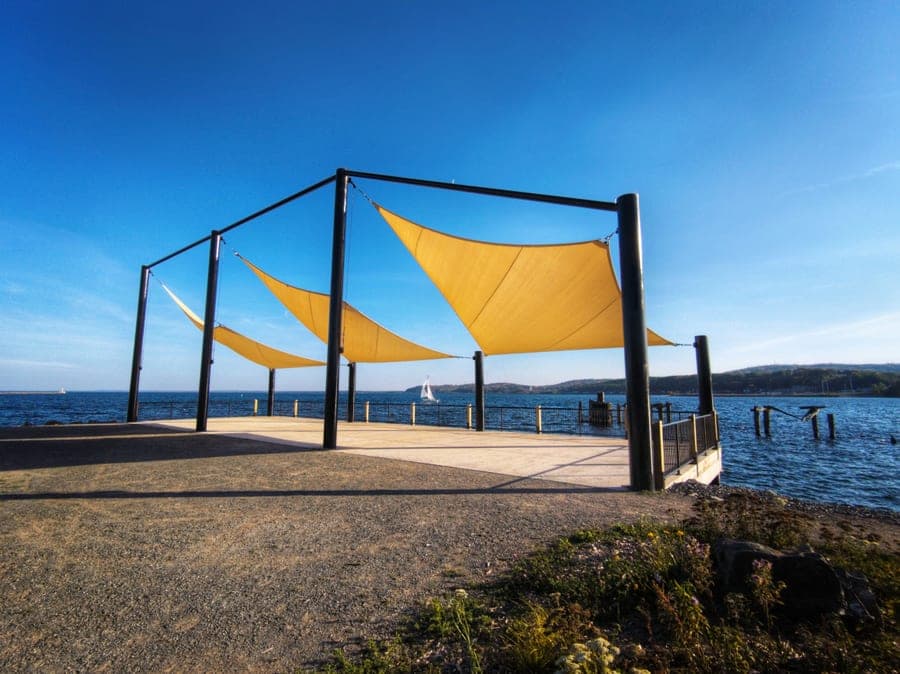 Windscreen4less Cable Shade Sail, 260 GSMThe heaviest fabric and the longest warranty of any sail here — seven years — and the only one with a galvanized cable sewn through the perimeter. | Best for an exposed deck | 260 GSM high-density polyethylene, UV 95 | Check price on Amazon |
| 03 | 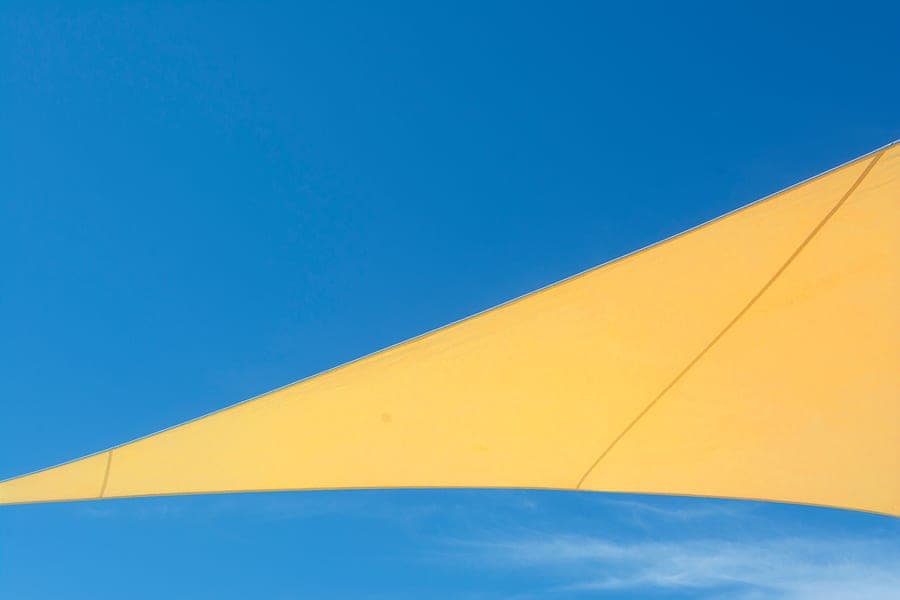 ColourTree Triangle Sun Shade Sail, 200 GSMA heavier 200 GSM fabric in the shape that tensions most predictably — three anchor points cannot fight each other the way four can. | Best where you only have three fixing points | 200 GSM HDPE, 95% UV block | Check price on Amazon |
| 04 | 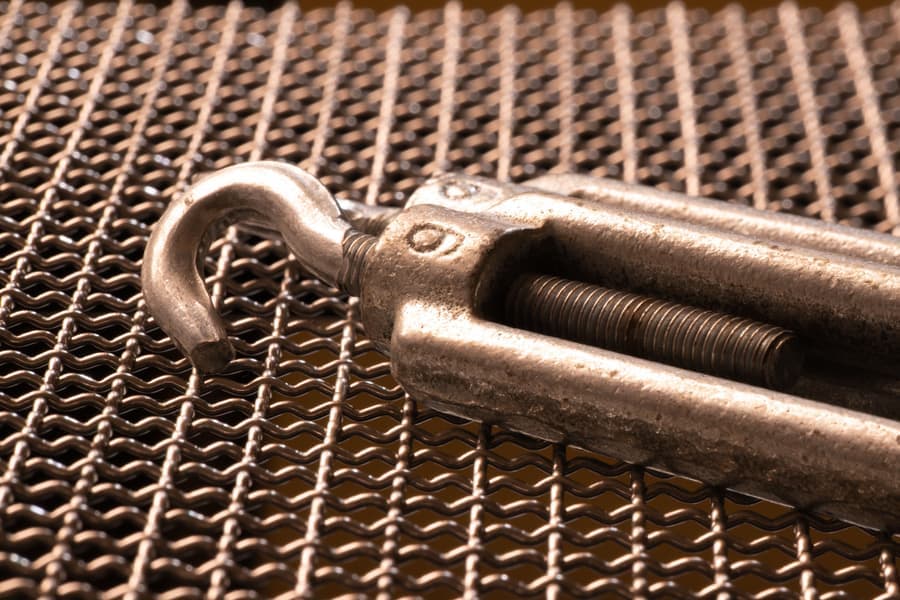 SUNNY GUARD Shade Sail Hardware Kit, 316 Stainless316 marine-grade stainless rather than 304 — the difference that decides whether your fixings survive a coastal or pool-side install. | The part that actually fails | Not published by manufacturer | Check price on Amazon |
The durability table
Every published figure we could source for these structures, in one place, with the manufacturer page each number came from. Where a cell reads "Not published by manufacturer", that figure does not exist in the manufacturer's own material — we do not estimate it and we do not copy one from another site.
| Model | Wind rating (mph) | Snow load | Frame | Roof | Anchoring required | Warranty | Spec source |
|---|---|---|---|---|---|---|---|
| ColourTree Rectangle Sun Shade Sail, 190 GSMTop pick | Not published by manufacturer | Not published by manufacturer | No frame — 100% virgin (non-recycled) HDPE fabric, reinforced stitched seams | 190 GSM HDPE mesh, 95% UV block, breathable | Stainless steel D-ring at each corner; cable rope and hardware kits sold separately | 3 years under normal weather and usage | ColourTree rectangle shade sail product pageChecked 2026-09-26 |
| Windscreen4less Cable Shade Sail, 260 GSM | Not published by manufacturer | Not published by manufacturer | Steel-wired perimeter with galvanized cable and A-ring reinforcement | 260 GSM high-density polyethylene, UV 95 | Strengthened A-rings at the corners, steel wire reinforced edges | 7 years under normal weather conditions | Windscreen4less shade sails pageChecked 2026-09-26 |
| ColourTree Triangle Sun Shade Sail, 200 GSM | Not published by manufacturer | Not published by manufacturer | No frame — breathable HDPE fabric | 200 GSM HDPE, 95% UV block | Stainless steel D-rings at the corners; hardware sold separately | 3 years | ColourTree triangle shade sail product pageChecked 2026-09-26 |
| SUNNY GUARD Shade Sail Hardware Kit, 316 Stainless | Not published by manufacturer | Not published by manufacturer | 316 marine-grade stainless steel | Not published by manufacturer | Turnbuckles, pad eyes, snap hooks, screws and expansion anchors; sized for triangle sails under 161 sq ft | Not published by manufacturer | SUNNY GUARD hardware kit product pageChecked 2026-09-26 |
Every pick in full
Top pick
ColourTree Rectangle Sun Shade Sail, 190 GSM
The clearest published fabric spec in the category — 190 GSM virgin HDPE, 95% UV block, three-year warranty — with the hardware sold separately.
- Wind rating
- Not published by manufacturer
- Snow load
- Not published by manufacturer
- Frame
- No frame — 100% virgin (non-recycled) HDPE fabric, reinforced stitched seams
- Roof
- 190 GSM HDPE mesh, 95% UV block, breathable
- Anchoring
- Stainless steel D-ring at each corner; cable rope and hardware kits sold separately
- Warranty
- 3 years under normal weather and usage
- Sizes
- 14 sizes, 8 x 10 ft to 16 x 20 ft
The clearest published fabric spec in the category, in the shape that actually matches a deck. Decks are rectangles; sails sold as rectangles waste less of them.
190 GSM virgin (non-recycled) HDPE, 95% UV block, breathable, with reinforced stitched seams. Virgin rather than recycled polymer is a published distinction worth having — recycled HDPE is where unexplained early UV failures tend to come from — and 95% block is enough to make a deck usable through the middle of the day.
Fourteen sizes from 8 x 10 ft to 16 x 20 ft, which is the practical advantage over every triangle: you can match a deck's proportions instead of triangulating across them and losing the corners. A rectangle over a rectangular deck shades the furniture rather than the railing.
Stainless steel D-rings at each corner, with cable rope and hardware kits sold separately. On a deck install that separation is useful rather than annoying: the supplied hardware in bundled kits is usually the first thing to go, and buying the fixings deliberately is how a deck installation survives. Three years of warranty under normal weather and usage.
Skip it if: Your deck is exposed and you want the heaviest option. The Windscreen4less cable sail below is built for that and warranted for more than twice as long.
#ad Price shown as of September 26, 2026. How this site is funded
Specifications from ColourTree rectangle shade sail product page, checked 2026-09-26.
Best for an exposed deck
Windscreen4less Cable Shade Sail, 260 GSM
The heaviest fabric and the longest warranty of any sail here — seven years — and the only one with a galvanized cable sewn through the perimeter.
- Wind rating
- Not published by manufacturer
- Snow load
- Not published by manufacturer
- Frame
- Steel-wired perimeter with galvanized cable and A-ring reinforcement
- Roof
- 260 GSM high-density polyethylene, UV 95
- Anchoring
- Strengthened A-rings at the corners, steel wire reinforced edges
- Warranty
- 7 years under normal weather conditions
- Sizes
- Not published by manufacturer
The heaviest fabric and the longest warranty of any sail on this site, with the one construction detail that matters most on a deck: a galvanized cable sewn right through the perimeter.
260 GSM high-density polyethylene, UV 95, with a steel-wired perimeter and A-ring reinforcement at the corners. A cable edge distributes tension along the whole perimeter instead of concentrating it at four points. On a deck — where the points you are pulling against are framing members rather than concrete — spreading that load is the difference between a sail that holds and a fixing that works loose.
Seven years of warranty under normal weather conditions. Nothing else here comes close; the next-longest sail term on this site is three years. On a structure where re-tensioning means crawling under a deck, buying the longest-lived option is the cheaper decision.
Strengthened A-rings rather than plain D-rings at each corner. A-rings spread the pull across a wider arc of the cable, which is exactly what you want where a sail is anchored to a timber post you set yourself rather than to a wall.
Skip it if: You need a specific size. Windscreen4less does not publish a size range for this line the way ColourTree does, so confirm the dimension before ordering.
#ad Price shown as of September 26, 2026. How this site is funded
Specifications from Windscreen4less shade sails page, checked 2026-09-26.
Best where you only have three fixing points
ColourTree Triangle Sun Shade Sail, 200 GSM
A heavier 200 GSM fabric in the shape that tensions most predictably — three anchor points cannot fight each other the way four can.
- Wind rating
- Not published by manufacturer
- Snow load
- Not published by manufacturer
- Frame
- No frame — breathable HDPE fabric
- Roof
- 200 GSM HDPE, 95% UV block
- Anchoring
- Stainless steel D-rings at the corners; hardware sold separately
- Warranty
- 3 years
- Sizes
- Not published by manufacturer
On a lot of decks you get three solid anchor points and no fourth, and that is a case for a triangle rather than a compromise.
200 GSM HDPE, 95% UV block, breathable, with stainless D-rings at the corners — a slightly heavier fabric than the rectangle from the same manufacturer, on the same three-year term.
Three points are always a flat plane, and that is the structural argument. A four-point sail has to be tensioned so that two diagonals agree; get it slightly wrong and one corner carries more than its share forever. Three corners cannot fight each other, so a triangle tensions cleanly and keeps its shape with less fuss — which matters when the fixing points are joists and posts rather than masonry.
Two triangles often beat one rectangle on a deck. Overlapping them from alternating high and low points gives you more coverage, better drainage and a structure where no single fixing is critical. It is also the only way to shade an L-shaped deck properly.
Skip it if: The deck is a clean rectangle with four good anchor points. A rectangle will shade it with less fabric and fewer fixings.
#ad Price shown as of September 26, 2026. How this site is funded
Specifications from ColourTree triangle shade sail product page, checked 2026-09-26.
The part that actually fails
SUNNY GUARD Shade Sail Hardware Kit, 316 Stainless
316 marine-grade stainless rather than 304 — the difference that decides whether your fixings survive a coastal or pool-side install.
- Wind rating
- Not published by manufacturer
- Snow load
- Not published by manufacturer
- Frame
- 316 marine-grade stainless steel
- Roof
- Not published by manufacturer
- Anchoring
- Turnbuckles, pad eyes, snap hooks, screws and expansion anchors; sized for triangle sails under 161 sq ft
- Warranty
- Not published by manufacturer
- Sizes
- M6 turnbuckles, 6 in. to 8 in. adjustable range
Included as a pick rather than an accessory, because on a deck the hardware is the component that decides whether the installation lasts, and the sail is not.
316 marine-grade stainless steel rather than 304. That is the single most useful specification on this page. 304 is fine inland and pits where there is salt or chlorine; 316 holds. A deck off the back of a coastal house, or beside a pool, is exactly the condition that eats 304 fittings from the inside of the swage.
Turnbuckles, pad eyes, snap hooks, screws and expansion anchors, with M6 turnbuckles giving a 6 in. to 8 in. adjustable range. The adjustment range is what lets you re-tension in year two without taking anything down — and shade sails always need re-tensioning in year two.
Sized for triangle sails under 161 sq ft, so check your sail against that before ordering. On a bigger span you need heavier fittings, and under-specified hardware on an over-sized sail is the most common cause of a failed installation we see. Shade sail hardware guide covers sizing it properly.
Skip it if: Your sail is over 161 sq ft. This kit is sized for smaller triangles, and oversizing the sail without oversizing the fittings is the classic failure.
#ad Price shown as of September 26, 2026. How this site is funded
Specifications from SUNNY GUARD hardware kit product page, checked 2026-09-26.
What a deck changes about a shade sail
Every shade sail wants to be pulled tight between points that do not move. A deck is a structure specifically designed to flex a little, with no concrete anywhere near it, and that reframes the whole installation.
There is nothing to drill into that is not timber. A masonry install puts the load into a wall or a slab that is not going anywhere. On a deck every anchor load ends up in a joist, a beam, a post you set in the ground, or the house wall at one end. Deck boards are not on that list.
Tension on a deck is a lever on the framing. A tight sail does not pull straight down; it pulls sideways and up at an angle, and a pad eye bolted near the end of a joist is loading that joist in the direction it is weakest. Fixings belong near a beam or through added blocking, not mid-span.
So the ranking criterion changes. Over concrete the fabric is the interesting variable. Over a deck it is the edge construction, the corner ring and the hardware — which is why a stainless kit is a pick on this page rather than an add-on.
What each sail publishes
Fabric weight, edge construction, UV block and warranty, exactly as the manufacturers print them.
| Product | Fabric | Edge | Corners | UV | Warranty |
|---|---|---|---|---|---|
| ColourTree rectangle | 190 GSM virgin HDPE | Reinforced stitched seams | Stainless D-rings | 95% | 3 yr |
| Windscreen4less cable sail | 260 GSM HDPE | Galvanized cable sewn through perimeter | Strengthened A-rings | 95% | 7 yr |
| ColourTree triangle | 200 GSM HDPE | Stitched | Stainless D-rings | 95% | 3 yr |
| SUNNY GUARD hardware kit | 316 stainless (not fabric) | M6 turnbuckles, 6–8 in. range | Pad eyes, snap hooks | Not applicable | Not published by manufacturer |
No shade sail manufacturer here publishes a wind rating — not one of the five on this site. That is not an oversight on their part, because the limit is set by your posts and your fittings rather than by their cloth. Shade sail wind ratings explains what to read instead.
Anchoring a sail over a deck
This is the part that decides the outcome, and it is almost entirely about where the load goes rather than what you buy.
- Fix into framing, never into decking. Find the joist, or add blocking between joists where an anchor needs to land. Through-bolt with a plate or a large washer on the underside so the load is spread rather than concentrated under a screw head.
- Spread the clamping force on composite decking. Composite crushes under a concentrated clamp more readily than wood, and that slow crush loosens a connection without anything visibly breaking.
- Use the house wall for one or two corners if you can. A masonry wall or a well-found rim joist at the house is the strongest point available on most decks, and it is free.
- Set a post for the far corners rather than trusting the railing. A deck railing is designed to resist someone leaning on it, not a tensioned sail pulling continuously. Shade sail posts and footings covers sizing and setting one properly.
- Buy 316 stainless if there is salt or a pool anywhere nearby, and accept 304 only well inland. The fitting fails from inside the swage where you cannot inspect it, which is why the material grade is worth paying for.
- Then plan to re-tension at the end of the first season. Every sail relaxes; every deck settles. Turnbuckles with a real adjustment range are what make that a ten-minute job instead of a rebuild.
What we would actually do
The ColourTree rectangle sized to the deck, with hardware bought separately in 316 stainless. The 190 GSM virgin HDPE at 95% block is the clearest published spec in the category, and matching a rectangle to a rectangular deck wastes less fabric than triangulating across it.
The Windscreen4less cable sail if the deck is exposed. A cable sewn through the perimeter spreads the pull along the edge instead of into four corners, which is exactly what you want when the anchor points are timber — and seven years of warranty against three is not a close call.
Two overlapping triangles if the deck is L-shaped or you only have three solid points. Alternating high and low corners gives better coverage and better drainage than one panel ever will.
And spend on the fittings before you spend on the fabric. On a deck, the cloth is rarely what fails. The pad eye in the wrong place and the 304 turnbuckle in salt air are what fail.
What we cut, and why
Every model below was a genuine candidate and did not make the list. The reason is stated in each case, because a shortlist with no visible rejections is not evidence of a selection process.
- Waterproof polyester sails on a deck
- A waterproof sail catches wind in exactly the proportion that it sheds rain, and a deck anchor point has less reserve than a concrete one. Over a deck we would take the breathable mesh and accept the rain. [HDPE vs waterproof shade fabric](/shade-sails/hdpe-vs-waterproof-shade-fabric) sets out the trade.
- Webbing-edged sails on an exposed deck
- A webbing perimeter with no cable concentrates tension at the corners. That is acceptable over a small sheltered span and the wrong choice where the anchor points are timber — which is every deck. The 180 GSM webbing sail is ranked properly on [best shade sails](/shade-sails/best-shade-sails).
- Any fixing into deck boards
- Not a product, a method — and the one that fails most. A pad eye screwed into decking is holding a wear surface, not structure. Every anchor has to reach a joist, a beam or added blocking, which is the subject of [deck shade solutions](/canopies/deck-shade-solutions).
Questions people ask
What is the best shade sail for a deck?
How do you attach a shade sail to a deck?
Can you attach a shade sail to a deck railing?
What size shade sail for a deck?
Do shade sails need a wind rating for a deck?
Will a shade sail damage a composite deck?
Should I use one rectangle or two triangles over a deck?
What hardware do I need for a shade sail on a deck?
Where these figures came from
- ColourTree rectangle sun shade sail — 190 GSM virgin (non-recycled) HDPE, 95% UV block, reinforced stitched seams, stainless D-rings, 14 sizes from 8 x 10 ft to 16 x 20 ft, 3-year warranty
- Windscreen4less shade sails — 260 GSM HDPE at UV 95, galvanized cable sewn through the perimeter, strengthened A-ring corners, 7-year warranty under normal weather conditions
- ColourTree triangle sun shade sail — 200 GSM HDPE, 95% UV block, stainless steel D-rings, 3-year warranty
- SUNNY GUARD shade sail hardware kit — 316 marine-grade stainless steel, M6 turnbuckles with 6 in. to 8 in. adjustable range, sized for triangle sails under 161 sq ft
Found an error? Tell us and we will correct it within seven days and note the change on the page with a dated line — see our editorial policy.