Pergola vs awning
One of these is a structure you anchor to the ground and stop thinking about. The other is a mechanism bolted to your house with a fabric roof that wears out. That difference decides everything else.
By Ryder M. · Published · Last updated
We compare published manufacturer specifications, warranty terms and owner-reported failure modes. We have not physically tested these structures. How we judge shade structures
Slat & Shade earns a commission on qualifying purchases made through links on this page. It costs you nothing extra and never changes what we recommend. Full disclosure
Part of Pergolas
The short answer
Buy a pergola if you want a permanent structure with a published wind rating of 70-100 mph and no consumable roof. Buy a retractable awning if the space cannot take posts, you want shade only on demand, and you accept a mechanism rated at Beaufort 5 — 19-24 mph — that you retract above it.
Our picks at a glance
| # | Structure | Best for | Wind rating | Price |
|---|---|---|---|---|
| 01 | 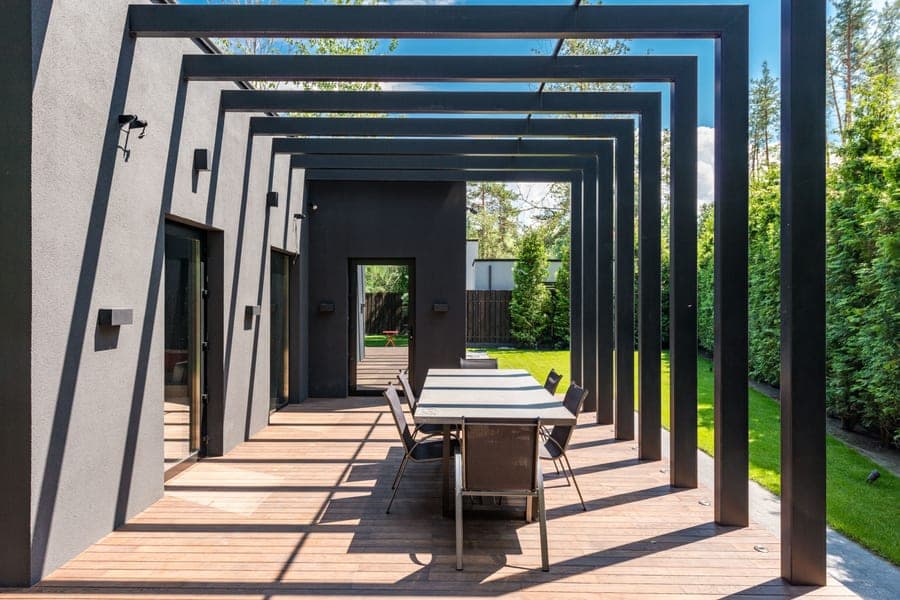 PURPLE LEAF Athena Louvered PergolaThe highest wind figure any louvered pergola in this class publishes, and the only one that ties the number to a specific anchoring condition. | The pergola answer for someone shopping awnings | 72 (fully secured with expansion screws on a hardened floor) | Check price on Amazon |
| 02 | 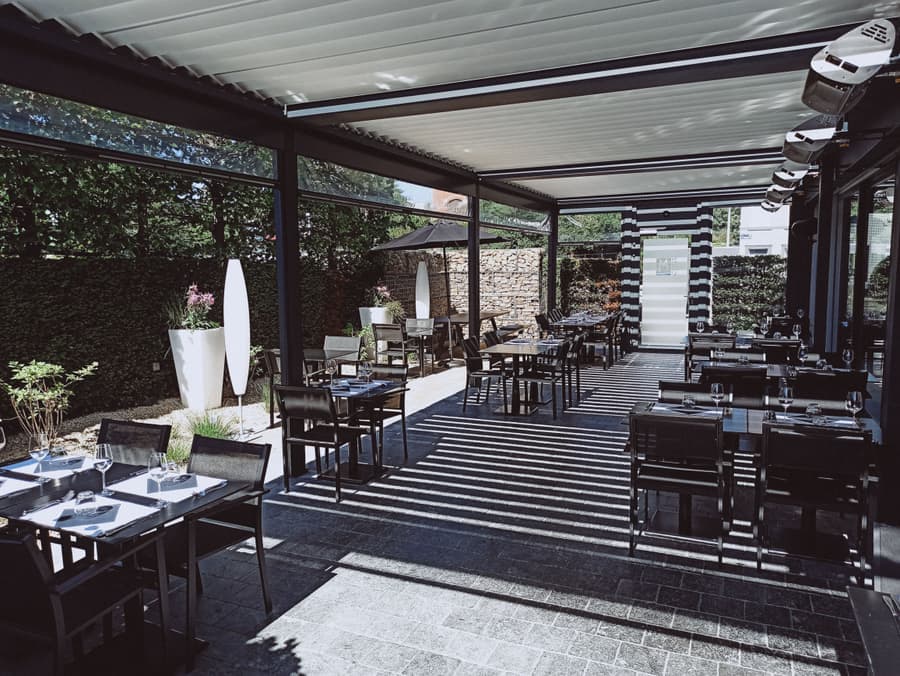 Outsunny Hardtop Polycarbonate PergolaA solid-roof aluminum pergola that publishes a roof load figure instead of a wind rating — useful for rain, unproven for wind. | The cheapest pergola that does an awning's actual job | Not published by manufacturer | Check price on Amazon |
| 03 | 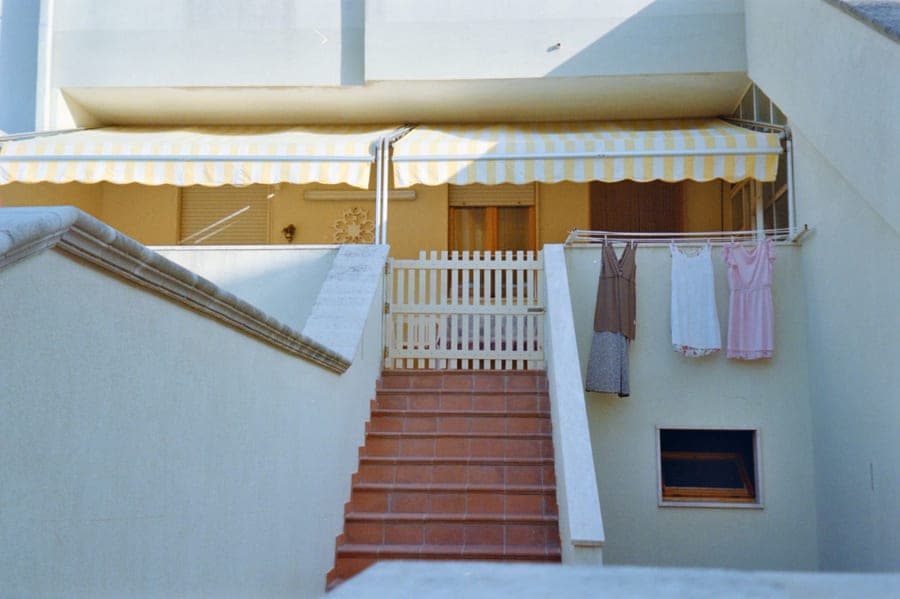 Diensweek P100 Manual Retractable AwningRetracts, which is the only wind strategy a fabric awning has. The published rating is a Beaufort number, not a mile-per-hour figure. | The awning answer with the fewest things to break | Beaufort 5 (roughly 19-24 mph) — retract above it | Check price on Amazon |
| 04 |  Diensweek Motorized Acrylic Retractable AwningSolution-dyed acrylic instead of coated polyester — the upgrade that decides whether the fabric still has its color in year six. | The awning fabric that is still the right color in year six | Beaufort 5 (roughly 19-24 mph) — retract above it | Check price on Amazon |
The durability table
Every published figure we could source for these structures, in one place, with the manufacturer page each number came from. Where a cell reads "Not published by manufacturer", that figure does not exist in the manufacturer's own material — we do not estimate it and we do not copy one from another site.
| Model | Wind rating (mph) | Snow load | Frame | Roof | Anchoring required | Warranty | Spec source |
|---|---|---|---|---|---|---|---|
| PURPLE LEAF Athena Louvered PergolaTop pick | 72 (fully secured with expansion screws on a hardened floor) | Not published by manufacturer | Powder-coated aluminum, 1.5 mm wall, 4.33 in. x 4.33 in. crossbeams | Adjustable aluminum louvers with integrated drainage | Expansion screws into a hardened floor — the published wind figure assumes it | 1 year | PURPLE LEAF louvered pergola collectionChecked 2026-09-26 |
| Outsunny Hardtop Polycarbonate Pergola | Not published by manufacturer | Roof weight capacity 10 lb/ft² (50 kg/m²) | Aluminum | Solid polycarbonate with drainage holes | Not published by manufacturer | 1 year | Outsunny hardtop pergola product pageChecked 2026-09-26 |
| Diensweek P100 Manual Retractable Awning | Beaufort 5 (roughly 19-24 mph) — retract above it | Not published by manufacturer | T5-grade aluminum with PVC-coated stainless steel arm cables and galvanized steel roller tube | 280 g/m² polyester with PU coating, water resistant, 50 UV+ | Not published by manufacturer | 1 year | Diensweek official siteChecked 2026-09-26 |
| Diensweek Motorized Acrylic Retractable Awning | Beaufort 5 (roughly 19-24 mph) — retract above it | Not published by manufacturer | Corrosion-resistant aluminum | 100% acrylic, fade-resistant, 80 UV+ | Not published by manufacturer | 1 year | Diensweek official siteChecked 2026-09-26 |
Every pick in full
The pergola answer for someone shopping awnings
PURPLE LEAF Athena Louvered Pergola
The highest wind figure any louvered pergola in this class publishes, and the only one that ties the number to a specific anchoring condition.
- Wind rating
- 72 (fully secured with expansion screws on a hardened floor)
- Snow load
- Not published by manufacturer
- Frame
- Powder-coated aluminum, 1.5 mm wall, 4.33 in. x 4.33 in. crossbeams
- Roof
- Adjustable aluminum louvers with integrated drainage
- Anchoring
- Expansion screws into a hardened floor — the published wind figure assumes it
- Warranty
- 1 year
- Sizes
- 10 x 12 ft to 14 x 24 ft
If you are comparing these two categories at all, you almost certainly want shade on demand — and the louvered pergola is the only pergola that gives you that without a fabric roof.
The published set is 72 mph fully secured with expansion screws on a hardened floor, powder-coated aluminum with a 1.5 mm wall and 4.33 in. x 4.33 in. crossbeams, and independent adjustable roof sections operated over a 0 to 90 degree range. Rainwater is collected in concealed channels and gutters and carried down through the posts, discharging through notches at the base of all four columns.
That drainage detail is the honest comparison point against an awning. A closed louvered roof with gutters in the beams does the job a fabric awning does — keeps a table dry — and does it with an aluminum plane instead of a textile that eventually fades, stretches and tears.
The published wind figure is roughly three times the Beaufort 5 rating on the awnings below, and it does not require you to be at home to act on it. PURPLE LEAF also lists wall-mounted lean-to configurations from 8 x 10 ft upward, which is the geometry an awning buyer is usually picturing.
The cost is a one-year warranty, a real install and a much higher price band. Expansion screws into a hardened floor is not a figure of speech — this is a structure that needs a slab, and the rating assumes you anchored into one. Is a louvered pergola worth it works through the premium honestly.
Skip it if: You have no slab and no intention of pouring one, or posts in the space are a non-starter. Neither is a problem an awning has.
#ad Price shown as of September 26, 2026. How this site is funded
Specifications from PURPLE LEAF louvered pergola collection, checked 2026-09-26.
The cheapest pergola that does an awning's actual job
Outsunny Hardtop Polycarbonate Pergola
A solid-roof aluminum pergola that publishes a roof load figure instead of a wind rating — useful for rain, unproven for wind.
- Wind rating
- Not published by manufacturer
- Snow load
- Roof weight capacity 10 lb/ft² (50 kg/m²)
- Frame
- Aluminum
- Roof
- Solid polycarbonate with drainage holes
- Anchoring
- Not published by manufacturer
- Warranty
- 1 year
- Sizes
- 12 x 10 ft, 14.5 x 10 ft, 16.5 x 10 ft
A solid-roof pergola is the closest structural equivalent to a fixed awning, and it is where a lot of awning shoppers should end up.
Aluminum frame under solid polycarbonate with drainage holes, a published roof weight capacity of 10 lb/ft² (50 kg/m²), in 12 x 10 ft, 14.5 x 10 ft and 16.5 x 10 ft. A roof weight capacity is not a snow rating and we will not read it as one, but it is a published figure in a class where most listings carry none.
Light still comes through, which is the argument for polycarbonate over an opaque fabric panel in a small yard — a solid steel roof or a dark canvas awning over a 12 ft patio makes the room behind it noticeably darker, and a translucent panel does not.
No wind figure is published for it, and on a light aluminum frame with a solid roof that is exactly where you would want one. We are not going to pretend the absence is a strength. What it does have over any awning is that nothing on it is consumable: no fabric to replace, no arms to re-tension, no motor.
Skip it if: You are comparing on wind, or the shade needs to disappear in winter. A fixed solid roof is a permanent decision about light over that part of the yard.
#ad Price shown as of September 26, 2026. How this site is funded
Specifications from Outsunny hardtop pergola product page, checked 2026-09-26.
The awning answer with the fewest things to break
Diensweek P100 Manual Retractable Awning
Retracts, which is the only wind strategy a fabric awning has. The published rating is a Beaufort number, not a mile-per-hour figure.
- Wind rating
- Beaufort 5 (roughly 19-24 mph) — retract above it
- Snow load
- Not published by manufacturer
- Frame
- T5-grade aluminum with PVC-coated stainless steel arm cables and galvanized steel roller tube
- Roof
- 280 g/m² polyester with PU coating, water resistant, 50 UV+
- Anchoring
- Not published by manufacturer
- Warranty
- 1 year
- Sizes
- 8 x 7 ft to 15 x 10 ft
If an awning is the right category, the manual version is the one a buy-it-for-life shopper should look at first, because the crank is the part least likely to fail and the cheapest to replace when it does.
The published build is T5-grade aluminum with PVC-coated stainless steel arm cables and a galvanized steel roller tube, under 280 g/m² polyester with a PU coating, water resistant and rated 50 UV+, in sizes from 8 x 7 ft to 15 x 10 ft, with a one-year warranty.
The wind rating is the number to understand before you buy anything in this category: Beaufort 5. On the National Weather Service scale that is 19-24 mph — a fresh breeze, not a storm. Above it, the published strategy is to retract, which means the awning's wind resistance is a function of whether somebody is home and paying attention.
Retraction is also the awning's genuine structural advantage. A pergola takes every storm it ever meets; a retracted awning takes none of them. A fabric roof that spends 90 percent of the year rolled up inside an aluminum cassette is a fabric roof that lasts a long time.
The consumable is the fabric. PU-coated polyester is the budget tier: it is water resistant and it will chalk, fade and stiffen under UV faster than acrylic. Plan on a re-cover rather than treating the purchase as permanent.
Skip it if: You travel, or the patio is exposed. An awning left out in a 40 mph gust is not covered by any rating, and nothing retracts it for you.
#ad Price shown as of September 26, 2026. How this site is funded
Specifications from Diensweek official site, checked 2026-09-26.
The awning fabric that is still the right color in year six
Diensweek Motorized Acrylic Retractable Awning
Solution-dyed acrylic instead of coated polyester — the upgrade that decides whether the fabric still has its color in year six.
- Wind rating
- Beaufort 5 (roughly 19-24 mph) — retract above it
- Snow load
- Not published by manufacturer
- Frame
- Corrosion-resistant aluminum
- Roof
- 100% acrylic, fade-resistant, 80 UV+
- Anchoring
- Not published by manufacturer
- Warranty
- 1 year
- Sizes
- Up to 15 x 10 ft
Within the awning category, the fabric is the decision that matters most to anyone who hates rebuying — and it gets much less attention than the motor.
This version publishes 100% acrylic, fade resistant, 80 UV+ on a corrosion-resistant aluminum frame, up to 15 x 10 ft, with a one-year warranty. Diensweek describes the fabric as dope-dyed acrylic with a PU coating, with water and UV resistance exceeding 80 percent.
Dope-dyed (solution-dyed) acrylic carries the pigment through the fiber rather than on the surface of a coating. That is the difference between a canopy that is the same color in year six and one that has gone chalky and pale on the sunward half — and on a product whose roof is the consumable, it is the single highest-leverage upgrade in the category.
The published wind rating is the same Beaufort 5, roughly 19-24 mph. Better fabric does not raise it, because the limit is the arm geometry and the wall fixing, not the textile.
The motor is the honest con. It is the part most likely to fail outside warranty, it needs power at the wall, and most motorized awnings do not retract themselves in wind unless you add a sensor. A motor buys convenience, not durability.
Skip it if: You want the fewest possible failure points. Every motorized awning adds a tube motor, a controller and a power feed to a product whose fabric is already the consumable.
#ad Price shown as of September 26, 2026. How this site is funded
Specifications from Diensweek official site, checked 2026-09-26.
You are choosing between a structure and a mechanism
Almost every online comparison of these two frames it as a style question — posts and beams versus a clean wall — and that is the least important difference.
A pergola is a structure. Four posts, beams, a roof plane, anchored into something solid. Nothing on it moves and nothing on it is consumable; the roof lasts as long as the frame. Its failure modes are coating degradation, timber rot and the anchors, and all three take years.
A retractable awning is a mechanism. An aluminum cassette bolted to the house wall, a roller tube, folding arms under cable tension, a fabric panel, and in many cases a tube motor. Four of those five are wear items. The fabric is a consumable, the arm cables stretch, the roller bearings dry out and the motor is an electro-mechanical part on the outside of a building.
Every other difference in this comparison follows from that one. The pergola costs more up front and nothing after. The awning costs less up front and something every several years. How long shade structures last collects what each category reports.
Where the awning genuinely wins
This site is biased toward structures that outlive their owners, and it would be dishonest to pretend an awning never wins. Three cases where it is clearly the right buy:
- The space cannot have posts. A narrow side yard, a balcony, a walkway, a driveway edge, a patio where a 4 in. post lands exactly where the door swings. An awning puts nothing on the ground, which no pergola can match.
- You want the sun back in winter. A retracted awning returns the space to full sun in about thirty seconds. A fixed pergola roof — slats, louvers closed, or polycarbonate — is a permanent change to how much light reaches that wall and the windows behind it.
- There is no slab and no appetite for one. Every published pergola wind rating assumes an anchored structure, and anchoring means concrete in most cases. An awning's load goes into the house wall, which is already there. How to anchor a pergola is blunt about what the alternatives are worth.
There is a fourth case that is nearly always decisive in practice: an awning is substantially cheaper up front than a louvered pergola of the same coverage. If the budget is the constraint rather than the lifespan, that is a legitimate reason and not a compromise worth arguing with.
Where the pergola wins, in published figures
The pergola's advantages are not aesthetic, and they are not close.
Wind. The louvered pergolas on this site publish 70-72 mph, the cedar kits publish up to 100 mph when properly anchored, and the awnings publish Beaufort 5 — 19-24 mph on the National Weather Service scale. That is not a narrow gap. It is the difference between a structure that handles a storm and a product whose published instruction is to put itself away before one arrives.
No consumable roof. An aluminum louver, a polycarbonate panel and a cedar rafter all last as long as the structure. A fabric panel does not, and the re-cover is a real recurring cost that almost nobody includes when they compare the sticker prices.
Nothing depends on you being home. The awning's wind strategy is retraction, which is an action. The pergola's wind strategy is the anchor, which is a condition. On a weekend away in September those are very different properties.
Resale and permanence. A pergola is a structure a buyer sees. An awning is equipment on a wall, and a tired one is a liability rather than a feature.
Side by side on what the manufacturers publish
Every figure below comes from the manufacturer's own listing, linked in the sources at the foot of this page. Nothing here is converted except where the conversion is named.
| Louvered pergola | Solid-roof pergola | Manual awning | Motorized acrylic awning | |
|---|---|---|---|---|
| Published wind | 72 mph (secured on a hardened floor) | Not published by manufacturer | Beaufort 5 (19-24 mph), retract above | Beaufort 5 (19-24 mph), retract above |
| Roof | Adjustable aluminum louvers, 0-90 degrees, gutters in the beams | Solid polycarbonate with drainage holes | 280 g/m² PU-coated polyester | 100% dope-dyed acrylic, 80 UV+ |
| Consumable parts | None | None | Fabric, arm cables | Fabric, arm cables, tube motor |
| Rain cover | Yes, louvers closed, drained through the posts | Yes, fixed | Light rain only; retract in weather | Light rain only; retract in weather |
| Load path | Into the slab, via expansion screws | Into the ground, via the frame | Into the house wall | Into the house wall |
| Warranty | 1 year | Not published by manufacturer | 1 year | 1 year |
| Sizes | 8 x 10 to 14 x 24 ft, incl. wall-mounted | 12 x 10, 14.5 x 10, 16.5 x 10 ft | 8 x 7 to 15 x 10 ft | Up to 15 x 10 ft |
Read the wind row and the consumable row together and the comparison is settled for anyone buying once. Read the load-path row and it is settled for anyone without a slab — in the other direction.
The ten-year cost nobody prices
Compare these on purchase price and the awning wins easily. Compare them over the life of the installation and it gets much closer, because only one of them has a parts list.
A pergola's running cost is maintenance, not parts. Powder-coated aluminum wants washing. Cedar wants re-sealing every two to three years or it grays, checks at the bolt holes and rots at the end grain. Neither is a purchase; both are a Saturday. Pergola maintenance has the honest schedule.
An awning's running cost is a re-cover, and the fabric decides the interval. PU-coated polyester is the budget tier and will chalk and stiffen under UV sooner; dope-dyed acrylic holds color far longer because the pigment is in the fiber rather than in a surface coating. Neither manufacturer publishes a service life, and we are not going to invent one — but a replacement canopy is a real line item and a fabric upgrade at purchase is the cheapest way to push it out.
Then there is the mechanism. Arm cables under constant tension, a roller tube with bearings, and on a motorized unit a tube motor and controller mounted outdoors. None of these is covered past twelve months by the warranties here. Replacement canopy guide covers how re-cover economics work on fabric shade generally.
Wind decides this more often than shade does
The Beaufort 5 rating on both awnings deserves a paragraph of its own, because it is routinely misread as a storm rating.
Beaufort 5 is 19-24 mph on the National Weather Service scale — described at sea as moderate waves with many white horses. On land it is the wind that moves small branches and makes an umbrella awkward. It is a breezy Tuesday, not a weather event.
So the published guidance to retract above Beaufort 5 is not a storm precaution. It is a routine operating instruction, and it means an extended awning is a fair-weather configuration by design. That is not a defect — a retractable awning is supposed to retract — but it reframes the comparison. You are not comparing a 72 mph structure against a 24 mph structure. You are comparing a structure that stays out against a structure that is only out when you are watching.
If your patio is exposed, on a slope, at a corner, or anywhere the wind funnels, that is close to decisive. Wind ratings explained covers how to read a published figure against your own site, and canopy wind ratings and weights covers the fabric-structure side in detail.
Attachment, the wall, and the permit question
There is one more asymmetry that does not show up on any spec sheet: where the load goes.
An awning transfers everything — dead weight, wind uplift on an extended panel, the leverage of a 10 ft projection — into a few lag fixings in your house wall. On brick or solid masonry that is straightforward. On siding over a stud wall it means hitting framing or a ledger, and on EIFS or stucco over foam it is a genuine problem that an installer should price before you buy.
A freestanding pergola puts none of that into the building, which is why it is often the simpler permit case as well: attaching a structure to the house is treated as a structural alteration in many jurisdictions, while a freestanding accessory structure below a footprint threshold is frequently exempt. Pergola permits and HOA rules sets out the questions to ask and the order to ask them in, and attached vs detached pergola covers the same decision inside the pergola category.
It also cuts the other way. If the shade has to sit directly against the house over a door or a run of windows, a freestanding pergola next to the wall looks and works worse than an awning or a wall-mounted lean-to designed for it.
Which one to buy
Three questions, in this order, settle it for almost everybody.
- 01Can the space take posts? If no, you are buying an awning and the rest of this page is about choosing the fabric. If yes, keep going.
- 02Do you have a slab, or will you pour one? Every published pergola wind rating assumes an anchored structure. No slab and no plan for one points back at the awning, or at a wall-mounted lean-to pergola fixed into masonry.
- 03Do you want the sun back? If the space has to be fully open some of the year, an awning or a louvered pergola. If permanent shade is the goal, a fixed or solid-roof pergola is cheaper and has nothing to maintain but the finish.
- 04If you are still split, decide on exposure. An exposed, windy or unattended patio favors the pergola heavily, because retraction is an action and anchoring is a condition.
- 05Then buy the fabric, not the motor. Within the awning category, dope-dyed acrylic over PU-coated polyester is the upgrade that changes what you own in year six; the motor is convenience.
Questions people ask
Is a pergola or an awning better?
How much wind can a retractable awning take?
Does an awning keep rain off better than a pergola?
Which costs less, a pergola or an awning?
Can you put a retractable awning on any house wall?
Do pergolas or awnings last longer?
Is a motorized awning worth it over a manual one?
Is there a pergola that works like an awning?
Where these figures came from
- PURPLE LEAF louvered pergola collection — 72 mph secured with expansion screws on a hardened floor, 1.5 mm wall, 4.33 in. crossbeams, 0-90 degree louvers, concealed gutters draining through the posts, wall-mounted lean-to from 8 x 10 ft, 1-year warranty (checked 7 Oct 2026)
- Outsunny polycarbonate hardtop pergola — 10 lb/ft² (50 kg/m²) roof weight capacity, solid polycarbonate with drainage holes, 12 x 10 / 14.5 x 10 / 16.5 x 10 ft, no published wind figure
- Diensweek official site — retractable awnings: T5-grade aluminum frame, dope-dyed acrylic with PU coating and water/UV resistance above 80%, 280 g/m² PU-coated polyester on the P100, Beaufort 5 wind resistance, 8 x 7 to 15 x 10 ft, 1-year warranty (checked 7 Oct 2026)
- NOAA National Weather Service Beaufort wind scale — force 5 is 19-24 mph
Found an error? Tell us and we will correct it within seven days and note the change on the page with a dated line — see our editorial policy.