Sunbrella shade sails
Sunbrella is the most recognized name in outdoor fabric and one of the hardest to buy as a shade sail, because Glen Raven sells yardage to fabricators rather than finished sails to homeowners. That one fact explains the price, the lead time and the no-returns policy.
By Ryder M. · Published · Last updated
We compare published manufacturer specifications, warranty terms and owner-reported failure modes. We have not physically tested these structures. How we judge shade structures
Slat & Shade earns a commission on qualifying purchases made through links on this page. It costs you nothing extra and never changes what we recommend. Full disclosure
Part of Shade Sails
The short answer
Sunbrella does not make shade sails. It makes the acrylic and knit shade fabrics a sail is sewn from, backed by a 10-year limited warranty on shade and marine fabric. Finished Sunbrella sails come from fabricators, made to order, at several times the price of an HDPE sail.
Our picks at a glance
| # | Structure | Best for | Fabric | Price |
|---|---|---|---|---|
| 01 | 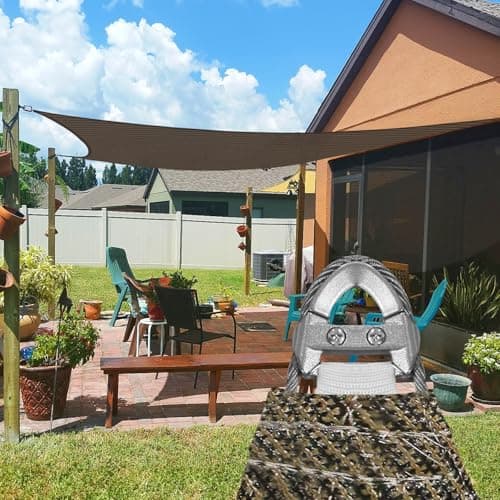 Windscreen4less Cable Shade Sail, 260 GSMThe heaviest fabric and the longest warranty of any sail here — seven years — and the only one with a galvanized cable sewn through the perimeter. | The off-the-shelf sail with the longest written warranty | 260 GSM high-density polyethylene, UV 95 | $142.48 · View on Amazon |
| 02 |  ColourTree Rectangle Sun Shade Sail, 190 GSMThe clearest published fabric spec in the category — 190 GSM virgin HDPE, 95% UV block, three-year warranty — with the hardware sold separately. | The best-documented fabric spec at an ordinary price | 190 GSM HDPE mesh, 95% UV block, breathable | $79.99 · View on Amazon |
| 03 | 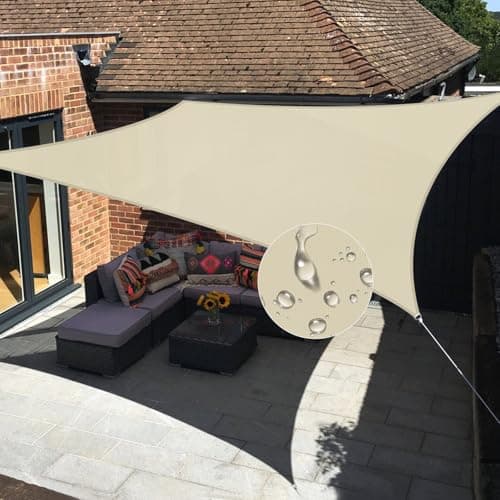 Windscreen4less Waterproof Shade SailA genuinely waterproof polyester sail rather than a breathable mesh — which means it sheds rain and catches wind in equal measure. | If what you actually wanted from acrylic was rain cover | Terylene polyester, waterproof, UV 95 | $49.98 · View on Amazon |
| 04 | 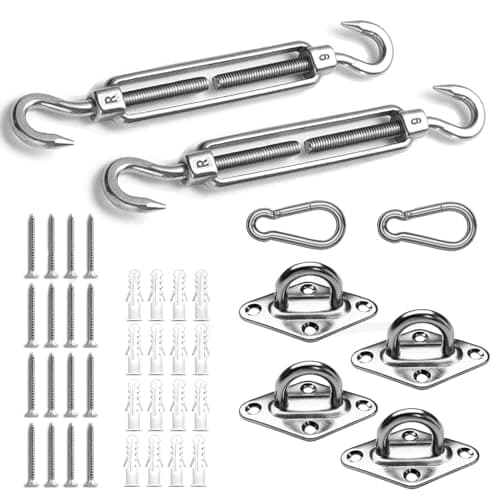 SUNNY GUARD Shade Sail Hardware Kit, 316 Stainless316 marine-grade stainless rather than 304 — the difference that decides whether your fixings survive a coastal or pool-side install. | The part that fails first, whatever the fabric costs | Not published by manufacturer | $19.99 · View on Amazon |
The durability table
Every published figure we could source for these structures, in one place, with the manufacturer page each number came from. Where a cell reads "Not published by manufacturer", that figure does not exist in the manufacturer's own material — we do not estimate it and we do not copy one from another site.
| Model | Wind rating (mph) | Snow load | Frame | Roof | Anchoring required | Warranty | Spec source |
|---|---|---|---|---|---|---|---|
| Windscreen4less Cable Shade Sail, 260 GSMTop pick | Not published by manufacturer | Not published by manufacturer | Steel-wired perimeter with galvanized cable and A-ring reinforcement | 260 GSM high-density polyethylene, UV 95 | Strengthened A-rings at the corners, steel wire reinforced edges | 7 years under normal weather conditions | Windscreen4less shade sails pageChecked 2026-09-26 |
| ColourTree Rectangle Sun Shade Sail, 190 GSM | Not published by manufacturer | Not published by manufacturer | No frame — 100% virgin (non-recycled) HDPE fabric, reinforced stitched seams | 190 GSM HDPE mesh, 95% UV block, breathable | Stainless steel D-ring at each corner; cable rope and hardware kits sold separately | 3 years under normal weather and usage | ColourTree rectangle shade sail product pageChecked 2026-09-26 |
| Windscreen4less Waterproof Shade Sail | Not published by manufacturer | Not published by manufacturer | Webbing-reinforced perimeter | Terylene polyester, waterproof, UV 95 | Not published by manufacturer | 3 years | Windscreen4less waterproof shade sails pageChecked 2026-09-26 |
| SUNNY GUARD Shade Sail Hardware Kit, 316 Stainless | Not published by manufacturer | Not published by manufacturer | 316 marine-grade stainless steel | Not published by manufacturer | Turnbuckles, pad eyes, snap hooks, screws and expansion anchors, sold as a kit per sail shape | Not published by manufacturer | SUNNY GUARD hardware kit product pageChecked 2026-09-26 |
Every pick in full
The off-the-shelf sail with the longest written warranty
Windscreen4less Cable Shade Sail, 260 GSM
The heaviest fabric and the longest warranty of any sail here — seven years — and the only one with a galvanized cable sewn through the perimeter.
- Wind rating
- Not published by manufacturer
- Snow load
- Not published by manufacturer
- Frame
- Steel-wired perimeter with galvanized cable and A-ring reinforcement
- Roof
- 260 GSM high-density polyethylene, UV 95
- Anchoring
- Strengthened A-rings at the corners, steel wire reinforced edges
- Warranty
- 7 years under normal weather conditions
- Sizes
- Not published by manufacturer
If the reason you typed "Sunbrella" was that you want the sail that does not fade out in four seasons, this is the nearest thing you can buy without going to a fabricator.
Seven years under normal weather conditions — the longest fabric warranty of any sail in this registry. Sunbrella's shade and marine fabric carries 10 years, so this does not match it, but it is three to four years longer than the 3-year terms that are normal across the HDPE field.
260 GSM high-density polyethylene, UV 95. GSM is the honest proxy for how much polymer is actually between you and the sun. At 260 it sits at the top of the consumer HDPE range — GSM and shade percentage explained covers why that number matters more than the color does.
A galvanized cable sewn through the perimeter, with reinforced A-rings at the corners. This is the structural difference that matters on a large span. Webbing stretches and feeds load unevenly into the corners; a cable edge distributes it along the whole perimeter, which is what stops a big sail flogging.
It is breathable, which is the opposite of what awning acrylic does. Wind passes through the weave instead of loading the posts. That is the single biggest reason an HDPE sail survives weather a solid sail does not.
Windscreen4less publishes no wind rating and no size list for this sail. Neither does anyone else in the category, so it is not a mark against this product specifically — but it does mean the span is your engineering problem, not the manufacturer's.
Skip it if: You want the sail to keep a table dry. Breathable mesh at 260 GSM passes a shower straight through onto whatever is underneath it.
#ad Price shown as of November 11, 2026. How this site is funded
Specifications from Windscreen4less shade sails page, checked 2026-09-26.
The best-documented fabric spec at an ordinary price
ColourTree Rectangle Sun Shade Sail, 190 GSM
The clearest published fabric spec in the category — 190 GSM virgin HDPE, 95% UV block, three-year warranty — with the hardware sold separately.
- Wind rating
- Not published by manufacturer
- Snow load
- Not published by manufacturer
- Frame
- No frame — 100% virgin (non-recycled) HDPE fabric, reinforced stitched seams
- Roof
- 190 GSM HDPE mesh, 95% UV block, breathable
- Anchoring
- Stainless steel D-ring at each corner; cable rope and hardware kits sold separately
- Warranty
- 3 years under normal weather and usage
- Sizes
- 14 sizes, 8 x 10 ft to 16 x 20 ft
The sail to buy when you want the spec sheet to be legible rather than impressive.
190 GSM 100% virgin — non-recycled — HDPE, 95% UV block. Virgin versus recycled is a real distinction in this category and almost nobody states it. Recycled HDPE carries contaminant that becomes a UV failure site; putting "virgin" in writing is a small act of honesty most listings skip.
Three-year warranty under normal weather and usage. Category-standard, a third of Sunbrella's shade-fabric term, and stated plainly rather than buried.
Stainless steel D-ring at each corner, with cable rope and hardware kits sold separately. Budget for that separately — see the hardware pick below — because corner hardware is the most common failure point on a sail of any fabric.
14 sizes, 8 x 10 ft through 16 x 20 ft. A published size ladder is worth more than it sounds: it means you size the sail to your anchor points instead of forcing your anchor points to a sail.
Reinforced stitched seams, breathable mesh. Same structural logic as the cable sail, one step down in fabric weight.
Skip it if: Your span is over roughly 16 ft on the long side, or you are in a reliably windy spot. Step up to the cable-edged 260 GSM sail instead.
#ad Price shown as of November 11, 2026. How this site is funded
Specifications from ColourTree rectangle shade sail product page, checked 2026-09-26.
If what you actually wanted from acrylic was rain cover
Windscreen4less Waterproof Shade Sail
A genuinely waterproof polyester sail rather than a breathable mesh — which means it sheds rain and catches wind in equal measure.
- Wind rating
- Not published by manufacturer
- Snow load
- Not published by manufacturer
- Frame
- Webbing-reinforced perimeter
- Roof
- Terylene polyester, waterproof, UV 95
- Anchoring
- Not published by manufacturer
- Warranty
- 3 years
- Sizes
- Not published by manufacturer
A good share of "Sunbrella shade sail" searches are really "a sail that does not leak". If that is you, buy a solid sail on purpose rather than paying acrylic money for a near-waterproof one.
Terylene polyester, waterproof, UV 95, with a webbing-reinforced perimeter. Solid fabric, not mesh. Water runs off it rather than through it.
Three-year warranty. Shorter than the cable sail's seven, and that gap is not an accident: solid fabric lives a harder structural life than mesh does.
It catches wind in exact proportion to how well it sheds rain. A solid sail is a sail in the nautical sense. Every pound of wind pressure a mesh sail lets pass goes into your posts and footings instead — shade sail posts and footings is the page to read before you buy one.
It needs a real pitch to work. Any solid sail that is not steeply angled pools water, and a pool of water is a load the fabric was never sized for. Fabricators of acrylic sails specify exactly the same thing.
No published size list and no wind rating. Same category-wide gap as everything else here.
Skip it if: You are in a windy location, or your anchor points cannot give you a steep pitch across the whole sail. A solid sail punishes both.
#ad Price shown as of November 11, 2026. How this site is funded
Specifications from Windscreen4less waterproof shade sails page, checked 2026-09-26.
The part that fails first, whatever the fabric costs
SUNNY GUARD Shade Sail Hardware Kit, 316 Stainless
316 marine-grade stainless rather than 304 — the difference that decides whether your fixings survive a coastal or pool-side install.
- Wind rating
- Not published by manufacturer
- Snow load
- Not published by manufacturer
- Frame
- 316 marine-grade stainless steel
- Roof
- Not published by manufacturer
- Anchoring
- Turnbuckles, pad eyes, snap hooks, screws and expansion anchors, sold as a kit per sail shape
- Warranty
- Not published by manufacturer
- Sizes
- M6 turnbuckles, 6 in. to 8 in. adjustable range
Worth saying plainly on a page about premium fabric: the fabric is rarely what fails. The fixings are.
316 marine-grade stainless rather than 304. The difference is molybdenum, and it is what decides whether your turnbuckles are still turning after a few seasons near a pool or the coast. Chlorine and salt pit 304.
Turnbuckles, pad eyes, snap hooks, screws and expansion anchors, sold as a kit per sail shape. Buying the kit matched to the shape avoids the classic mistake of ordering four fixings for a triangle.
M6 turnbuckles with a 6 in. to 8 in. adjustable range. That range is your re-tensioning budget for the life of the sail. Every fabric relaxes; a turnbuckle with travel left is what lets you take the sag back out.
It is not a substitute for sizing the sail correctly. Hardware tensions a sail; it does not rescue one that is too big for its anchor points. Shade sail sizing and tension does the arithmetic.
No published warranty on the kit itself. The material spec is the commitment here, not a term of years.
Skip it if: Your sail already ships with a matched hardware kit, or you are fixing to timber posts and need lag-style fixings rather than the masonry anchors in this kit.
#ad Price shown as of November 11, 2026. How this site is funded
Specifications from SUNNY GUARD hardware kit product page, checked 2026-09-26.
Sunbrella is a fabric company, not a sail company
This is the thing that makes the query confusing, so it goes first. Glen Raven, the maker of Sunbrella, sells fabric by the roll to awning and marine fabricators. It does not sell a finished shade sail. Every "Sunbrella shade sail" on the market is somebody else's sail, cut and sewn from Sunbrella yardage, and the Sunbrella warranty that comes with it covers the fabric — not the stitching, not the hardware, not the installation.
That explains almost everything else about buying one. There is no Sunbrella sail on Amazon, because there is no Sunbrella sail. The retailers who do sell finished acrylic sails build them to order in your size, which is why the typical policy is explicitly non-returnable, and why the lead time is measured in weeks rather than in next-day shipping.
It also means a listing claiming "Sunbrella fabric" is a claim about one input, not about the finished product. Check the fabric name and the fabricator's own warranty before you pay a premium for a brand that is covering one layer of what you bought.
What Sunbrella actually publishes
Two different things are sold for shade work under the Sunbrella name, and they behave differently. Confusing them is the most common mistake on this topic.
- Woven solution-dyed acrylic — the classic awning and marine cloth. Solution-dyed means the color is in the fiber rather than printed on it, which is why these fabrics hold color for years rather than seasons. It is water-repellent rather than breathable, resists stains, mildew and rot, and is the fabric behind most pre-made "Sunbrella shade sails".
- Sunbrella Contour — a knit shade fabric engineered specifically for sails. Per the trade announcement at its launch, it is a blend of Sunbrella acrylic and high-density polyethylene, 120 in. wide, 11.5 oz, blocking about 95 percent of UV, and engineered to let water pass through its surface rather than shed it. In other words: Contour behaves structurally much more like an HDPE sail than like awning acrylic.
- A 10-year limited warranty on Sunbrella shade and marine fabrics, covering the fabric becoming unserviceable through color or strength loss from normal use and exposure. Upholstery fabrics carry five years. Those are Glen Raven's published terms, and they are the strongest in the shade-fabric category by a wide margin.
- Contour's own published warranty is 10 years limited, for color and strength. Same headline term as the broader shade line.
- No wind rating, no snow load, no span tables. Sunbrella publishes fabric properties, not structural ones — exactly like every HDPE maker in the shade sail brand comparison. How much wind your sail survives is a function of its size, its pitch and its posts, and no fabric warranty speaks to it.
Treat the warranty term as the real differentiator, because it is the only figure here that is directly comparable. Ten years against the three that is standard across consumer HDPE, and against the seven on the longest-warranted sail we can find off the shelf.
A warning about warranty numbers in the retail channel
Worth flagging because it is easy to be misled by it. Retailers selling made-to-order Sunbrella sails quote the fabric warranty in their own words, and those words do not always match Glen Raven's published document. We found one established retailer advertising a "19-Year UV warranty on Sunbrella Fabric - 2 years FULL" on its Sunbrella sail range, where the manufacturer's own published limited warranty for shade and marine fabric is 10 years.
We are not calling that dishonest — warranty terms change, and some fabric lines have carried longer UV-specific terms historically. But the figure you can actually enforce is the one in the manufacturer's warranty document, not the one in a product description. Before you pay a premium for a warranty, ask the seller which Sunbrella fabric line the sail is made from and get the current warranty document for that line in writing.
The same discipline applies one level down: the fabricator's warranty on the seams, webbing and hardware is a separate promise from Glen Raven's on the cloth, and it is usually much shorter. Materials and warranties sets out how this split works across the whole category.
Acrylic or HDPE — what you are actually trading
This is the decision underneath the brand question, and it is genuinely close. The short version: acrylic buys you color life and near-waterproofing, and it costs you airflow, which is the thing that keeps a sail up.
| Woven Sunbrella acrylic | Breathable HDPE mesh | |
|---|---|---|
| Fabric warranty | 10 years limited (shade and marine) | 3 years typical; 7 years on the longest here |
| Water behavior | Water-repellent; sheds with enough pitch | Passes water through the weave |
| Wind behavior | Solid — the whole sail loads the posts | Porous — much of the pressure passes through |
| UV block | Up to 98% claimed by retailers of finished sails | 90-95% published, varying with GSM |
| Heat underneath | Traps warm air against the fabric | Vents warm air upward through the mesh |
| How you buy it | Made to order by a fabricator; typically non-returnable | Off the shelf in published sizes, returnable |
| Relative cost | Several times an HDPE sail of the same size, before hardware | The category baseline |
The row that decides most backyards is wind behavior, not warranty. A 10-year fabric warranty is worth very little if the structure it is tensioned between was not sized for a solid sail, and most domestic anchor points — a fence post, a house eave, a 4x4 in a modest footing — were not. HDPE vs waterproof shade fabric works through the same trade in more detail for the solid-fabric case.
The row that decides the rest is how you buy it. Made-to-order and non-returnable is a fine deal when you have measured accurately and your anchor points are fixed. It is a bad deal when you are guessing.
What a finished Sunbrella sail costs, honestly
We will not quote a live figure here, because made-to-order pricing moves with size, shape and color, and a stale number on a page like this is worse than none. The bracket is what matters.
Expect a pre-made acrylic sail from a specialist retailer to cost several times what a comparable off-the-shelf HDPE sail costs in the same dimensions, before any hardware. Triangles generally price above squares and rectangles of similar area, because the cutting yield is worse. Custom shapes price above both.
Mounting hardware is always separate, and it is not a rounding error. A stainless turnbuckle-and-pad-eye kit sized for the sail shape is a meaningful addition on top. Budget for it from the start rather than discovering it at checkout.
The hidden cost is the posts. A solid sail needs more structure than a mesh one for the same span, which can mean deeper footings or heavier posts than you planned. Shade sail cost breaks down where the money actually goes on an installed sail, and it is usually not the fabric.
And the geometry is not optional. Retailers of acrylic sails specify a minimum pitch — one we read requires at least 18 to 20 degrees for runoff. A sail you cannot pitch that steeply will pool, and a pooling sail is on a short clock whatever it is made of.
When Sunbrella is the right answer
There is a real case for it, and it is narrower than the brand's reputation suggests.
- You want a specific color to still be that color in a decade. This is the strongest argument for solution-dyed acrylic and it is not marketing. If the sail is a visible architectural element rather than a utility cover, color life is the whole point.
- Your shape is not a rectangle, a square or a triangle. Made-to-order is the only route to a four-point sail with unequal sides, or a run that follows a wall. Nobody stocks that.
- You already have, or will build, structure sized for a solid sail. Steel posts in real footings, or fixings into masonry. If you are specifying the structure anyway, the extra load is a design input rather than a risk.
- You want rain cover from the sail itself and have the pitch for it. With a steep enough fall, water-repellent acrylic genuinely keeps a table usable in a shower. Mesh never will.
- You are replacing fabric on an existing frame that was built for it. Re-skinning a pergola canopy or a cabana in acrylic is a different proposition from hanging a new sail off a fence.
And when it is the wrong answer: you are tensioning between a house wall and two posts you did not design, you are in a windy spot, you are not certain of your measurements, or you want the space to be cooler underneath. In all four cases a breathable HDPE sail is the better structure, not merely the cheaper one. The best shade sails ranks the ones worth buying on published figures.
Buying a made-to-order sail without regretting it
If you have decided acrylic is right, these are the steps that separate a good order from an expensive mistake. Every one of them happens before you pay.
- 01Fix your anchor points first, then measure between them. Not the other way around. Measure point-to-point in a straight line, and record the height of each point — the heights are what set your pitch.
- 02Subtract for tension hardware at every corner. A sail ordered at the exact measured dimension cannot be tensioned, because the turnbuckles and shackles need somewhere to live. Ask the fabricator how much they expect you to leave; it is typically several inches per corner.
- 03Check you can achieve the specified minimum pitch across the whole sail, not just along one edge. Retailers of acrylic sails commonly specify 18 to 20 degrees for runoff. A corner that is close to level is where water will stand.
- 04Ask which Sunbrella fabric line it is, by name, and get the current warranty document for that line. Awning acrylic and Contour are different fabrics with different behavior, and the seller's advertised term may not match the manufacturer's.
- 05Ask what the fabricator warrants, separately from the cloth. Stitching, webbing, corner rings and the hardware if supplied. This is usually the shorter number and the one that actually fails.
- 06Size the posts and footings for a solid sail before ordering. If any post is going in new, this is the last cheap moment to make it bigger. Shade sail posts and footings has the detail.
- 07Confirm the return policy in writing. Made-to-order usually means no returns at all. That is reasonable, and it is also why every step above comes first.
- 08Plan to take it down for winter. Acrylic is not a snow fabric, and no shade sail is. Shade sail care and cleaning covers storage, and it is the cheapest life extension available for any sail.
The honest summary
Sunbrella's fabric warranty is the best in the category, and it is the only part of a Sunbrella sail that Sunbrella stands behind. Ten years on shade and marine cloth against a three-year norm is a real, documented, meaningful gap — and it says nothing about seams, hardware, posts or wind.
For most backyards, the structural argument beats the fabric argument. A breathable sail puts less load into your anchor points, runs cooler underneath, is returnable if you mis-measured, and costs a fraction as much. That is why the picks on this page are HDPE and polyester rather than acrylic, and it is not a value judgment about Sunbrella.
Buy acrylic when color life, a custom shape or genuine rain cover is the point, and when the structure is yours to specify. Buy mesh when the sail has to live on anchor points you inherited. Both are defensible; only one of them is the default.
Questions people ask
Does Sunbrella make shade sails?
What is the warranty on Sunbrella shade fabric?
Is a Sunbrella shade sail waterproof?
Why can't I find a Sunbrella shade sail on Amazon?
Is Sunbrella worth it for a shade sail?
What is Sunbrella Contour?
How much does a Sunbrella shade sail cost?
Is acrylic or HDPE better for a shade sail?
Does a Sunbrella sail need different hardware?
Can I leave an acrylic shade sail up over winter?
Where these figures came from
- Glen Raven / Sunbrella 10-year limited warranty document — 10 years limited on Sunbrella shade and marine fabrics against the fabric becoming unserviceable through color or strength loss in normal use and exposure
- Sunbrella (Glen Raven) — the shade, awning and marine fabric lines sold by the roll for sail fabrication
- Sunbrella Contour launch announcement — first knit Sunbrella shade fabric engineered for shade sails; Sunbrella acrylic and high-density polyethylene, 120 in. wide, 11.5 oz, about 95 percent UV block, water passes through the surface, 10-year limited warranty for color and strength, 28-yard rolls
- BackyardCity pre-made Sunbrella shade sails — made-to-order square, rectangle and triangle sails in solution-dyed woven acrylic, UV protection factor up to 98%, mounting hardware sold separately, explicitly non-returnable, minimum 18-20 degree mounting angle specified for runoff, and a retailer-advertised warranty figure that does not match the manufacturer's published 10-year term
- Windscreen4less shade sails — 260 GSM HDPE cable sail, UV 95, galvanized cable perimeter with A-ring corners, 7-year warranty under normal weather conditions
- ColourTree rectangle sun shade sail — 190 GSM 100% virgin (non-recycled) HDPE, 95% UV block, stainless D-rings, 3-year warranty, 14 sizes from 8 x 10 ft to 16 x 20 ft
- Windscreen4less waterproof shade sails — Terylene polyester, waterproof, UV 95, webbing-reinforced perimeter, 3-year warranty
- SUNNY GUARD shade sail hardware kit — 316 marine-grade stainless steel turnbuckles, pad eyes, snap hooks, screws and expansion anchors, sold per sail shape, M6 turnbuckles with 6 in. to 8 in. adjustable range
Found an error? Tell us and we will correct it within seven days and note the change on the page with a dated line — see our editorial policy.