The best gazebos for wind and rain
Weather does not arrive one variable at a time. The structure that keeps rain off a table in a shower is often the one with the biggest sail area in a gust, and almost nothing in this category publishes a figure for both.
By Ryder M. · Published · Last updated
We compare published manufacturer specifications, warranty terms and owner-reported failure modes. We have not physically tested these structures. How we judge shade structures
Slat & Shade earns a commission on qualifying purchases made through links on this page. It costs you nothing extra and never changes what we recommend. Full disclosure
Part of Hardtop Gazebos
The short answer
Only one gazebo we track publishes both halves: the Backyard Discovery Norwood, with a 100 mph wind rating conditional on anchoring and a 29-gauge thermal-insulated galvanized steel peak roof. Everything else makes you choose — Sojag has the rain roof and no wind figure, Sunjoy publishes 50 mph and vents the roof.
Our picks at a glance
| # | Structure | Best for | Wind rating | Price |
|---|---|---|---|---|
| 01 | 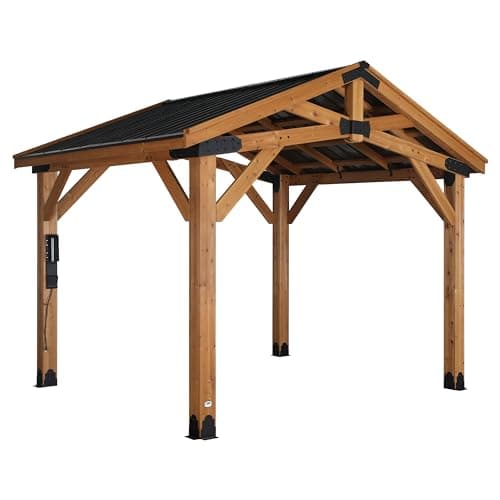 Backyard Discovery Norwood Cedar GazeboThe only gazebo we can find that publishes a 100 mph wind rating and a convertible snow figure — and it converts to roughly 56 lb/ft², several times any other hardtop here. | The only structure here that publishes both halves | 100 (Pro-Tect tested; product must be anchored per the manual) | $1,999.00 · View on Amazon |
| 02 | 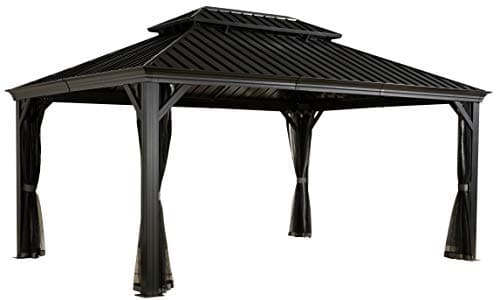 Sojag Messina Hardtop GazeboThe strongest warranty structure in the category — limited lifetime on the frame and 15 years on the finish — paired with wind and snow ratings the manufacturer describes but does not print. | The best rain roof, with nothing published about wind | Not published by manufacturer | $2,749.99 · View on Amazon |
| 03 | 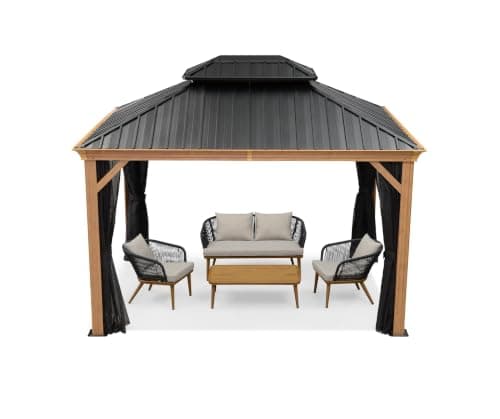 PURPLE LEAF Hardtop GazeboThe widest size range in the category and the lowest published wind rating on this site — 40 mph, from the same brand that rates its pergolas at 70. | Publishes a wind figure — and it is the lowest here | 40 | $1,065.00 · View on Amazon |
| 04 | 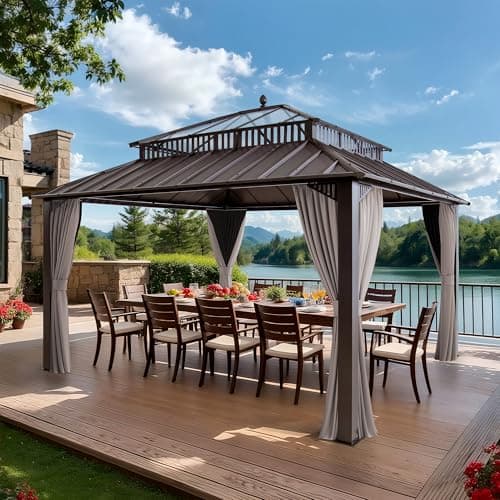 Sunjoy Kingston 12 x 14 Aluminum Gazebo with Steel RoofPublishes both a wind rating and a snow figure — but the snow figure is a whole-roof total, not a per-square-foot load, so it is not directly comparable to anyone else's. | The wind figure is real; the vent is the rain problem | 50 | $1,017.00 · View on Amazon |
| 05 | 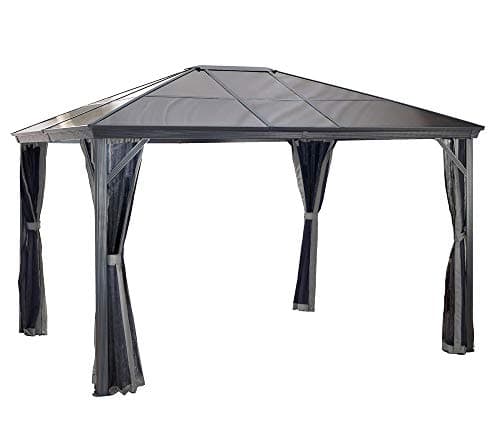 Sojag Verona Hardtop GazeboA polycarbonate-roofed alternative to the Messina that trades snow-shedding confidence for daylight underneath. | Rain cover without making a dark corner darker | Not published by manufacturer | $1,099.99 · View on Amazon |
| 06 | 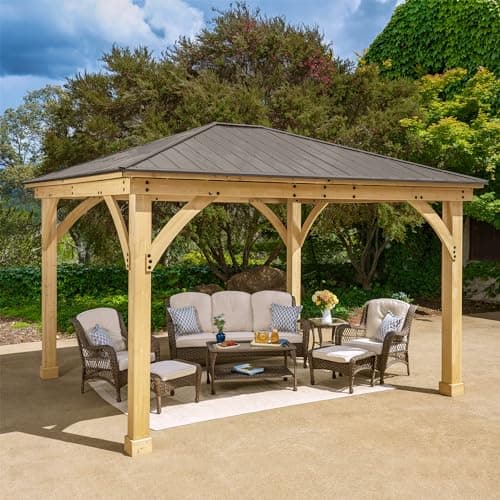 Yardistry Meridian 12 x 14 Cedar GazeboThe only structure here with 6x6 cedar posts and a five-year rot warranty — and it publishes no wind or snow figure at all. | The roof that cannot rust, and nothing published at all | Not published by manufacturer | $2,124.99 · View on Amazon |
The durability table
Every published figure we could source for these structures, in one place, with the manufacturer page each number came from. Where a cell reads "Not published by manufacturer", that figure does not exist in the manufacturer's own material — we do not estimate it and we do not copy one from another site.
| Model | Wind rating (mph) | Snow load | Frame | Roof | Anchoring required | Warranty | Spec source |
|---|---|---|---|---|---|---|---|
| Backyard Discovery Norwood Cedar GazeboTop pick | 100 (Pro-Tect tested; product must be anchored per the manual) | 6,700 lb across the roof, or up to 30 in. of snow (12 x 10 ft model — roughly 56 lb/ft²) | 100% cedar, 6 in. x 6 in. posts, galvanized steel hardware | 29-gauge galvanized steel peak roof, thermal insulated | Mandatory. Product must be anchored as specified in the instruction manual | 5 years | Backyard Discovery Norwood 12x10 product pageChecked 2026-09-26 |
| Sojag Messina Hardtop Gazebo | Not published by manufacturer | Not published by manufacturer | Powder-coated aluminum | Galvanized steel panels | Not published by manufacturer | 1 year limited on the gazebo; limited lifetime on the aluminum/steel frame; 15 years on the powder-coated finish | Sojag hardtop gazebo collectionChecked 2026-09-26 |
| PURPLE LEAF Hardtop Gazebo | 40 | 2,500 lb (published as a total, without a stated roof area) | Powder-coated aluminum alloy | Galvanized steel, single or double roof | Not published by manufacturer | Not published by manufacturer | PURPLE LEAF hardtop gazebo collectionChecked 2026-09-26 |
| Sunjoy Kingston 12 x 14 Aluminum Gazebo with Steel Roof | 50 | 3,000 lb across the entire roof (not a per-square-foot rating) | Aluminum and steel | Galvanized steel, two-tier vented | Pre-drilled ground plates: included stakes for soft ground, expansion bolts for hard surfaces (bolts not included) | Not published by manufacturer | Sunjoy Kingston product pageChecked 2026-09-26 |
| Sojag Verona Hardtop Gazebo | Not published by manufacturer | Not published by manufacturer | Powder-coated aluminum | UV-protected tinted polycarbonate panels | Not published by manufacturer | 1 year limited on the gazebo; limited lifetime on the frame; 15 years on the powder-coated finish | Sojag hardtop gazebo collectionChecked 2026-09-26 |
| Yardistry Meridian 12 x 14 Cedar Gazebo | Not published by manufacturer | Not published by manufacturer | 100% premium cedar, 6 in. x 6 in. posts with heavy corner gussets | Rust-proof coffee-brown aluminum | Post mounting brackets supplied; anchoring hardware is not, because mounting surfaces vary | 1 year on materials and workmanship; 5 years on lumber against rot and decay | Yardistry Meridian 12x14 product pageChecked 2026-09-26 |
Every pick in full
The only structure here that publishes both halves
Backyard Discovery Norwood Cedar Gazebo
The only gazebo we can find that publishes a 100 mph wind rating and a convertible snow figure — and it converts to roughly 56 lb/ft², several times any other hardtop here.
- Wind rating
- 100 (Pro-Tect tested; product must be anchored per the manual)
- Snow load
- 6,700 lb across the roof, or up to 30 in. of snow (12 x 10 ft model — roughly 56 lb/ft²)
- Frame
- 100% cedar, 6 in. x 6 in. posts, galvanized steel hardware
- Roof
- 29-gauge galvanized steel peak roof, thermal insulated
- Anchoring
- Mandatory. Product must be anchored as specified in the instruction manual
- Warranty
- 5 years
- Sizes
- 10 x 10, 12 x 10, 14 x 10, 14 x 12, 16 x 12, 20 x 12 and 24 x 12 ft
This is the whole point of the page in one entry. Every other structure below is published for wind or for rain and silent on the other; this one is the exception, and that is why it wins a combined ranking it would not necessarily win on either half alone.
100 mph, Pro-Tect tested, with the manufacturer stating the product must be anchored as the instruction manual specifies. That condition is half the specification and we treat it that way throughout the site — wind ratings explained covers why a bare number with no anchoring clause tells you almost nothing.
A 29-gauge galvanized steel peak roof, thermal insulated. A peak sheds and a flat panel ponds, and the insulation is the detail you notice at two in the morning: bare steel drums under heavy rain and sweats condensation on its underside, and an insulated panel does neither.
6,700 lb across the roof, or up to 30 in. of snow on the 12 x 10 ft model — roughly 56 lb/ft². Relevant here even if you never see snow, because a roof built to that load does not flex when a gust lifts it, and a roof that does not flex does not open its laps and start leaking.
6 in. x 6 in. cedar posts with galvanized steel hardware, five-year warranty, sizes 10 x 10 ft through 24 x 12 ft. The larger sizes matter in weather: rain that arrives at an angle goes straight under a narrow eave, so getting the seating well inside the roof line is the thing that actually keeps people dry.
The honest cons. It is a cedar kit, so it is a weekend build rather than an afternoon one, it is the most expensive structure on this page, and cedar standing in a wet climate is a maintenance contract — it wants sealing on a schedule and it will gray and check if you skip it. How long shade structures last sets out what that schedule actually buys you.
Skip it if: You want a structure you never touch again. In a genuinely wet climate, timber is the material that asks the most of you.
#ad Price shown as of November 11, 2026. How this site is funded
Specifications from Backyard Discovery Norwood 12x10 product page, checked 2026-09-26.
The best rain roof, with nothing published about wind
Sojag Messina Hardtop Gazebo
The strongest warranty structure in the category — limited lifetime on the frame and 15 years on the finish — paired with wind and snow ratings the manufacturer describes but does not print.
- Wind rating
- Not published by manufacturer
- Snow load
- Not published by manufacturer
- Frame
- Powder-coated aluminum
- Roof
- Galvanized steel panels
- Anchoring
- Not published by manufacturer
- Warranty
- 1 year limited on the gazebo; limited lifetime on the aluminum/steel frame; 15 years on the powder-coated finish
- Sizes
- 10 x 10 ft through 12 x 20 ft
If the question were only rain, this would be first. It is second because the manufacturer will not put a number on the other half, and on a storm page that silence is a cost.
Solid galvanized steel roof panels on a powder-coated aluminum frame. Nothing translucent to craze, nothing to go cloudy, nothing to repair — the simplest roof in the category to keep watertight, because the fewest things are happening in it.
Limited lifetime on the aluminum and steel frame, 15 years on the powder-coated finish, one year limited on the gazebo. In a wet climate the finish is what goes first on a cheap structure, and fifteen years on it is the single most informative warranty line in this category. Aluminum also does not rust, which over a decade of standing in rain is worth more than most published figures.
Sizes from 10 x 10 ft to 12 x 20 ft, including the long shallow shapes that sit against a house wall — where the building is already solving half your wind-driven-rain problem for you.
And now the cost: no published wind rating, no snow load, no anchoring specification. ShelterLogic describes the Messina's weather performance without printing a figure you can check. We are not going to estimate one. On the rain half this is the structure we would buy; on the wind half you are taking it on trust and anchoring it to the manual regardless.
Which makes it the right pick for a sheltered site and the wrong one for an exposed ridge. If your yard is open on the windward side, the Norwood above is the pick on this page that has a number behind it.
Skip it if: You need a wind figure to plan around, or your site is genuinely exposed. Nothing structural is published for this model.
#ad Price shown as of November 11, 2026. How this site is funded
Specifications from Sojag hardtop gazebo collection, checked 2026-09-26.
Publishes a wind figure — and it is the lowest here
PURPLE LEAF Hardtop Gazebo
The widest size range in the category and the lowest published wind rating on this site — 40 mph, from the same brand that rates its pergolas at 70.
- Wind rating
- 40
- Snow load
- 2,500 lb (published as a total, without a stated roof area)
- Frame
- Powder-coated aluminum alloy
- Roof
- Galvanized steel, single or double roof
- Anchoring
- Not published by manufacturer
- Warranty
- Not published by manufacturer
- Sizes
- 6 x 8 ft through 14 x 28 ft
Included because it publishes, and because the figure it publishes is the most useful warning on this page.
40 mph, from the brand that rates its own louvered pergolas at 70 to 72. Same company, same aluminum, different roof — and that gap is not an inconsistency, it is the physics this whole page is about. A pergola's slatted roof lets wind through. A solid gazebo roof is a wing. Gazebo wind ratings has the full chart and polycarbonate vs steel gazebo roofs covers what the panel choice changes.
Galvanized steel roof, single or double, on a powder-coated aluminum alloy frame. On the rain half that is a solid, properly shedding roof and there is nothing wrong with it. A double roof also gives you a vented tier, which helps a gust spill rather than lift — at the cost of a gap that driving rain can find.
The widest size range in the category, 6 x 8 ft through 14 x 28 ft. If you are covering an awkward footprint, this is usually the brand that has your dimension.
A snow load published as 2,500 lb with no stated roof area, which is close to unusable as a specification — a total without an area cannot be compared against anything. Snow load explained covers why the unit is the whole point.
The honest read: 40 mph is a windy afternoon, not a storm. It is roughly a strong breeze to near-gale on the Beaufort scale, and plenty of ordinary autumn weather exceeds it. Buy this for a sheltered yard where the real problem is rain, anchor it properly, and treat the published figure as the ceiling it is. No warranty term is published at all.
Skip it if: You are on an exposed site or anywhere that sees regular gales. 40 mph is the lowest published wind rating on this site and it is published for a reason.
#ad Price shown as of November 11, 2026. How this site is funded
Specifications from PURPLE LEAF hardtop gazebo collection, checked 2026-09-26.
The wind figure is real; the vent is the rain problem
Sunjoy Kingston 12 x 14 Aluminum Gazebo with Steel Roof
Publishes both a wind rating and a snow figure — but the snow figure is a whole-roof total, not a per-square-foot load, so it is not directly comparable to anyone else's.
- Wind rating
- 50
- Snow load
- 3,000 lb across the entire roof (not a per-square-foot rating)
- Frame
- Aluminum and steel
- Roof
- Galvanized steel, two-tier vented
- Anchoring
- Pre-drilled ground plates: included stakes for soft ground, expansion bolts for hard surfaces (bolts not included)
- Warranty
- Not published by manufacturer
- Sizes
- Roof 12 x 14 ft; base 11 x 13 ft; height 11.02 ft
The clearest illustration on this page that wind and rain pull a roof design in opposite directions.
50 mph published, with the anchoring method published alongside it — pre-drilled ground plates, stakes supplied for soft ground, expansion bolts for hard surfaces, bolts not included. A manufacturer that prints the anchoring method has thought about the structure staying put, and most here do not.
3,000 lb across the entire roof, published as a whole-roof total rather than a per-square-foot load, so it is not directly comparable to anyone else's figure.
A two-tier vented galvanized steel roof — and that vent is the trade. A gap between tiers lets a gust pass through instead of lifting the whole panel, which is genuinely why the wind figure is better than PURPLE LEAF's. It also lets wind-driven rain in, because rain that arrives at 40 degrees does not care that the gap was designed for hot air. For a grill it is the right roof; for sitting under in a squall it is the compromise.
Roof 12 x 14 ft, base 11 x 13 ft, height 11.02 ft. Note the difference between roof and base: the overhang is your eave, and the eave is what decides whether angled rain lands on the table or outside it.
No warranty term is published, which on a structure sold partly on its published ratings is a gap worth naming.
Skip it if: The weather you actually get is driving rain rather than gusts. A vented tier is an opening, and openings are where blown rain gets in.
#ad Price shown as of November 11, 2026. How this site is funded
Specifications from Sunjoy Kingston product page, checked 2026-09-26.
Rain cover without making a dark corner darker
Sojag Verona Hardtop Gazebo
A polycarbonate-roofed alternative to the Messina that trades snow-shedding confidence for daylight underneath.
- Wind rating
- Not published by manufacturer
- Snow load
- Not published by manufacturer
- Frame
- Powder-coated aluminum
- Roof
- UV-protected tinted polycarbonate panels
- Anchoring
- Not published by manufacturer
- Warranty
- 1 year limited on the gazebo; limited lifetime on the frame; 15 years on the powder-coated finish
- Sizes
- Not published by manufacturer
The Verona is the Messina's argument with a different panel, and the reason to consider it is light rather than weather.
UV-protected tinted polycarbonate panels. Solid, so they shed rain exactly as steel does — the water does not know the difference — but translucent, which matters if the structure is going against a north wall or over a space that is already short of daylight. A steel roof there turns a dim corner into a cave.
Limited lifetime on the frame, 15 years on the powder-coated finish, one year on the gazebo. Identical to the Messina, on the same powder-coated aluminum.
The cons are two, and the first is the same as the Messina's. No wind rating, no snow load, no anchoring specification published. The second is material: polycarbonate is quieter under rain than bare steel but it is the panel people worry about under sustained load, and it creeps rather than dents. In a climate where winter arrives wet rather than frozen that matters less than it sounds; in snow country it matters a lot.
Sojag does not publish a size range for this model either, so check the specific listing before you plan a slab. The Messina's 10 x 10 ft to 12 x 20 ft range is the one the manufacturer prints.
Skip it if: Snow is the real load rather than rain. [Best gazebos for snow load](/gazebos/best-gazebos-for-snow-load) is the page for that question.
#ad Price shown as of November 11, 2026. How this site is funded
Specifications from Sojag hardtop gazebo collection, checked 2026-09-26.
The roof that cannot rust, and nothing published at all
Yardistry Meridian 12 x 14 Cedar Gazebo
The only structure here with 6x6 cedar posts and a five-year rot warranty — and it publishes no wind or snow figure at all.
- Wind rating
- Not published by manufacturer
- Snow load
- Not published by manufacturer
- Frame
- 100% premium cedar, 6 in. x 6 in. posts with heavy corner gussets
- Roof
- Rust-proof coffee-brown aluminum
- Anchoring
- Post mounting brackets supplied; anchoring hardware is not, because mounting surfaces vary
- Warranty
- 1 year on materials and workmanship; 5 years on lumber against rot and decay
- Sizes
- Roof 12 x 14 ft; base 10 ft 10⅜ in. x 12 ft 10⅜ in.
Last on a page ranked by published figures, because it publishes none — and included anyway, because one of its specifications is genuinely the best answer to a wet climate.
A rust-proof coffee-brown aluminum roof. Steel panels are galvanized, and galvanizing is a coating: scratch it during assembly, or let a cut edge sit wet for five winters, and that is where rust starts. Aluminum cannot rust at a scratch at all. In a genuinely wet climate — coastal, or anywhere it rains ten months a year — that is a real durability advantage over every steel roof on this page.
100% premium cedar with 6 in. x 6 in. posts and heavy corner gussets. Structurally this is in the Norwood's class, and the gussets are the detail most kits skip; they are what stops a post-and-beam frame racking when a gust tries to parallelogram it.
One year on materials and workmanship, five years on the lumber against rot and decay. The tiering is the informative part: the manufacturer is confident about the cedar and ordinary about everything else.
Post mounting brackets supplied, anchoring hardware not — because mounting surfaces vary. Budget and buy that separately before the build day; brackets are useless without the right fixing for your surface, and how to anchor a gazebo covers each one.
And the problem: Yardistry publishes no wind rating and no snow load. For a structure built this heavily that is frustrating rather than damning, but on a storm page it is why this sits last. You are buying visible mass and an un-rustable roof, and taking the loads entirely on trust.
Skip it if: You want the weather performance in writing. Nothing about this gazebo's wind or snow behavior is published by its manufacturer.
#ad Price shown as of November 11, 2026. How this site is funded
Specifications from Yardistry Meridian 12x14 product page, checked 2026-09-26.
Why wind and rain is a harder question than either alone
Most buying advice treats these as two filters applied to the same list. They are closer to opposites, and understanding why is what stops you buying the wrong structure for your actual weather.
Rain wants a solid, continuous, well-pitched roof with a generous overhang. Every one of those words adds sail area, adds weight high up, and adds surface for a gust to push against. The best possible rain roof is the worst possible wind profile.
Wind wants a roof that lets air through, or spills it. A pergola's slatted roof is close to ideal and it keeps nobody dry. A vented two-tier gazebo roof is the compromise most manufacturers reach for — and the vent that lets a gust escape is an opening that angled rain comes through.
The number that proves it is PURPLE LEAF's. The same brand, in the same aluminum, publishes 70 to 72 mph for its louvered pergolas and 40 mph for its hardtop gazebos. Nothing changed except the roof. That single comparison is the most useful thing on this page.
And storms bring a third thing nobody rates for: cyclic loading. A gust is not a steady push, it is a rapid series of pushes and releases, and that works fasteners loose over a season in a way steady wind does not. It is why anchoring and a periodic bolt check matter more in a stormy climate than the headline rating does.
The four things we ranked on
In this order. Each one is either published by the manufacturer or it is not, and where it is not we say so rather than estimating it.
- A published wind rating with its anchoring condition attached. Backyard Discovery publishes 100 mph with the product required to be anchored per the manual; Sunjoy publishes 50 mph alongside the actual anchoring method. Both are more credible than a bare number, and far more credible than no number.
- A solid, unvented, pitched roof panel. Solid sheds, vented leaks in a crosswind, flat ponds. A ponded panel is also a loaded panel — water is heavy, and the sag that collects it gets deeper as it fills.
- Sides you can close on the windward face. This is the part almost no buying guide mentions and it does more for comfort in a squall than any roof spec. Curtains, netting panels or a wall kit on one or two sides turns a structure you abandon in bad weather into one you sit in.
- Frame and fixings that do not corrode. A storm climate is a wet climate, and the slow failure is galvanic and electrochemical rather than structural: rust at a cut steel edge, a lifted powder coat, a seized bolt you cannot re-torque. Aluminum frames and aluminum roofs have a real advantage here that no rating captures.
One thing we deliberately did not rank on: a claimed "waterproof" or "weather-resistant" label. Those words are unregulated and every structure here carries one. The panel material and the roof geometry are checkable; the adjective is not.
What each one publishes, side by side
Manufacturer figures only, from the sources listed at the foot of this page. Blanks are blanks — where a maker publishes nothing, the cell says so.
| Gazebo | Published wind | Roof | Frame | Warranty |
|---|---|---|---|---|
| Backyard Discovery Norwood | 100 mph, anchored per manual | 29-gauge galvanized steel peak, thermal insulated | 6 x 6 in. cedar posts | 5 years |
| Sojag Messina | Not published by manufacturer | Solid galvanized steel panels | Powder-coated aluminum | Lifetime frame, 15 years finish, 1 year gazebo |
| PURPLE LEAF hardtop | 40 mph | Galvanized steel, single or double | Powder-coated aluminum alloy | Not published by manufacturer |
| Sunjoy Kingston 12 x 14 | 50 mph | Two-tier vented galvanized steel | Aluminum and steel | Not published by manufacturer |
| Sojag Verona | Not published by manufacturer | UV-protected tinted polycarbonate | Powder-coated aluminum | Lifetime frame, 15 years finish, 1 year gazebo |
| Yardistry Meridian 12 x 14 | Not published by manufacturer | Rust-proof aluminum | 6 x 6 in. cedar posts, corner gussets | 1 year materials, 5 years lumber against rot |
Read the blanks as the finding. Four of the six publish no wind figure. Two of those six publish nothing structural at all. This is not a reporting failure on our part; it is the state of the category, and it is why a page like this ranks on disclosure as much as on performance.
Setting one up so it survives a storm
The specification decides the ceiling. Everything below decides whether you ever get near it.
- 01Anchor it to the manufacturer's manual, to a surface that can take the load. Every wind rating on this page is published as conditional on anchoring, and an unanchored structure does not have a reduced rating — it has no rating, because the number was never measured that way. How to anchor a gazebo covers concrete, pavers, grass and decks.
- 02Site it with the windward side in mind. A fence, a hedge or the house on the prevailing-wind face does more than any upgrade in the product list, and a structure tucked against a wall has one less face to lift. Best shade structures for windy areas covers siting properly.
- 03Check the roof laps and the bolt torque at the start of every season. Cyclic gust loading works fasteners loose, and a lap that has opened two millimetres is a leak you will find in the first heavy rain. This is a fifteen-minute job that prevents most of the problems on why gazebo roofs leak.
- 04Keep the gutter line and the ground clear. Water that cannot leave the structure's footprint sits against post bases, and a post base standing in water is where a cedar frame starts to go and a steel foot starts to rust.
- 05Close the windward side before the weather, not during it. Curtains and netting panels are cheap, and the difference between a dry table and a wet one in a squall is almost always one closed face rather than a better roof.
- 06Take anything fabric down ahead of a named storm. Canopies, side curtains and shade panels are all sails, and they transfer their load straight into the frame's fixings.
What we would actually buy
Three situations, because the right answer here genuinely depends on which half of the weather is your real problem.
Exposed site, real wind, rain that arrives sideways: the Backyard Discovery Norwood. It is the only structure on this page with a published figure for both halves, it is the only 100 mph rating in the category, and the insulated steel peak roof is the best rain panel here. It costs the most, it is a build, and the cedar wants maintenance. Those are the prices of the only complete answer available.
Sheltered yard where rain is the problem and wind is an occasional nuisance: the Sojag Messina. Solid steel panels, an aluminum frame that cannot rust, and the longest warranty document in the category. Accept that nothing structural is published, anchor it to the manual anyway, and spend the saving on side curtains.
A wet climate rather than a stormy one — coastal, or somewhere it simply rains: the Yardistry Meridian. The aluminum roof cannot rust at a scratch, which over fifteen years of rain is worth more than most ratings, and the 6x6 cedar frame is as heavy as anything here. You are buying it on mass and materials, not on published figures, and you should know that going in.
One honest note on how this page is paid for. Every product link here earns the same rate, so nothing above is ranked by what it pays. The ranking is published figures first, and the entry we would most like to be able to recommend without caveats — the Messina — sits second precisely because its manufacturer will not print a number.
What we cut, and why
Every model below was a genuine candidate and did not make the list. The reason is stated in each case, because a shortlist with no visible rejections is not evidence of a selection process.
- Soft-top gazebos with a fabric canopy
- A fabric roof is the sail this page is warning about, and it is also a consumable. No canopy carries a wind rating, a slack canopy flogs and destroys itself in a single storm, and water pools in any panel that has stretched. Right structure for shade and bugs; wrong structure for weather. [Hardtop vs soft top](/gazebos/hardtop-vs-soft-top-gazebos) works through the trade.
- Outsunny 10 x 13 patio gazebo with netting and curtains
- The curtains are genuinely useful against blown rain — closing the windward side is the single most effective thing you can do about angled water — but the manufacturer states plainly that it is not meant for extreme weather. On a page about storms, that sentence is disqualifying.
- Commercial pop-up canopies
- Designed to be taken down, which is the opposite of what this page is ranking. The best of them publish a wind figure in the low 50s mph and all of them assume you are standing there to drop the legs. [Pop-up gazebo wind ratings](/gazebos/pop-up-gazebo-wind-rating) covers what those numbers mean.
- Screen shelters and portable gazebos
- Mesh walls spill wind well, which is a real advantage, and a fabric roof over an unanchored hub frame is still a fabric roof over an unanchored hub frame. These are camping structures and they are good ones — [best gazebos for camping](/gazebos/best-gazebos-for-camping) is the right page — but they are not storm structures.
- Carport-style tube-and-tarp shelters
- The better ones publish respectable figures for what they are, including snow loads in genuine pounds per square foot. They are still a tarp over a tube frame, and a tarp in sustained wind-driven rain stretches, ponds and then tears at a grommet.
Questions people ask
What is the best gazebo for wind and rain together?
Why do gazebos have lower wind ratings than pergolas?
Does a vented two-tier roof help or hurt in a storm?
Is 40 mph a usable wind rating?
Should I pick a steel or a polycarbonate roof for rain?
Will side curtains keep wind-driven rain out?
Does anchoring really change the wind rating?
Is an aluminum roof better than steel in a wet climate?
Can a soft-top gazebo handle wind and rain?
How often should I check a gazebo in a stormy climate?
Does closing one side really help that much?
Where these figures came from
- Backyard Discovery Norwood 12x10 cedar gazebo — 6 in. x 6 in. cedar posts with galvanized steel hardware, 100 mph Pro-Tect tested with the product required to be anchored per the instruction manual, 6,700 lb across the roof or up to 30 in. of snow on the 12 x 10 ft model, 29-gauge thermal-insulated galvanized steel peak roof, 5-year warranty, sizes 10 x 10 to 24 x 12 ft
- Sojag hardtop gazebo range — powder-coated aluminum frame with galvanized steel roof panels (Messina) and UV-protected tinted polycarbonate panels (Verona), 1 year limited on the gazebo, limited lifetime on the aluminum/steel frame, 15 years on the powder-coated finish, Messina sizes 10 x 10 to 12 x 20 ft; no wind rating, snow load or anchoring specification published
- PURPLE LEAF hardtop gazebo collection — 40 mph wind rating, a 2,500 lb snow load published as a total without a stated roof area, powder-coated aluminum alloy frame, galvanized steel single or double roof, sizes 6 x 8 to 14 x 28 ft
- PURPLE LEAF louvered pergola collection — 70 to 72 mph published for the louvered pergolas, cited here as the same-brand, same-material comparison against the 40 mph hardtop gazebo figure
- Sunjoy Kingston 12 x 14 aluminum gazebo — 50 mph wind rating, 3,000 lb across the entire roof, two-tier vented galvanized steel roof, aluminum and steel frame, pre-drilled ground plates with stakes supplied for soft ground and expansion bolts for hard surfaces (bolts not included), roof 12 x 14 ft and base 11 x 13 ft
- Yardistry Meridian 12 x 14 cedar gazebo — 100% premium cedar with 6 in. x 6 in. posts and heavy corner gussets, rust-proof coffee-brown aluminum roof, post mounting brackets supplied without anchoring hardware, 1 year on materials and workmanship with 5 years limited on lumber against rot and decay; no wind rating or snow load published
- Outsunny 10 x 13 patio gazebo with netting and curtains — double-tier polyester canopy with published water drainage, aluminum frame, with the manufacturer stating it is not meant for extreme weather
Found an error? Tell us and we will correct it within seven days and note the change on the page with a dated line — see our editorial policy.