The best gazebos for high winds
Only two gazebos in this comparison publish a wind rating at all. That absence is the most important thing on this page, and it changes what "best for wind" can honestly mean.
By Ryder M. · Published · Last updated
We compare published manufacturer specifications, warranty terms and owner-reported failure modes. We have not physically tested these structures. How we judge shade structures
Slat & Shade earns a commission on qualifying purchases made through links on this page. It costs you nothing extra and never changes what we recommend. Full disclosure
Part of Hardtop Gazebos

The short answer
The Backyard Discovery Norwood is the pick: a published 100 mph wind rating, double anything else in this category, on 6x6 cedar posts with anchoring made mandatory by the manufacturer. Among aluminum-framed gazebos the Sunjoy Kingston leads at 50 mph. Unanchored, neither has a rating at all — the anchor matters more than the model.
Our picks at a glance
| # | Structure | Best for | Wind rating | Price |
|---|---|---|---|---|
| 01 |  Backyard Discovery Norwood Cedar GazeboThe only gazebo we can find that publishes a 100 mph wind rating and a convertible snow figure — and it converts to roughly 56 lb/ft², several times any other hardtop here. | Top pick for wind | 100 (Pro-Tect tested; product must be anchored per the manual) | Check price on Amazon |
| 02 |  Sunjoy Kingston 12 x 14 Aluminum Gazebo with Steel RoofPublishes both a wind rating and a snow figure — but the snow figure is a whole-roof total, not a per-square-foot load, so it is not directly comparable to anyone else's. | Best aluminum-framed figure | 50 | Check price on Amazon |
| 03 |  Sunjoy 13 x 15 Hardtop Gazebo with Two-Tier Steel RoofThe largest footprint in Sunjoy's published-rating range, carrying the same 50 mph wind figure as its smaller siblings. | Best larger footprint with a rating | 50 | Check price on Amazon |
| 04 | 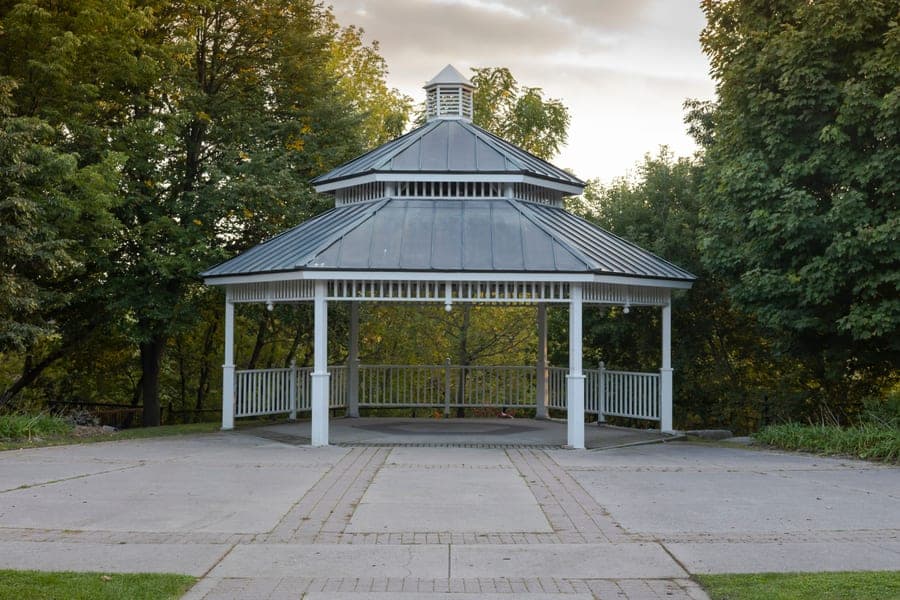 Sojag Messina Hardtop GazeboThe strongest warranty structure in the category — limited lifetime on the frame and 15 years on the finish — paired with wind and snow ratings the manufacturer describes but does not print. | Best build with no published figure | Not published by manufacturer | Check price on Amazon |
| 05 | 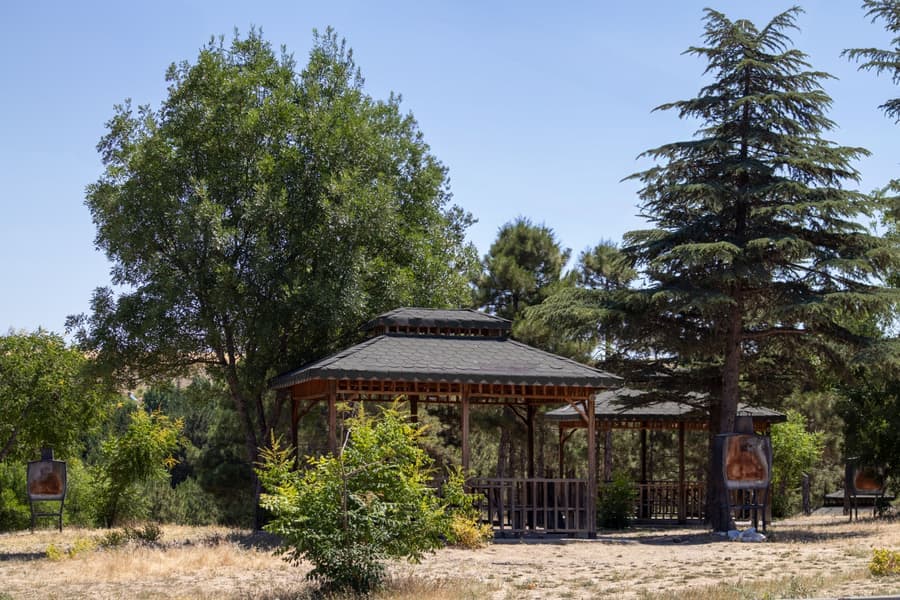 Yardistry Meridian 12 x 14 Cedar GazeboThe only structure here with 6x6 cedar posts and a five-year rot warranty — and it publishes no wind or snow figure at all. | Best mass and structure | Not published by manufacturer | Check price on Amazon |
| 06 |  PURPLE LEAF Hardtop GazeboThe widest size range in the category and the lowest published wind rating on this site — 40 mph, from the same brand that rates its pergolas at 70. | Lowest published rating here | 40 | Check price on Amazon |
The durability table
Every published figure we could source for these structures, in one place, with the manufacturer page each number came from. Where a cell reads "Not published by manufacturer", that figure does not exist in the manufacturer's own material — we do not estimate it and we do not copy one from another site.
| Model | Wind rating (mph) | Snow load | Frame | Roof | Anchoring required | Warranty | Spec source |
|---|---|---|---|---|---|---|---|
| Backyard Discovery Norwood Cedar GazeboTop pick | 100 (Pro-Tect tested; product must be anchored per the manual) | 6,700 lb across the roof, or up to 30 in. of snow (12 x 10 ft model — roughly 56 lb/ft²) | 100% cedar, 6 in. x 6 in. posts, galvanized steel hardware | 29-gauge galvanized steel peak roof, thermal insulated | Mandatory. Product must be anchored as specified in the instruction manual | 5 years | Backyard Discovery Norwood 12x10 product pageChecked 2026-09-26 |
| Sunjoy Kingston 12 x 14 Aluminum Gazebo with Steel Roof | 50 | 3,000 lb across the entire roof (not a per-square-foot rating) | Aluminum and steel | Galvanized steel, two-tier vented | Pre-drilled ground plates: included stakes for soft ground, expansion bolts for hard surfaces (bolts not included) | Not published by manufacturer | Sunjoy Kingston product pageChecked 2026-09-26 |
| Sunjoy 13 x 15 Hardtop Gazebo with Two-Tier Steel Roof | 50 | 3,400 lb across the entire roof (not a per-square-foot rating) | Steel or aluminum depending on configuration | Two-tier vented steel with woodgrain finish | Not published by manufacturer | Not published by manufacturer | Sunjoy hardtop gazebo collectionChecked 2026-09-26 |
| Sojag Messina Hardtop Gazebo | Not published by manufacturer | Not published by manufacturer | Powder-coated aluminum | Galvanized steel panels | Not published by manufacturer | 1 year limited on the gazebo; limited lifetime on the aluminum/steel frame; 15 years on the powder-coated finish | Sojag hardtop gazebo collectionChecked 2026-09-26 |
| Yardistry Meridian 12 x 14 Cedar Gazebo | Not published by manufacturer | Not published by manufacturer | 100% premium cedar, 6 in. x 6 in. posts with heavy corner gussets | Rust-proof coffee-brown aluminum | Post mounting brackets supplied; anchoring hardware is not, because mounting surfaces vary | 1 year on materials and workmanship; 5 years on lumber against rot and decay | Yardistry Meridian 12x14 product pageChecked 2026-09-26 |
| PURPLE LEAF Hardtop Gazebo | 40 | 2,500 lb (published as a total, without a stated roof area) | Powder-coated aluminum alloy | Galvanized steel, single or double roof | Not published by manufacturer | Not published by manufacturer | PURPLE LEAF hardtop gazebo collectionChecked 2026-09-26 |
Every pick in full
Top pick for wind
Backyard Discovery Norwood Cedar Gazebo
The only gazebo we can find that publishes a 100 mph wind rating and a convertible snow figure — and it converts to roughly 56 lb/ft², several times any other hardtop here.
- Wind rating
- 100 (Pro-Tect tested; product must be anchored per the manual)
- Snow load
- 6,700 lb across the roof, or up to 30 in. of snow (12 x 10 ft model — roughly 56 lb/ft²)
- Frame
- 100% cedar, 6 in. x 6 in. posts, galvanized steel hardware
- Roof
- 29-gauge galvanized steel peak roof, thermal insulated
- Anchoring
- Mandatory. Product must be anchored as specified in the instruction manual
- Warranty
- 5 years
- Sizes
- 10 x 10, 12 x 10, 14 x 10, 14 x 12, 16 x 12, 20 x 12 and 24 x 12 ft
100 mph, Pro-Tect tested — double the next-best figure in this category, and the highest published wind rating for any structure on this site alongside its Beaumont pergola sibling. It also comes with the condition attached in the strongest form we have seen: the product must be anchored as specified in the instruction manual.
What makes the figure credible rather than surprising is the construction. 100% cedar with 6 in. x 6 in. posts and galvanized steel hardware, under a 29-gauge galvanized steel peak roof. Wind failure in a four-post structure is usually a racking failure — the frame parallelograms before anything breaks — and post section is the direct answer to that. A 6x6 cedar post is a different structural member from a 3-inch aluminum tube.
This is also the product that corrected our own reading of this category. Every other hardtop gazebo we track has an aluminum frame and publishes 40-50 mph, which made it easy to conclude that a solid roof caps the figure. The Norwood shows that frame section is the first-order variable and roof type is the second-order one within a given frame material — the PURPLE LEAF pergola-versus-gazebo pair still isolates the roof effect cleanly, because it holds the frame constant.
It publishes a snow figure too: 6,700 lb across the roof on the 12 x 10 model, or up to 30 inches of snow. Over 120 ft² that converts to roughly 56 lb/ft², which is several times any aluminum hardtop here. Five-year warranty, sizes from 10 x 10 to 24 x 12 ft.
The honest caveat: it is cedar, and cedar needs sealing. Re-seal every two to three years and this outlasts the aluminum options; neglect it and it grays, checks at the through-bolts and rots at the end grain. There is no partial credit on that.
Skip it if: You will not re-seal cedar every two to three years, or you want a maintenance-free frame — the aluminum options below need washing and nothing else.
#ad Price shown as of September 26, 2026. How this site is funded
Specifications from Backyard Discovery Norwood 12x10 product page, checked 2026-09-26.
Best aluminum-framed figure
Sunjoy Kingston 12 x 14 Aluminum Gazebo with Steel Roof
Publishes both a wind rating and a snow figure — but the snow figure is a whole-roof total, not a per-square-foot load, so it is not directly comparable to anyone else's.
- Wind rating
- 50
- Snow load
- 3,000 lb across the entire roof (not a per-square-foot rating)
- Frame
- Aluminum and steel
- Roof
- Galvanized steel, two-tier vented
- Anchoring
- Pre-drilled ground plates: included stakes for soft ground, expansion bolts for hard surfaces (bolts not included)
- Warranty
- Not published by manufacturer
- Sizes
- Roof 12 x 14 ft; base 11 x 13 ft; height 11.02 ft
It leads the aluminum-framed field because it is the only one in that group that treats wind as a specification. 50 mph published rating — the highest we can source for an aluminum hardtop gazebo — and, more usefully, a published account of how it expects to be held down.
That account is: pre-drilled ground plates with three holes each, included stakes for soft ground, and expansion bolts for hard surfaces not included. Read that as the instruction it is. The 50 mph figure applies to a gazebo fixed through all three holes in all four plates with the correct fixing for the surface it stands on, and the fixing for concrete or a deck is a separate purchase.
Frame is aluminum and steel; roof is a two-tier vented galvanized steel panel. The vented two-tier roof is a genuine wind feature and not just styling — the gap between tiers gives rising air somewhere to go instead of pressurizing under the roof plane, which is the same principle as opening the louvers on a pergola.
It also publishes a snow figure, 3,000 lb across a 12 x 14 ft roof, which converts to roughly 17.9 lb/ft². Wind and snow arrive together, and a loaded roof in wind is a worse case than either alone, so having both numbers from one manufacturer is worth more than the sum of the parts.
Skip it if: You need a footprint other than 12 x 14 ft — this model is that size only, and the 13 x 15 is the next step up.
#ad Price shown as of September 26, 2026. How this site is funded
Specifications from Sunjoy Kingston product page, checked 2026-09-26.
Best larger footprint with a rating
Sunjoy 13 x 15 Hardtop Gazebo with Two-Tier Steel Roof
The largest footprint in Sunjoy's published-rating range, carrying the same 50 mph wind figure as its smaller siblings.
- Wind rating
- 50
- Snow load
- 3,400 lb across the entire roof (not a per-square-foot rating)
- Frame
- Steel or aluminum depending on configuration
- Roof
- Two-tier vented steel with woodgrain finish
- Anchoring
- Not published by manufacturer
- Warranty
- Not published by manufacturer
- Sizes
- 13 x 15 ft
The same 50 mph published rating on a larger footprint, which is the useful thing about it: wind ratings do not usually scale down gracefully as a structure gets bigger, because a larger roof is a larger sail on the same number of legs. Sunjoy publishing the same figure at 13 x 15 ft as at 12 x 14 is a reasonable signal that the frame was sized for it.
Snow capacity is published as 3,400 lb across the entire roof. Over 195 ft² that is roughly 17.4 lb/ft² — marginally below the Kingston's 17.9, which is what you would expect from spreading a slightly larger total over a proportionally larger area, and close enough that the two are effectively equivalent.
Roof is a two-tier vented steel panel with a woodgrain finish, with removable mesh netting sidewalls. Take the netting off before weather. Sidewalls, curtains and netting convert an open-sided gazebo into a far larger sail, and they are the easiest precaution in the category to take and the most commonly skipped.
Frame material varies by configuration between steel and aluminum. No warranty term and no anchoring provision is published for this one, which is where it falls behind the Kingston.
Skip it if: You want the documented anchoring provision — that is published for the Kingston and not for this model.
#ad Price shown as of September 26, 2026. How this site is funded
Specifications from Sunjoy hardtop gazebo collection, checked 2026-09-26.
Best build with no published figure
Sojag Messina Hardtop Gazebo
The strongest warranty structure in the category — limited lifetime on the frame and 15 years on the finish — paired with wind and snow ratings the manufacturer describes but does not print.
- Wind rating
- Not published by manufacturer
- Snow load
- Not published by manufacturer
- Frame
- Powder-coated aluminum
- Roof
- Galvanized steel panels
- Anchoring
- Not published by manufacturer
- Warranty
- 1 year limited on the gazebo; limited lifetime on the aluminum/steel frame; 15 years on the powder-coated finish
- Sizes
- 10 x 10 ft through 12 x 20 ft
Sojag describes the Messina as wind resistant and publishes no wind rating. On a page about high winds that has to count against it, and it is worth being clear about what it does not disqualify.
What Sojag publishes instead is the category's strongest warranty: one year limited on the gazebo, a limited lifetime warranty on the aluminum and steel frame, and fifteen years on the powder-coated finish. A manufacturer willing to cover a frame indefinitely is a manufacturer with claim data suggesting the frame does not fail — and in a wind context, structural failure of the frame is precisely the risk. That is indirect evidence, and it is evidence.
The build is a galvanized steel panel roof on a powder-coated aluminum frame, in sizes from 10 x 10 to 12 x 20. Choose the smaller end of that range for an exposed site. Roof area is the variable you control: a 10 x 10 collects less than half the wind load of a 12 x 20 on a similar frame, and on a windy site that matters more than any specification difference between brands.
Our honest position: if you need a number to check against a local requirement, buy the Sunjoy. If you want the structure most likely to still be standing and covered in ten years, the Messina is defensible even here.
Skip it if: You need a published figure. "Wind resistant" with no number attached is not something you can check against anything.
#ad Price shown as of September 26, 2026. How this site is funded
Specifications from Sojag hardtop gazebo collection, checked 2026-09-26.
Best mass and structure
Yardistry Meridian 12 x 14 Cedar Gazebo
The only structure here with 6x6 cedar posts and a five-year rot warranty — and it publishes no wind or snow figure at all.
- Wind rating
- Not published by manufacturer
- Snow load
- Not published by manufacturer
- Frame
- 100% premium cedar, 6 in. x 6 in. posts with heavy corner gussets
- Roof
- Rust-proof coffee-brown aluminum
- Anchoring
- Post mounting brackets supplied; anchoring hardware is not, because mounting surfaces vary
- Warranty
- 1 year on materials and workmanship; 5 years on lumber against rot and decay
- Sizes
- Roof 12 x 14 ft; base 10 ft 10⅜ in. x 12 ft 10⅜ in.
No published wind rating, and the most substantial physical structure on this page: 100% cedar with 6 in. x 6 in. posts and heavy corner gussets. Nothing else here has posts that size, and in wind, section size and connection stiffness are what resist the racking that pulls a frame apart.
The gussets are worth noticing specifically. Wind failure in a four-post structure is usually a racking failure — the frame parallelograms before anything breaks — and corner gussets are the direct answer to that. It is a construction detail rather than a marketing figure, and it is the kind of thing that does not show up in a spec table.
Mass helps too, and only up to a point. A heavy cedar structure resists sliding well. It does very little against uplift, which is the force that actually takes structures apart, and uplift is resisted by the anchor and nothing else. Yardistry supplies post mounting brackets and explicitly does not supply anchoring hardware, because mounting surfaces vary — so the fixings are your decision and the important one.
Warranty: one year on materials and workmanship, five years on the lumber against rot and decay.
Skip it if: You want a figure, or you will not maintain cedar. Neither is a small caveat on an exposed site.
#ad Price shown as of September 26, 2026. How this site is funded
Specifications from Yardistry Meridian 12x14 product page, checked 2026-09-26.
Lowest published rating here
PURPLE LEAF Hardtop Gazebo
The widest size range in the category and the lowest published wind rating on this site — 40 mph, from the same brand that rates its pergolas at 70.
- Wind rating
- 40
- Snow load
- 2,500 lb (published as a total, without a stated roof area)
- Frame
- Powder-coated aluminum alloy
- Roof
- Galvanized steel, single or double roof
- Anchoring
- Not published by manufacturer
- Warranty
- Not published by manufacturer
- Sizes
- 6 x 8 ft through 14 x 28 ft
Included because it publishes a figure and the figure is informative: 40 mph, the lowest on this page, from a brand that publishes 70-72 mph for its louvered pergolas.
That pairing is the clearest single demonstration of why this category rates lower than pergolas do. Same company, same powder-coated aluminum, same factory — and a 30 mph gap that comes down entirely to a solid roof versus an open one. It is not a quality gap. If you understand that pairing, you understand most of wind ratings explained.
The range itself is the reason to consider it: 6 x 8 ft through 14 x 28 ft, in more configurations than anyone else here. And on a windy site the small end of that range is genuinely worth considering — a 6 x 8 grill shelter presents a fraction of the roof area of a dining-sized gazebo, and reducing the sail is more effective than any brand-level specification difference.
Snow is published as 2,500 lb with no roof area stated, across a range spanning 6 x 8 to 14 x 28, which makes it unusable as a specification. No warranty term is published.
Skip it if: Your site is genuinely exposed and you want the highest published number — 40 mph is the lowest here, with no warranty term to fall back on.
#ad Price shown as of September 26, 2026. How this site is funded
Specifications from PURPLE LEAF hardtop gazebo collection, checked 2026-09-26.
What "best for high winds" can honestly mean here
Three of the six gazebos on this page publish a wind rating. Three do not. That means a ranking built purely on published figures would have three entries, and a ranking that filled the gaps with estimates would be fiction.
So this page ranks on published figures where they exist, and on the structural and warranty evidence that bears on wind where they do not: frame and post dimensions, corner connection detail, roof venting, anchoring provision, and whether the manufacturer is willing to cover the frame long-term. Those are proxies. We are labeling them as proxies rather than dressing them up as a wind ranking.
The published spread is 40 mph to 100 mph, and it tracks frame material far more closely than roof type. Every aluminum-framed gazebo here sits at 40-50; the cedar-framed Norwood with 6x6 posts publishes 100. That is a genuinely large difference and it is the clearest signal available on this page.
It still is not the largest difference in play. The gap between anchored and unanchored is the entire rating — not a reduction, the whole thing, because the figure was never measured in that condition. Choosing carefully between these six is worth less than fixing whichever one you buy to the ground properly. That ordering is not intuitive and it is the most useful thing here.
Why the aluminum figures are low and the cedar one is not
Someone comparing a 50 mph aluminum gazebo against a 100 mph pergola could reasonably conclude the gazebo is badly made. The picture is more specific than that, and it is worth understanding because it changes what you should buy.
Roof type is real. An open or slatted pergola roof lets air pass through it; a solid gazebo roof does not, so the whole roof plane collects wind load and transfers it down the posts into the anchors. The clean demonstration is PURPLE LEAF publishing 70-72 mph for its louvered pergolas and 40 mph for its hardtop gazebos — one company, one aluminum, one factory, a 30 mph spread with the frame held constant. The roof is the only variable in that pair.
Frame section is bigger. The Norwood carries a solid steel roof and publishes 100 mph, because it does it on 6 in. x 6 in. cedar posts rather than aluminum tube. Its Beaumont pergola sibling publishes the same 100 mph on an open roof. So within cedar the roof barely moves the figure; within aluminum it moves it by 30 mph. Frame first, roof second.
Which gives you a real option if wind is your binding constraint: consider whether you want a hardtop at all. A louvered pergola with the louvers opened before a storm gives you rain cover most of the time and a far better wind figure. Pergola vs gazebo is the comparison, and best pergolas for high winds is the alternative shortlist.
What actually keeps a gazebo standing
In order of how much difference each makes. The first item outweighs everything below it combined.
- 01Anchor every leg, through every hole, into structure rather than surface. Concrete takes expansion bolts; a deck needs a joist or added blocking, never the boards; pavers have to be lifted; soil needs a poured footing below frost depth or driven anchors. An unanchored gazebo has no wind rating at all. How to anchor a gazebo covers each surface, including composite decks.
- 02Take the netting, curtains and sidewalls off before weather. Free, two minutes, and it removes a large amount of sail area. The most under-used precaution in this category.
- 03Reduce the roof area if you can. Roof area is the load. A smaller gazebo on an exposed site is a better decision than a larger one with a marginally better published figure.
- 04Keep the roof fasteners tight. A panel that lifts and reseats a few times works its fixings loose, and on a gazebo the roof is the load-collecting surface — so it is the roof that starts coming apart, not the frame. Check them every season.
- 05Site it with something upwind. A fence, a hedge or the house itself reduces exposure more than most specification differences between these products. Free, and nobody mentions it — though in snow country a fence also concentrates drifting, so weigh both.
- 06Use stainless or hot-dip galvanized fixings at the base plates. Corrosion at the foot of a leg is the most predictable first failure on an otherwise sound frame, and a corroded anchor is not holding the rating you paid for.
If your site is genuinely exposed
Some honest advice that costs us a commission. If you are on an open ridge, a coastal plot or anywhere that regularly sees sustained wind in the 40s, the right answer may not be a hardtop gazebo at all.
The aluminum-framed figures in this category top out at 50 mph, for a structure permanently presenting a solid roof to the wind and only as good as its anchors. That is a reasonable product for a sheltered suburban yard and a lot of money to leave standing where the wind regularly approaches its own rating. If you want a hardtop on an exposed site, the 100 mph cedar-framed option is the one to look at — and it still has to be anchored exactly as the manual specifies.
The alternatives, in rough order of how well they handle exposure: a louvered pergola with the louvers opened for weather, which is both better rated and adjustable; a shade sail, which comes down in twenty minutes and costs a fraction; or a smaller structure — a 6 x 8 grill shelter instead of a 12 x 16 dining pavilion — which reduces the load rather than resisting it.
And if you are in a high-wind or coastal code zone, the figure that actually matters is the design wind speed your building department applies to your address, not anything a manufacturer prints. Nothing on this site is engineering advice; that conversation is worth having before you spend.
What we cut, and why
Every model below was a genuine candidate and did not make the list. The reason is stated in each case, because a shortlist with no visible rejections is not evidence of a selection process.
- Every soft-top and fabric-canopy gazebo
- A fabric canopy in wind is the failure this page exists to avoid. They flog, tear at the grommets, and the frame follows. No manufacturer publishes a meaningful wind figure for one, and the honest guidance is to take them down.
- Pop-up gazebos, including the good ones
- Commercial aluminum-framed pop-ups are genuinely well built and the only wind figure we found for any of them is ABCCANOPY's 85 km/h — roughly 53 mph — which sounds competitive until you remember the correct wind strategy for a pop-up is to fold it down. They are covered in [canopies](/canopies).
- Gazebos whose only wind claim came from a retailer listing
- Several models circulate with wind figures that appear on retail pages and nowhere in the manufacturer's own material, and in a couple of cases different retailers of the same product quote different numbers. A figure we cannot trace to the manufacturer is a lead, not a fact — see our [methodology](/methodology).
- Anything rated only with sidewalls and netting removed, where that was not stated
- Where a rating's test configuration is unclear we would rather leave the product off than present a figure whose conditions we cannot describe. Sidewalls change the loading on a gazebo substantially.
Questions people ask
What is the best gazebo for high winds?
How much wind can a hardtop gazebo withstand?
Why are gazebo wind ratings so much lower than pergola ratings?
Will a heavier gazebo survive wind better?
Should I take the netting off my gazebo in wind?
Do gazebo weights work instead of anchors?
Is a smaller gazebo safer in wind?
What should I buy if my site is really exposed?
Where these figures came from
- Backyard Discovery Norwood 12x10 — 100 mph Pro-Tect tested rating, 6x6 cedar posts, mandatory anchoring, snow figure
- Backyard Discovery Beaumont — 100 mph on the open-roof cedar pergola, cited for the frame-versus-roof comparison
- Sunjoy Kingston 12x14 — 50 mph wind rating, ground-plate anchoring provision, vented two-tier steel roof
- Sunjoy hardtop gazebo collection — 50 mph figure and 3,400 lb snow figure for the 13 x 15
- PURPLE LEAF hardtop gazebo collection — 40 mph rating and size range
- PURPLE LEAF louvered pergola collection — 70-72 mph figures, the same-brand comparison this page turns on
- Sojag hardtop gazebo collection — warranty structure, materials, no wind figure published
- Yardistry Meridian 12x14 — 6x6 cedar posts, corner gussets, anchoring hardware not supplied
Found an error? Tell us and we will correct it within seven days and note the change on the page with a dated line — see our editorial policy.