The best gazebos for snow load
Two manufacturers here publish a snow figure in pounds across the whole roof, one publishes pounds per square foot, and two publish nothing. Here they are on the same footing.
By Ryder M. · Published · Last updated
We compare published manufacturer specifications, warranty terms and owner-reported failure modes. We have not physically tested these structures. How we judge shade structures
Slat & Shade earns a commission on qualifying purchases made through links on this page. It costs you nothing extra and never changes what we recommend. Full disclosure
Part of Hardtop Gazebos
The short answer
The Backyard Discovery Norwood is the pick: its published 6,700 lb across a 12 x 10 ft roof converts to roughly 56 lb/ft², more than three times the best aluminum-framed figure here. Every manufacturer that publishes a snow figure also tells you to clear the roof — treat any number as a survival ceiling, not a running allowance.
Our picks at a glance
| # | Structure | Best for | Snow load | Price |
|---|---|---|---|---|
| 01 |  Backyard Discovery Norwood Cedar GazeboThe only gazebo we can find that publishes a 100 mph wind rating and a convertible snow figure — and it converts to roughly 56 lb/ft², several times any other hardtop here. | Top pick for snow | 6,700 lb across the roof, or up to 30 in. of snow (12 x 10 ft model — roughly 56 lb/ft²) | Check price on Amazon |
| 02 |  Sunjoy Kingston 12 x 14 Aluminum Gazebo with Steel RoofPublishes both a wind rating and a snow figure — but the snow figure is a whole-roof total, not a per-square-foot load, so it is not directly comparable to anyone else's. | Best aluminum-framed figure | 3,000 lb across the entire roof (not a per-square-foot rating) | Check price on Amazon |
| 03 | 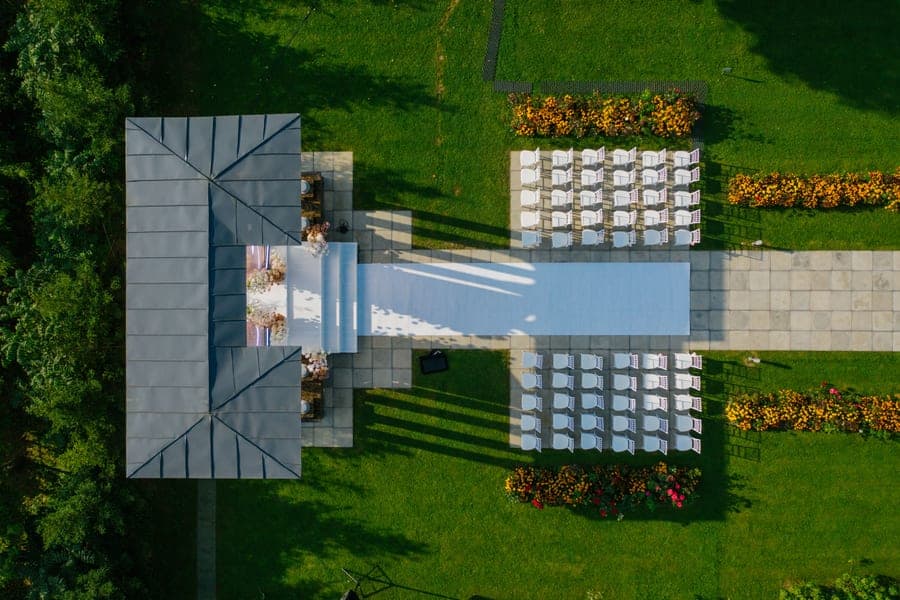 Sunjoy 13 x 15 Hardtop Gazebo with Two-Tier Steel RoofThe largest footprint in Sunjoy's published-rating range, carrying the same 50 mph wind figure as its smaller siblings. | Best larger footprint | 3,400 lb across the entire roof (not a per-square-foot rating) | Check price on Amazon |
| 04 | 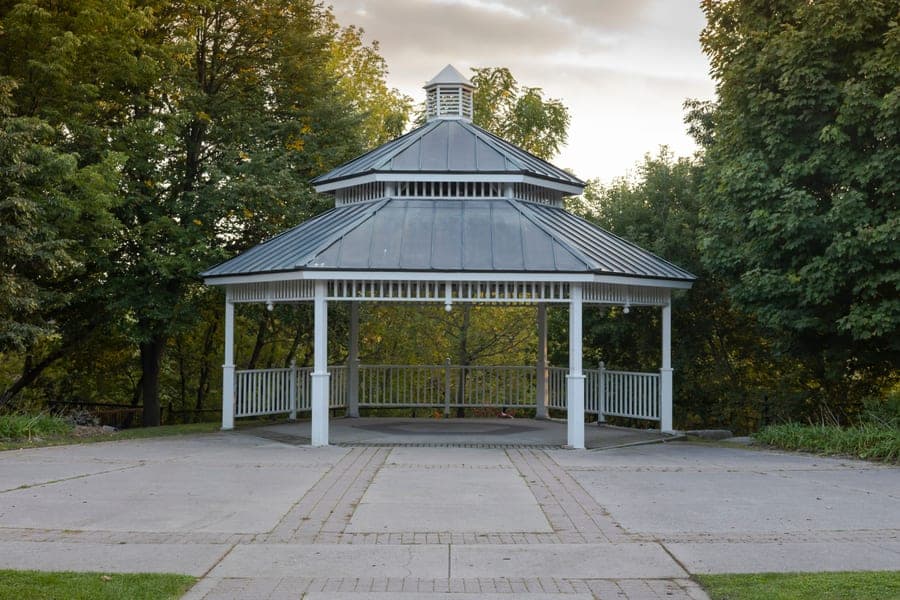 Sojag Messina Hardtop GazeboThe strongest warranty structure in the category — limited lifetime on the frame and 15 years on the finish — paired with wind and snow ratings the manufacturer describes but does not print. | Best build and warranty for snow country | Not published by manufacturer | Check price on Amazon |
| 05 | 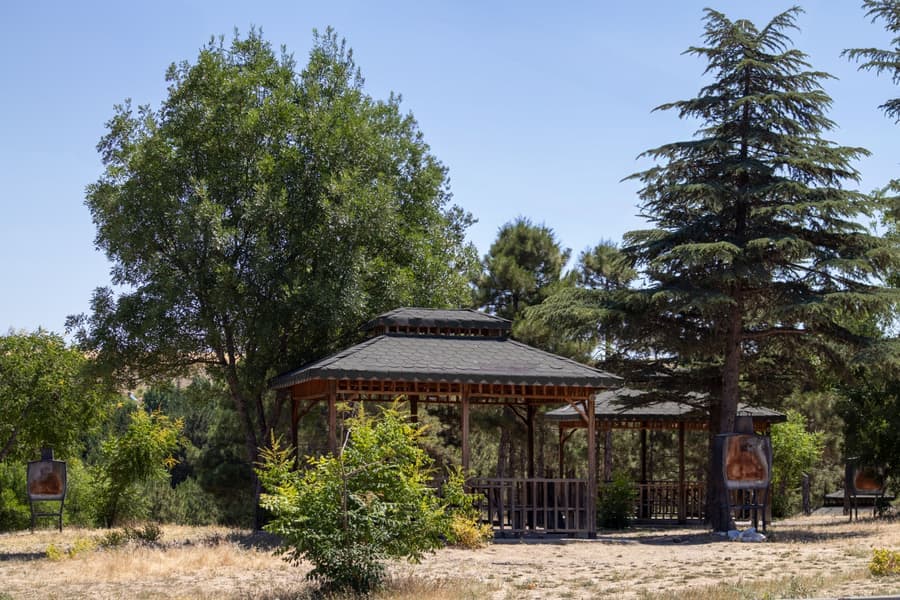 Yardistry Meridian 12 x 14 Cedar GazeboThe only structure here with 6x6 cedar posts and a five-year rot warranty — and it publishes no wind or snow figure at all. | Best structure with no published figure | Not published by manufacturer | Check price on Amazon |
| 06 |  Sojag Verona Hardtop GazeboA polycarbonate-roofed alternative to the Messina that trades snow-shedding confidence for daylight underneath. | The polycarbonate caveat | Not published by manufacturer | Check price on Amazon |
The durability table
Every published figure we could source for these structures, in one place, with the manufacturer page each number came from. Where a cell reads "Not published by manufacturer", that figure does not exist in the manufacturer's own material — we do not estimate it and we do not copy one from another site.
| Model | Wind rating (mph) | Snow load | Frame | Roof | Anchoring required | Warranty | Spec source |
|---|---|---|---|---|---|---|---|
| Backyard Discovery Norwood Cedar GazeboTop pick | 100 (Pro-Tect tested; product must be anchored per the manual) | 6,700 lb across the roof, or up to 30 in. of snow (12 x 10 ft model — roughly 56 lb/ft²) | 100% cedar, 6 in. x 6 in. posts, galvanized steel hardware | 29-gauge galvanized steel peak roof, thermal insulated | Mandatory. Product must be anchored as specified in the instruction manual | 5 years | Backyard Discovery Norwood 12x10 product pageChecked 2026-09-26 |
| Sunjoy Kingston 12 x 14 Aluminum Gazebo with Steel Roof | 50 | 3,000 lb across the entire roof (not a per-square-foot rating) | Aluminum and steel | Galvanized steel, two-tier vented | Pre-drilled ground plates: included stakes for soft ground, expansion bolts for hard surfaces (bolts not included) | Not published by manufacturer | Sunjoy Kingston product pageChecked 2026-09-26 |
| Sunjoy 13 x 15 Hardtop Gazebo with Two-Tier Steel Roof | 50 | 3,400 lb across the entire roof (not a per-square-foot rating) | Steel or aluminum depending on configuration | Two-tier vented steel with woodgrain finish | Not published by manufacturer | Not published by manufacturer | Sunjoy hardtop gazebo collectionChecked 2026-09-26 |
| Sojag Messina Hardtop Gazebo | Not published by manufacturer | Not published by manufacturer | Powder-coated aluminum | Galvanized steel panels | Not published by manufacturer | 1 year limited on the gazebo; limited lifetime on the aluminum/steel frame; 15 years on the powder-coated finish | Sojag hardtop gazebo collectionChecked 2026-09-26 |
| Yardistry Meridian 12 x 14 Cedar Gazebo | Not published by manufacturer | Not published by manufacturer | 100% premium cedar, 6 in. x 6 in. posts with heavy corner gussets | Rust-proof coffee-brown aluminum | Post mounting brackets supplied; anchoring hardware is not, because mounting surfaces vary | 1 year on materials and workmanship; 5 years on lumber against rot and decay | Yardistry Meridian 12x14 product pageChecked 2026-09-26 |
| Sojag Verona Hardtop Gazebo | Not published by manufacturer | Not published by manufacturer | Powder-coated aluminum | UV-protected tinted polycarbonate panels | Not published by manufacturer | 1 year limited on the gazebo; limited lifetime on the frame; 15 years on the powder-coated finish | Sojag hardtop gazebo collectionChecked 2026-09-26 |
Every pick in full
Top pick for snow
Backyard Discovery Norwood Cedar Gazebo
The only gazebo we can find that publishes a 100 mph wind rating and a convertible snow figure — and it converts to roughly 56 lb/ft², several times any other hardtop here.
- Wind rating
- 100 (Pro-Tect tested; product must be anchored per the manual)
- Snow load
- 6,700 lb across the roof, or up to 30 in. of snow (12 x 10 ft model — roughly 56 lb/ft²)
- Frame
- 100% cedar, 6 in. x 6 in. posts, galvanized steel hardware
- Roof
- 29-gauge galvanized steel peak roof, thermal insulated
- Anchoring
- Mandatory. Product must be anchored as specified in the instruction manual
- Warranty
- 5 years
- Sizes
- 10 x 10, 12 x 10, 14 x 10, 14 x 12, 16 x 12, 20 x 12 and 24 x 12 ft
It publishes the highest snow figure we can source anywhere on this site, and it publishes it twice — in two different forms that check each other.
6,700 lb across the roof on the 12 x 10 model, or up to 30 inches of snow. Over 120 ft² that first figure converts to roughly 56 lb/ft², which is more than three times the best aluminum-framed hardtop here. Publishing a depth alongside the weight is unusual and useful: it means the manufacturer has thought about how the figure will actually be read by someone standing in their yard in February.
The construction explains it. 100% cedar with 6 in. x 6 in. posts and galvanized steel hardware, under a 29-gauge thermal-insulated galvanized steel peak roof. Snow load is a sustained, vertical, cumulative load — the least dramatic and most relentless thing a structure carries — and it is resisted by post section, beam depth and connection stiffness. A 6x6 cedar post is a different structural member from an aluminum tube, and it shows up in the figure.
The roof is right for snow too: steel sheds, holds its shape indefinitely, and does not creep the way polycarbonate does under repeated loading. A peak roof rather than a low-pitch one also sheds rather than accumulates, and pitch does more for real-world snow performance than a few pounds per square foot of rated capacity.
It also publishes a 100 mph Pro-Tect tested wind rating and makes anchoring mandatory — the product must be anchored as specified in the instruction manual. Snow and wind arrive together, and a loaded roof in wind is the worst case in this category, so having both figures from one manufacturer with an anchoring requirement attached is the strongest documentation set here. Five-year warranty.
The caveat is cedar. Re-seal every two to three years, and keep end grain out of standing snowmelt — which in snow country is a genuine ask, because the base of a post can sit wet for months. Neglected cedar in that environment is the hardest case for timber there is.
Skip it if: You will not re-seal cedar every two to three years. Snow country is the least forgiving environment for neglected timber, and there is no partial credit.
#ad Price shown as of September 26, 2026. How this site is funded
Specifications from Backyard Discovery Norwood 12x10 product page, checked 2026-09-26.
Best aluminum-framed figure
Sunjoy Kingston 12 x 14 Aluminum Gazebo with Steel Roof
Publishes both a wind rating and a snow figure — but the snow figure is a whole-roof total, not a per-square-foot load, so it is not directly comparable to anyone else's.
- Wind rating
- 50
- Snow load
- 3,000 lb across the entire roof (not a per-square-foot rating)
- Frame
- Aluminum and steel
- Roof
- Galvanized steel, two-tier vented
- Anchoring
- Pre-drilled ground plates: included stakes for soft ground, expansion bolts for hard surfaces (bolts not included)
- Warranty
- Not published by manufacturer
- Sizes
- Roof 12 x 14 ft; base 11 x 13 ft; height 11.02 ft
It leads the aluminum-framed field on arithmetic. Sunjoy publishes 3,000 lb across the entire roof for the Kingston, and it publishes the roof dimensions — 12 x 14 ft — which means you can do the division. 3,000 lb over 168 ft² is roughly 17.9 lb/ft², the highest convertible figure from any aluminum hardtop we track.
That the figure needs converting at all is the category's biggest specification problem, and it cuts both ways here: published as a whole-roof total, 3,000 lb sounds like a much bigger claim than 17.9 lb/ft², and it is the same number. What makes Sunjoy usable rather than misleading is that it publishes the roof area alongside it. PURPLE LEAF publishes 2,500 lb across a range spanning 6 x 8 to 14 x 28 ft, and that figure cannot be converted at all.
The build is right for snow too. Galvanized steel panels, two-tier and vented — steel sheds, and it holds its shape indefinitely rather than creeping the way polycarbonate does under repeated loading. The aluminum and steel frame sits on pre-drilled ground plates, with stakes supplied for soft ground and expansion bolts for hard surfaces sold separately.
And clear it anyway. A published capacity is a survival ceiling for a single loading event on a correctly assembled structure. It says nothing about a winter of freeze-thaw cycles building a compacted ice layer under fresh snow, or about drifting concentrating several times the average depth against one side of the roof.
Skip it if: You need a footprint other than 12 x 14 ft, or your region's ground snow load exceeds roughly 17.9 lb/ft² — your building department holds that figure.
#ad Price shown as of September 26, 2026. How this site is funded
Specifications from Sunjoy Kingston product page, checked 2026-09-26.
Best larger footprint
Sunjoy 13 x 15 Hardtop Gazebo with Two-Tier Steel Roof
The largest footprint in Sunjoy's published-rating range, carrying the same 50 mph wind figure as its smaller siblings.
- Wind rating
- 50
- Snow load
- 3,400 lb across the entire roof (not a per-square-foot rating)
- Frame
- Steel or aluminum depending on configuration
- Roof
- Two-tier vented steel with woodgrain finish
- Anchoring
- Not published by manufacturer
- Warranty
- Not published by manufacturer
- Sizes
- 13 x 15 ft
A larger roof and a proportionally larger published total: 3,400 lb across the entire roof, which over 195 ft² converts to roughly 17.4 lb/ft². Effectively the same capacity as the Kingston, spread over more area.
That consistency is worth something. When a manufacturer's snow figures scale roughly in proportion to roof area across a range, it suggests the frames were sized for the load rather than the headline number being reused. A manufacturer whose 12 x 14 and 12 x 20 both claim the same total would be telling you the opposite.
Roof is a two-tier vented steel panel with a woodgrain finish, which is the right material for snow for the same reasons as the Kingston. It also publishes a 50 mph wind rating, and having both figures from one source matters more than either alone: snow and wind arrive together, and a loaded roof in wind is a worse case than either on its own.
Frame material varies by configuration between steel and aluminum, and neither a warranty term nor an anchoring provision is published for this model — which is where it falls behind the Kingston on documentation rather than on capacity.
Skip it if: You want the anchoring provision documented. That is published for the Kingston and not for this one, and anchoring matters in snow too — a loaded roof in wind is the worst case.
#ad Price shown as of September 26, 2026. How this site is funded
Specifications from Sunjoy hardtop gazebo collection, checked 2026-09-26.
Best build and warranty for snow country
Sojag Messina Hardtop Gazebo
The strongest warranty structure in the category — limited lifetime on the frame and 15 years on the finish — paired with wind and snow ratings the manufacturer describes but does not print.
- Wind rating
- Not published by manufacturer
- Snow load
- Not published by manufacturer
- Frame
- Powder-coated aluminum
- Roof
- Galvanized steel panels
- Anchoring
- Not published by manufacturer
- Warranty
- 1 year limited on the gazebo; limited lifetime on the aluminum/steel frame; 15 years on the powder-coated finish
- Sizes
- 10 x 10 ft through 12 x 20 ft
Sojag describes the Messina roof as carrying an engineered snow load and publishes no figure. It is on this page anyway, and the reason is a combination of the right materials and the most informative warranty in backyard shade.
The materials first: galvanized steel panels on a powder-coated aluminum frame. Steel is unambiguously the right roof for snow. It sheds, and it does not creep — polycarbonate panels deflect under repeated loading, recover, and recover slightly less each winter, accumulating into permanent sag that most warranties do not cover.
The warranty: one year limited on the gazebo, limited lifetime on the aluminum and steel frame, fifteen years on the powder-coated finish. In a snow context the frame is what carries the load, and a manufacturer prepared to cover the frame indefinitely is making a statement about exactly that component.
Sojag is also the manufacturer whose own guidance is to clear the roof — that accumulation should always be removed, even from a roof it describes as four-season. That is not a contradiction of the engineering claim; it is the correct instruction, and the fact that the best-credentialed manufacturer in the category gives it is the single best argument for taking snow removal seriously regardless of what you buy.
Skip it if: You need a number to check against your local ground snow load. Sojag does not publish one, and "engineered snow load" is not a figure you can compare.
#ad Price shown as of September 26, 2026. How this site is funded
Specifications from Sojag hardtop gazebo collection, checked 2026-09-26.
Best structure with no published figure
Yardistry Meridian 12 x 14 Cedar Gazebo
The only structure here with 6x6 cedar posts and a five-year rot warranty — and it publishes no wind or snow figure at all.
- Wind rating
- Not published by manufacturer
- Snow load
- Not published by manufacturer
- Frame
- 100% premium cedar, 6 in. x 6 in. posts with heavy corner gussets
- Roof
- Rust-proof coffee-brown aluminum
- Anchoring
- Post mounting brackets supplied; anchoring hardware is not, because mounting surfaces vary
- Warranty
- 1 year on materials and workmanship; 5 years on lumber against rot and decay
- Sizes
- Roof 12 x 14 ft; base 10 ft 10⅜ in. x 12 ft 10⅜ in.
No published snow load, and the heaviest structure on this page: 100% cedar with 6 in. x 6 in. posts and heavy corner gussets, under a rust-proof aluminum roof.
In snow, section size is doing real work. Snow load is a sustained, vertical, cumulative load — the least dramatic and most relentless thing a structure carries — and it is resisted by post section, beam depth and connection stiffness. 6x6 posts and gussets are a genuinely substantial answer to that, even though Yardistry does not attach a number to it.
The aluminum roof is a reasonable snow material: lighter than steel, sheds well, does not creep. Being rust-proof matters more in snow country than elsewhere because a roof that sits under wet snow for months is a roof that stays wet for months.
The warranty is where cedar's snow-country risk shows up and where Yardistry addresses it: one year on materials and workmanship, five years on the lumber against rot and decay. Freeze-thaw cycling and prolonged wet are what damages timber, and putting the extended term on rot specifically is the manufacturer covering the right thing.
Skip it if: You need a published figure, or you will not re-seal the cedar. Snow country is the hardest environment for neglected timber.
#ad Price shown as of September 26, 2026. How this site is funded
Specifications from Yardistry Meridian 12x14 product page, checked 2026-09-26.
The polycarbonate caveat
Sojag Verona Hardtop Gazebo
A polycarbonate-roofed alternative to the Messina that trades snow-shedding confidence for daylight underneath.
- Wind rating
- Not published by manufacturer
- Snow load
- Not published by manufacturer
- Frame
- Powder-coated aluminum
- Roof
- UV-protected tinted polycarbonate panels
- Anchoring
- Not published by manufacturer
- Warranty
- 1 year limited on the gazebo; limited lifetime on the frame; 15 years on the powder-coated finish
- Sizes
- Not published by manufacturer
Here so the trade-off is on the page rather than implied. The Verona is the Messina's sibling — same frame, same warranty structure — with UV-protected tinted polycarbonate panels instead of galvanized steel.
In a mild climate that is an upgrade. Polycarbonate passes daylight, which changes how the space underneath reads and whether anything will grow under it. A steel roof makes the space genuinely dim.
In snow country it is the wrong panel, and the reason is creep. Under repeated loading polycarbonate deflects, recovers when the load comes off, and recovers a little less each time. Across several winters that accumulates into permanent sag. It is slow, it does not present as a failure event, and it is generally not covered by any warranty — including this one, whose fifteen-year term is on the powder-coated finish rather than the panels. The second clock is UV: as the protective layer degrades, yellowing and brittleness follow, and a brittle panel under snow is a different proposition from a new one.
Warranty and frame are the Messina's. Snow figure: not published, same as the Messina.
Skip it if: You get meaningful snow. Choose the Messina's steel roof in the same frame — it is the same structure with the panel that handles the load.
#ad Price shown as of September 26, 2026. How this site is funded
Specifications from Sojag hardtop gazebo collection, checked 2026-09-26.
Getting these figures onto the same footing
This is the whole reason the page exists. Snow capacity in this category is published in two incompatible units, and comparing them requires one division that almost nobody does.
Pounds per square foot is the form building codes and engineers use, and it is comparable across products of any size. Pounds across the whole roof is the form Sunjoy and PURPLE LEAF use, and it means nothing until you divide by the roof area.
The conversion matters more than it sounds. 3,000 lb on a 12 x 14 ft roof is 17.9 lb/ft². The same 3,000 lb on a 12 x 20 ft roof would be 12.5. Same headline, a third less capacity. And when a manufacturer publishes a total with no roof area — as PURPLE LEAF does, across a range from 6 x 8 to 14 x 28 — the figure is not a specification at all.
| Structure | As published | Roof area | Per ft² equivalent |
|---|---|---|---|
| Backyard Discovery Norwood 12 x 10 | 6,700 lb across the roof, or up to 30 in. of snow | 120 ft² | Roughly 56 lb/ft² |
| Sunjoy Kingston 12 x 14 | 3,000 lb across the entire roof | 168 ft² | Roughly 17.9 lb/ft² |
| Sunjoy 13 x 15 | 3,400 lb across the entire roof | 195 ft² | Roughly 17.4 lb/ft² |
| Sojag Messina | Not published by manufacturer | 10 x 10 to 12 x 20 ft | Not published by manufacturer |
| Sojag Verona | Not published by manufacturer | Not published by manufacturer | Not published by manufacturer |
| Yardistry Meridian 12 x 14 | Not published by manufacturer | 168 ft² roof | Not published by manufacturer |
| PURPLE LEAF hardtop | 2,500 lb, no area stated | 6 x 8 to 14 x 28 ft | Cannot be calculated |
The spread is enormous and it tracks frame section rather than roof material — roughly 56 lb/ft² on 6x6 cedar posts against roughly 17.9 on aluminum tube, a factor of three, with a steel roof on both. Note also what the PURPLE LEAF row shows: a 2,500 lb figure attached to a range running 6 x 8 to 14 x 28 ft describes capacities anywhere from roughly 52 lb/ft² to under 7 depending on which gazebo you bought. That is not a specification.
For reference across categories: Domi publishes 15 lb/ft² for its louvered pergolas and Quictent publishes 9 lb/ft² for its 10 x 20 carport — both in the useful unit. Snow load explained has the full set.
Finding the figure you need to compare against
A capacity means nothing without the demand. The number you need is your region's ground snow load, and it varies enormously across the US — from single digits across much of the south to figures many times higher in mountain and lake-effect regions.
Ask your local building department. They hold the adopted ground snow load for your address, and if the structure needs a permit they will be applying it anyway. It is a five-minute call and it is the only way to get a figure you can rely on. Requirements vary by jurisdiction; we are not going to print a map, because the authoritative number is the one your jurisdiction adopts.
Two adjustments to hold in mind once you have it. Roof snow load is not ground snow load — pitch, exposure and thermal conditions all change what actually sits on a roof, and codes apply factors to get from one to the other. And wet snow weighs far more than dry snow at the same depth, which is why depth is an unreliable guide and why a late-season storm can load a roof several times harder than a mid-winter powder fall of the same measurement.
Clearing the roof without wrecking it
The most common way these roofs get damaged is during snow removal, not during the storm. Sojag's guidance to always remove accumulation is correct; doing it with a shovel is how panels get scratched and cracked.
- 01Work from the ground with a roof rake. Never climb onto a gazebo roof — none of these structures is rated for a person's weight as a point load, and the panels least of all.
- 02Push, do not chop. A shovel edge or an ice chipper will scratch powder coat and crack polycarbonate. A scratch through to bare steel at a panel edge or fastener hole is where corrosion starts on an otherwise sound roof.
- 03Leave a thin layer behind. Trying to scrape down to bare panel is what causes the damage. The objective is removing the load, not cleaning the roof.
- 04Clear evenly across the roof. Stripping one side and leaving the other replaces a uniform load with an unbalanced one, which is harder on the frame than the snow was.
- 05Do it before the thaw. Snow that has been through a melt-freeze cycle is heavier, bonded to the panel, and far harder to remove without damage. The easy time is while it is still loose.
- 06Check the fasteners afterwards, roof panels first. Loading and unloading works fixings loose, and on a gazebo the roof is the load-collecting surface.
What to prioritize if you are in snow country
Ranked by how much difference it actually makes, which is not the order product pages suggest.
- A figure you can convert and check. A product publishing per square foot, or publishing a total with its roof area, has told you something. One publishing a total with no area has not.
- Steel over polycarbonate. Not close in snow country. Steel dents; polycarbonate creeps, and creep is cumulative and uncovered.
- Pitch. A steeper roof sheds rather than accumulates, and pitch does more for real-world snow performance than a few pounds per square foot of rated capacity.
- A commitment to clearing it. Every manufacturer with good snow credentials says to clear the roof. If that is not going to happen, buy a structure with an open roof — a slatted cedar or louvered pergola does not accumulate in the same way. The trade is that you get no rain cover.
- Anchoring, still. Snow and wind arrive together and a loaded roof in wind is the worst case. How to anchor a gazebo covers each surface.
- Stainless fixings at the base plates. A leg standing in snowmelt for four months is the wettest any part of this structure ever gets.
What we cut, and why
Every model below was a genuine candidate and did not make the list. The reason is stated in each case, because a shortlist with no visible rejections is not evidence of a selection process.
- PURPLE LEAF hardtop gazebos, on this page specifically
- They publish a snow figure — 2,500 lb — and publish it with no roof area, across a range spanning 6 x 8 ft to 14 x 28 ft. That describes capacities anywhere from roughly 52 lb/ft² to under 7 depending on which gazebo you bought, so it cannot be converted or compared. They appear in our other gazebo roundups; a snow comparison is the one place the figure is unusable.
- Every fabric-roof and soft-top gazebo
- No manufacturer publishes a snow figure for one, and the correct instruction is to take them down before the first snow. Fabric pools under wet snow, stretches, and concentrates the whole load on the grommets.
- Pop-up gazebos and carport-style shelters, on this page
- Some genuinely publish snow figures — Quictent's 10 x 20 carport states 9 lb/ft² — but they are a different product for a different job. See [best carport canopies](/canopies/best-carport-canopies) and [canopy wind ratings and weights](/canopies/canopy-wind-ratings-and-weights).
- Anything whose snow figure came only from a retailer
- Snow capacity is the spec most often paraphrased or mangled in retail listings — we found the same model quoted in pounds on one listing and pounds per square foot on another. A figure we cannot trace to the manufacturer does not go in a table.
Questions people ask
What is the best gazebo for heavy snow?
What snow load can a hardtop gazebo take?
What does a Costco or club-store gazebo's snow rating mean?
Do I really need to remove snow from a hardtop gazebo?
How do I get snow off a gazebo roof safely?
Is polycarbonate or steel better for snow?
Does a gazebo need extra snow support?
Why is snow load published in pounds instead of pounds per square foot?
Where these figures came from
- Backyard Discovery Norwood 12x10 — 100 mph Pro-Tect tested wind rating, 6,700 lb / 30 in. snow figure, 6x6 cedar posts, 29-gauge steel roof, mandatory anchoring
- Sunjoy Kingston 12x14 — 3,000 lb whole-roof snow figure, roof dimensions, 50 mph wind rating
- Sunjoy hardtop gazebo collection — 3,400 lb figure for the 13 x 15
- Sojag hardtop gazebo collection — engineered snow load described without a figure, guidance to remove accumulation, warranty structure
- Yardistry Meridian 12x14 — cedar post dimensions, aluminum roof, 5 year lumber warranty against rot and decay
- PURPLE LEAF hardtop gazebo collection — 2,500 lb figure published without a roof area, across a 6x8 to 14x28 range
- Domi Outdoor Living louvered pergola — 15 lb/ft², cited for cross-category reference
- Quictent 10x20 carport — 9 lb/ft², cited for cross-category reference
Found an error? Tell us and we will correct it within seven days and note the change on the page with a dated line — see our editorial policy.