Gazebo snow support and snow removal
Hardtop gazebos are sold as four-season structures and then shipped with an instruction most owners never read: the snow has to come off. This is what that means in practice, and what a support post does and does not add.
By Ryder M. · Published · Last updated
We compare published manufacturer specifications, warranty terms and owner-reported failure modes. We have not physically tested these structures. How we judge shade structures
Slat & Shade earns a commission on qualifying purchases made through links on this page. It costs you nothing extra and never changes what we recommend. Full disclosure
Part of Hardtop Gazebos
The short answer
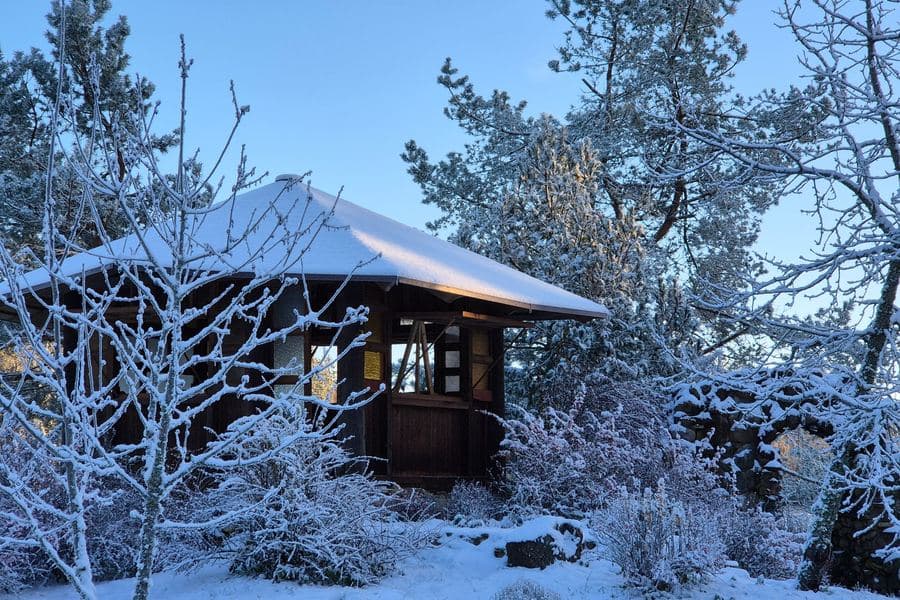
Clear snow from a gazebo roof before it accumulates — Sojag states any accumulation should always be removed. A winter support post props the roof from beneath at the connector and buys margin, not immunity. Clear from the ground with a soft-edged roof rake, never by climbing on the roof.
Our picks at a glance
| # | Structure | Best for | Snow load | Price |
|---|---|---|---|---|
| 01 | 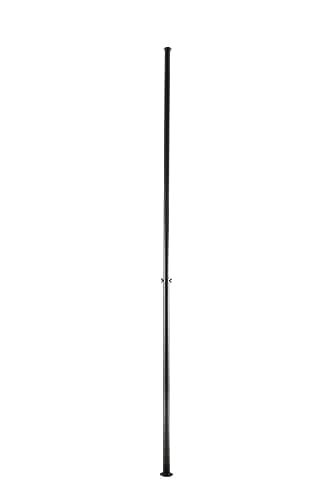 Sojag Universal Winter Support PostThe only mass-market winter support post a gazebo manufacturer actually publishes — and the clearest admission in the category that a hardtop roof wants help under snow. | The one purpose-made prop a gazebo maker publishes | Not published by manufacturer | $64.32 · View on Amazon |
| 02 | 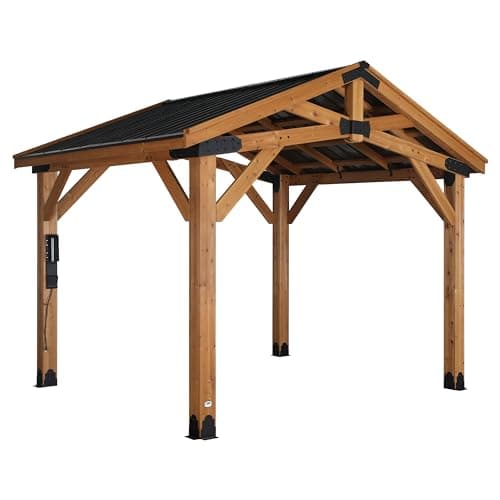 Backyard Discovery Norwood Cedar GazeboThe only gazebo we can find that publishes a 100 mph wind rating and a convertible snow figure — and it converts to roughly 56 lb/ft², several times any other hardtop here. | What a gazebo looks like when snow was designed for | 6,700 lb across the roof, or up to 30 in. of snow (12 x 10 ft model — roughly 56 lb/ft²) | $1,999.00 · View on Amazon |
| 03 | 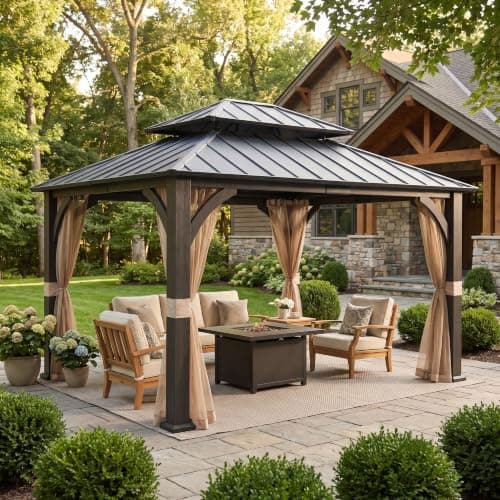 Sunjoy 13 x 15 Hardtop Gazebo with Two-Tier Steel RoofThe largest footprint in Sunjoy's published-rating range, carrying the same 50 mph wind figure as its smaller siblings. | The highest total-weight figure among the aluminum hardtops here | 3,400 lb across the entire roof (not a per-square-foot rating) | $1,299.00 · View on Amazon |
| 04 | 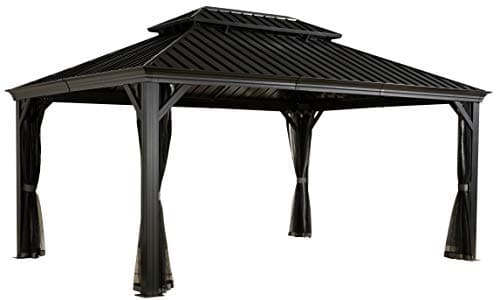 Sojag Messina Hardtop GazeboThe strongest warranty structure in the category — limited lifetime on the frame and 15 years on the finish — paired with wind and snow ratings the manufacturer describes but does not print. | The model whose own listing carries the instruction | Not published by manufacturer | $2,749.99 · View on Amazon |
The durability table
Every published figure we could source for these structures, in one place, with the manufacturer page each number came from. Where a cell reads "Not published by manufacturer", that figure does not exist in the manufacturer's own material — we do not estimate it and we do not copy one from another site.
| Model | Wind rating (mph) | Snow load | Frame | Roof | Anchoring required | Warranty | Spec source |
|---|---|---|---|---|---|---|---|
| Sojag Universal Winter Support PostTop pick | Not published by manufacturer | Not published by manufacturer | High-quality dark gray steel | Not published by manufacturer | Positioned against the roof connector; includes a pre-drilled base for anchoring; compatible with all Sojag free-standing structures | 1 year limited | Sojag Universal Winter Support Post product pageChecked 2026-10-21 |
| Backyard Discovery Norwood Cedar Gazebo | 100 (Pro-Tect tested; product must be anchored per the manual) | 6,700 lb across the roof, or up to 30 in. of snow (12 x 10 ft model — roughly 56 lb/ft²) | 100% cedar, 6 in. x 6 in. posts, galvanized steel hardware | 29-gauge galvanized steel peak roof, thermal insulated | Mandatory. Product must be anchored as specified in the instruction manual | 5 years | Backyard Discovery Norwood 12x10 product pageChecked 2026-09-26 |
| Sunjoy 13 x 15 Hardtop Gazebo with Two-Tier Steel Roof | 50 | 3,400 lb across the entire roof (not a per-square-foot rating) | Steel or aluminum depending on configuration | Two-tier vented steel with woodgrain finish | Not published by manufacturer | Not published by manufacturer | Sunjoy hardtop gazebo collectionChecked 2026-09-26 |
| Sojag Messina Hardtop Gazebo | Not published by manufacturer | Not published by manufacturer | Powder-coated aluminum | Galvanized steel panels | Not published by manufacturer | 1 year limited on the gazebo; limited lifetime on the aluminum/steel frame; 15 years on the powder-coated finish | Sojag hardtop gazebo collectionChecked 2026-09-26 |
Every pick in full
The one purpose-made prop a gazebo maker publishes
Sojag Universal Winter Support Post
The only mass-market winter support post a gazebo manufacturer actually publishes — and the clearest admission in the category that a hardtop roof wants help under snow.
- Wind rating
- Not published by manufacturer
- Snow load
- Not published by manufacturer
- Frame
- High-quality dark gray steel
- Roof
- Not published by manufacturer
- Anchoring
- Positioned against the roof connector; includes a pre-drilled base for anchoring; compatible with all Sojag free-standing structures
- Warranty
- 1 year limited
- Sizes
- Adjustable from 78.7 to 118.9 in.
The reason this page has a product section at all: a manufacturer selling a post whose stated job is holding its own roof up in winter.
Adjustable from 78.7 to 118.9 in. — roughly 6 ft 7 in. to 9 ft 11 in. That range covers the interior height of most hardtop gazebos in this class, which is the point of the word universal in its name.
Dark gray steel, positioned against the roof connector. Sojag's instruction is specific about where it goes: against the connector, not anywhere convenient under a panel. The connector is a load path into the frame; the middle of a roof panel is not.
Includes a pre-drilled base for anchoring. A prop that can slide out from under a load is worse than no prop, because you will trust it. Fix the base.
Sojag states it is compatible with all its free-standing structures, and not with wall-mounted ones — a wall-mounted gazebo has a different load path and the post has nothing useful to bear against.
One year limited warranty, and no published load rating. That is the honest gap: nowhere does the manufacturer publish how much additional load the post carries. Treat it as margin of unknown size, which is exactly why it is not a substitute for clearing the roof.
Skip it if: You have a wall-mounted or lean-to gazebo, or you were hoping for a published figure you could design around. There isn't one.
#ad Price shown as of November 11, 2026. How this site is funded
Specifications from Sojag Universal Winter Support Post product page, checked 2026-10-21.
What a gazebo looks like when snow was designed for
Backyard Discovery Norwood Cedar Gazebo
The only gazebo we can find that publishes a 100 mph wind rating and a convertible snow figure — and it converts to roughly 56 lb/ft², several times any other hardtop here.
- Wind rating
- 100 (Pro-Tect tested; product must be anchored per the manual)
- Snow load
- 6,700 lb across the roof, or up to 30 in. of snow (12 x 10 ft model — roughly 56 lb/ft²)
- Frame
- 100% cedar, 6 in. x 6 in. posts, galvanized steel hardware
- Roof
- 29-gauge galvanized steel peak roof, thermal insulated
- Anchoring
- Mandatory. Product must be anchored as specified in the instruction manual
- Warranty
- 5 years
- Sizes
- 10 x 10, 12 x 10, 14 x 10, 14 x 12, 16 x 12, 20 x 12 and 24 x 12 ft
Included as the benchmark, because the gap between this and a typical hardtop is the whole reason winter support posts exist.
6,700 lb across the roof, or up to 30 in. of snow on the 12 x 10 ft model — roughly 56 lb/ft². That is several times any other hardtop figure on this site, and it is published as a depth as well as a weight, which is the form an owner can actually use.
100 mph wind, Pro-Tect tested, conditional on being anchored per the manual. Snow and wind figures that come from the same testing program are worth more than two numbers from two marketing pages.
100% cedar with 6 in. x 6 in. posts and a 29-gauge galvanized steel peak roof, thermal insulated. Cedar at that section is doing structural work, not trim. It is also why this is a different purchase in both price and assembly from a bolt-together aluminum kit.
Five-year warranty, against the one-year limited that is standard across most of this category.
You still clear the roof. A high published capacity moves the threshold; it does not remove the maintenance. Thirty inches is a number you can hit in one storm in parts of the snow belt.
Skip it if: You want something you can put up in a weekend on a patio. This is a cedar build, and a heavier job in every sense.
#ad Price shown as of November 11, 2026. How this site is funded
Specifications from Backyard Discovery Norwood 12x10 product page, checked 2026-09-26.
The highest total-weight figure among the aluminum hardtops here
Sunjoy 13 x 15 Hardtop Gazebo with Two-Tier Steel Roof
The largest footprint in Sunjoy's published-rating range, carrying the same 50 mph wind figure as its smaller siblings.
- Wind rating
- 50
- Snow load
- 3,400 lb across the entire roof (not a per-square-foot rating)
- Frame
- Steel or aluminum depending on configuration
- Roof
- Two-tier vented steel with woodgrain finish
- Anchoring
- Not published by manufacturer
- Warranty
- Not published by manufacturer
- Sizes
- 13 x 15 ft
Where most of the category lands, and a lesson in reading a published snow number carefully.
3,400 lb across the entire roof — not a per-square-foot rating. A total is a far weaker piece of information than a pressure, because it tells you nothing about how the load may be distributed. Across a 13 x 15 ft roof it works out near 17 lb/ft² if the snow is even, and snow is never even.
50 mph published wind rating. Modest, and typical of aluminum-frame hardtops in this class.
This is the number a winter support post is aimed at. Wet snow runs roughly 20 lb per cubic foot; a foot of it across that roof is well past the published total. That arithmetic, not marketing, is why the clear-the-roof instruction exists.
No snow depth is published, so you are converting weight to depth yourself and the conversion depends on how wet the snow is. Assume the worst case rather than the average.
Check the figure against your own region's ground snow load before deciding any hardtop is adequate unattended. Gazebo snow load explained sets out how to do that conversion properly.
Skip it if: You are in a heavy snow region and want to leave the structure unattended all winter. No aluminum hardtop here publishes a figure that supports that.
#ad Price shown as of November 11, 2026. How this site is funded
Specifications from Sunjoy hardtop gazebo collection, checked 2026-09-26.
The model whose own listing carries the instruction
Sojag Messina Hardtop Gazebo
The strongest warranty structure in the category — limited lifetime on the frame and 15 years on the finish — paired with wind and snow ratings the manufacturer describes but does not print.
- Wind rating
- Not published by manufacturer
- Snow load
- Not published by manufacturer
- Frame
- Powder-coated aluminum
- Roof
- Galvanized steel panels
- Anchoring
- Not published by manufacturer
- Warranty
- 1 year limited on the gazebo; limited lifetime on the aluminum/steel frame; 15 years on the powder-coated finish
- Sizes
- 10 x 10 ft through 12 x 20 ft
Here because its published product page states the rule this page is built on, in the manufacturer's words.
"Any accumulation of snow should always be removed from the roof." Not heavy accumulation. Not accumulation over a stated depth. Any. It sits in the feature list beside the materials, which is where an owner is least likely to read it and most likely to need it.
Gray powder-coated aluminum structure with a gray powder-coated galvanized steel roof. A steel roof panel is stiffer than polycarbonate and sheds snow better once it starts moving — it is also the reason a roof rake can scar a finish you cannot touch up.
Meets CPAI-84 flame-resistant international safety standards, published on the manufacturer's listing.
One year limited warranty on the manufacturer's current listing, and no published snow load at all for this model. An absent figure is not a high one.
Sojag sells both the winter support post and winter covers for these structures, which is the clearest signal available that the brand expects active winter maintenance rather than set-and-forget.
Skip it if: You need a published snow figure before you buy. Sojag does not publish one for this model, and that absence is the answer.
#ad Price shown as of November 11, 2026. How this site is funded
Specifications from Sojag hardtop gazebo collection, checked 2026-09-26.
What the manufacturers actually say
Start with the published instruction, because it is unambiguous and almost nobody reads it. Sojag's own product listing for the Messina hardtop gazebo states that any accumulation of snow should always be removed from the roof. The same brand sells a universal winter support post described as adding reinforcement for the winter season, positioned against the roof connector, and a range of winter covers.
Put those three facts side by side and the position is clear. These are four-season structures in the sense that they can stay up through winter — not in the sense that winter can be ignored. The roof is rated to stand there, and the owner is expected to keep the load off it.
That also has a warranty dimension. Damage from snow and storm is a standard exclusion in this category, and operating instructions that are not followed typically void coverage. A roof that collapsed under snow that the manual told you to remove is a roof you paid for twice.
Why the published numbers run out faster than people expect
Most hardtop gazebos publish snow capacity as a total across the whole roof, which is a far weaker number than it looks.
- Sunjoy publishes 3,000 lb for the Kingston and 3,400 lb for its 13 x 15 ft hardtop, both across the entire roof and explicitly not per square foot. Spread evenly over a 13 x 15 ft roof, 3,400 lb is around 17 lb/ft².
- PURPLE LEAF publishes 2,500 lb as a total with no stated roof area, which makes the figure almost impossible to convert. A total without an area is not a specification an owner can use.
- Fresh dry snow runs roughly 7 lb per cubic foot; wet or settled snow runs 15 to 20 lb or more. A foot of wet snow on a 195 sq ft roof is in the region of 3,000 to 4,000 lb — at or past the published total for most of the category, from a single storm.
- Snow does not land evenly. It drifts to one side, it slides and piles at eaves, and it builds deepest where two roof planes meet. A total figure assumes a distribution you will not get.
- Backyard Discovery's Norwood is the outlier at roughly 56 lb/ft², published as up to 30 in. of snow. That is what a figure looks like when it is designed around snow rather than quoted after the fact.
- And an absent figure is not a generous one. Several popular hardtops publish no snow capacity at all, which means there is nothing to compare your region's ground snow load against.
This is why the instruction says any accumulation. The manufacturer is not being cautious for its own sake — for most of these roofs, a single heavy storm is the design case.
What a winter support post does
A support post is an extra, temporary load path. Instead of the roof carrying everything out to the perimeter frame and down the four corner posts, a prop under the roof connector takes part of the load straight to the ground in the middle of the span, where the bending is worst.
That genuinely helps, and the size of the help is not published. Sojag states the post adds reinforcement and provides extra stability; it does not state how many pounds it carries, and no figure of that kind exists for any product in this class. So the correct way to use it is as margin against the storm that arrives while you are away, not as a license to leave the roof loaded.
Where you put it decides whether it works. Against the roof connector — a frame junction designed to take load — and not under the middle of a panel, which will dish around a point load. The pre-drilled base exists so the foot can be fixed rather than skating on a wet patio.
It is not for wall-mounted gazebos. Sojag says compatible with all free-standing structures, and a lean-to carries half its load into the house wall, where a floor-standing prop has nothing useful to do.
One post is a help; four posts is not a different structure. If your region's snow load genuinely exceeds what the roof publishes, propping is not the fix. Taking the roof panels down for the season, or buying a structure with a real published capacity, is.
Clearing the roof without wrecking it
The damage done clearing snow off a gazebo is usually worse than the snow would have been. Do it in this order.
- 01Clear early and clear often. Six inches twice is easier, safer and gentler on the roof than twelve inches once, and the load never reaches the number that worries you.
- 02Work from the ground. Never climb on a gazebo roof and never put a ladder against the frame — these are light structures, and a person is a bigger point load than the snow.
- 03Use a roof rake with a soft or plastic blade and a non-abrasive slide pad. A metal edge will scratch powder coating and gouge polycarbonate, and a scratched polycarbonate panel yellows and crazes along the scratch within a season or two.
- 04Pull snow down the slope, never sideways or uphill. Dragging across the fall line twists panels against their fixings and is how leaks start at the laps.
- 05Leave the last inch. Trying to scrape a roof clean is what puts the rake into the surface. A thin residual layer weighs almost nothing and protects the finish.
- 06Keep clear of the drop zone and watch for a slab release. Snow on a steel panel lets go all at once once it starts moving, and a roof's worth of it falling on someone is the real hazard of this job.
- 07Check the gutters, drainage channels and roof laps afterwards. Ice in a drainage channel backs water under the laps, which is a leak in February and a stain in April — gazebo roof leaks covers where they start.
- 08Never use a shovel, a broom handle, salt or any de-icer on the panels. Salt attacks powder coating and galvanizing, and chipping at ice removes the coating with it.
- 09Set the support post before the first storm, not during it. Fitting a prop under an already-loaded roof means standing under a loaded roof.
Deciding what your winter actually needs
Three honest routes through a snowy winter, and the figure that picks between them.
| Your situation | What to do | Product | Honest limit |
|---|---|---|---|
| Light snow region, roof capacity published | Clear after each storm, no prop needed | Soft-edged roof rake | Needs you to be there |
| Moderate snow, away for stretches | Fit a support post and still clear when home | Universal winter support post | No published load figure |
| Heavy snow, no published capacity | Take the roof panels down for the season | Winter cover for the frame | A weekend of work twice a year |
| Heavy snow, buying new | Buy capacity rather than managing a shortfall | Cedar gazebo with a published lb/ft² figure | Several times the price |
| Soft-top or pop-up gazebo | Take it down entirely before winter | None — it is not a winter structure | No snow capacity at all |
The last row is not a hedge. A soft-top or pop-up gazebo has no snow capacity worth the name and should be down before the first fall — how to winterize a gazebo covers taking one down properly and storing the canopy so it survives to spring.
If you are choosing a structure now with winter in mind, start at best gazebos for snow load, which ranks the models by what they actually publish.
What fails, and in what order
- Roof panels dish between purlins first. It is a visible, reversible warning and the signal to clear immediately — the capacity you have left after a panel deforms is not the published capacity.
- Fixings pull through at the laps. Snow load works panels against their fasteners, and the hole that opens up is the leak you find in spring.
- Drainage channels ice up and back water into the frame. On a louvered or channelled roof this is the common winter failure rather than collapse.
- Corner connections rack under uneven load. A drift on one side pushes the frame out of square, which is why a structure that survived one winter is not guaranteed to survive the next.
- And the one that is not a failure: a frame that is fine and a finish that is ruined. Most winter damage on these gazebos is cosmetic and self-inflicted with a metal rake or a bag of ice melt.
- Check anchoring before winter, not after. Snow and wind arrive together and the anchoring is what holds the structure through both — how to anchor a gazebo covers the correct fixing by surface.
Questions people ask
Do I need to remove snow from a gazebo roof?
What does a gazebo winter support post do?
How much snow can a hardtop gazebo hold?
How do you get snow off a gazebo roof safely?
Will a roof rake damage a gazebo roof?
Can I leave a hardtop gazebo up all winter?
How many winter support posts does a gazebo need?
Does snow damage void a gazebo warranty?
How much does a foot of snow weigh on a gazebo roof?
Should I use a winter cover instead?
Is a cedar gazebo better in snow than an aluminum one?
Where these figures came from
- Sojag Universal Winter Support Post — dark gray steel, adjustable from 78.7 to 118.9 in., positioned against the roof connector, pre-drilled base for anchoring, storage bag, compatible with all Sojag free-standing structures, 1 year limited warranty
- Sojag Messina Hardtop Gazebo 10 x 14 ft — "Any accumulation of snow should always be removed from the roof"; gray powder-coated aluminum structure, gray powder-coated galvanized steel roof panels, CPAI-84 compliant, 1 Year Limited warranty
- Sojag winter covers for gazebos — polyethylene fabric covers sold for winter protection of the structure
- Sunjoy hardtop gazebo collection — 3,400 lb across the entire roof on the 13 x 15 ft model and 3,000 lb on the Kingston, both published as totals rather than per-square-foot ratings; 50 mph wind
- Backyard Discovery Norwood 12 x 10 ft cedar gazebo — 6,700 lb across the roof or up to 30 in. of snow (roughly 56 lb/ft²), 100 mph Pro-Tect tested when anchored per the manual, 100% cedar with 6 in. x 6 in. posts, 5 year warranty
- PURPLE LEAF hardtop gazebo collection — 2,500 lb published as a total without a stated roof area, 40 mph wind rating
Found an error? Tell us and we will correct it within seven days and note the change on the page with a dated line — see our editorial policy.