Are hardtop gazebos worth it?
A hardtop is a structure; a soft-top is a consumable. Whether the first is worth the money comes down to how many of the second you would otherwise buy.
By Ryder M. · Published · Last updated
We compare published manufacturer specifications, warranty terms and owner-reported failure modes. We have not physically tested these structures. How we judge shade structures
Slat & Shade earns a commission on qualifying purchases made through links on this page. It costs you nothing extra and never changes what we recommend. Full disclosure
Part of Hardtop Gazebos
The short answer
Yes, if the structure stays up year-round and you would otherwise replace a fabric canopy every few seasons. A hardtop brings a non-perishable roof, a frame some manufacturers warrant for life, and in two cases a published wind rating. It is not worth it if the gazebo only comes out for summer, or if the spot is too exposed to anchor properly.
Our picks at a glance
| # | Structure | Best for | Wind rating | Price |
|---|---|---|---|---|
| 01 | 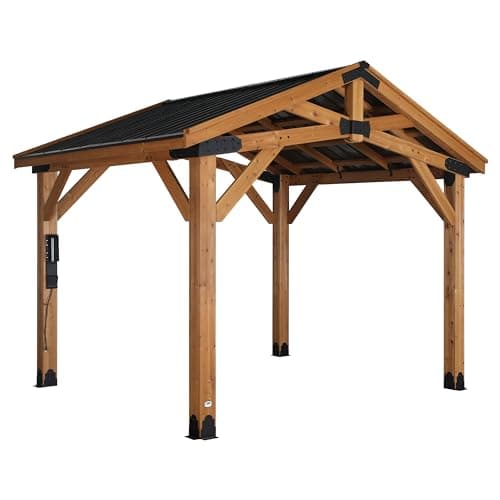 Backyard Discovery Norwood Cedar GazeboThe only gazebo we can find that publishes a 100 mph wind rating and a convertible snow figure — and it converts to roughly 56 lb/ft², several times any other hardtop here. | Where the money clearly goes somewhere | 100 (Pro-Tect tested; product must be anchored per the manual) | $1,999.00 · View on Amazon |
| 02 | 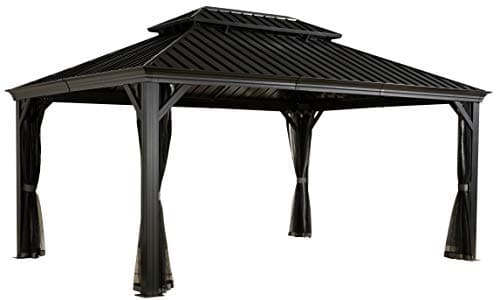 Sojag Messina Hardtop GazeboThe strongest warranty structure in the category — limited lifetime on the frame and 15 years on the finish — paired with wind and snow ratings the manufacturer describes but does not print. | The warranty case for a hardtop | Not published by manufacturer | $2,749.99 · View on Amazon |
| 03 | 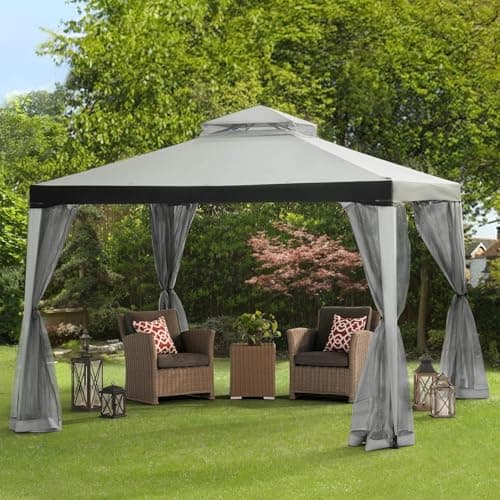 SUNJOY 10 x 10 Soft Top Gazebo with Mosquito NettingNetting and curtains ride on a built-in dual rail rather than clipping to the frame, which is the difference between netting you use and netting that stays in the box. | The case against — and when it is right | Not published by manufacturer | $103.28 · View on Amazon |
The durability table
Every published figure we could source for these structures, in one place, with the manufacturer page each number came from. Where a cell reads "Not published by manufacturer", that figure does not exist in the manufacturer's own material — we do not estimate it and we do not copy one from another site.
| Model | Wind rating (mph) | Snow load | Frame | Roof | Anchoring required | Warranty | Spec source |
|---|---|---|---|---|---|---|---|
| Backyard Discovery Norwood Cedar GazeboTop pick | 100 (Pro-Tect tested; product must be anchored per the manual) | 6,700 lb across the roof, or up to 30 in. of snow (12 x 10 ft model — roughly 56 lb/ft²) | 100% cedar, 6 in. x 6 in. posts, galvanized steel hardware | 29-gauge galvanized steel peak roof, thermal insulated | Mandatory. Product must be anchored as specified in the instruction manual | 5 years | Backyard Discovery Norwood 12x10 product pageChecked 2026-09-26 |
| Sojag Messina Hardtop Gazebo | Not published by manufacturer | Not published by manufacturer | Powder-coated aluminum | Galvanized steel panels | Not published by manufacturer | 1 year limited on the gazebo; limited lifetime on the aluminum/steel frame; 15 years on the powder-coated finish | Sojag hardtop gazebo collectionChecked 2026-09-26 |
| SUNJOY 10 x 10 Soft Top Gazebo with Mosquito Netting | Not published by manufacturer | Not published by manufacturer | Powder-coated steel in grey, 0.98 in. x 0.98 in. posts, 26.45 lb | Ventilated two-tier weather-resistant fabric canopy; removable polyester mesh netting on a built-in dual rail system | Anchoring kit included | Not published by manufacturer | Sunjoy 10x10 soft top gazebo product pageChecked 2026-09-29 |
Every pick in full
Where the money clearly goes somewhere
Backyard Discovery Norwood Cedar Gazebo
The only gazebo we can find that publishes a 100 mph wind rating and a convertible snow figure — and it converts to roughly 56 lb/ft², several times any other hardtop here.
- Wind rating
- 100 (Pro-Tect tested; product must be anchored per the manual)
- Snow load
- 6,700 lb across the roof, or up to 30 in. of snow (12 x 10 ft model — roughly 56 lb/ft²)
- Frame
- 100% cedar, 6 in. x 6 in. posts, galvanized steel hardware
- Roof
- 29-gauge galvanized steel peak roof, thermal insulated
- Anchoring
- Mandatory. Product must be anchored as specified in the instruction manual
- Warranty
- 5 years
- Sizes
- 10 x 10, 12 x 10, 14 x 10, 14 x 12, 16 x 12, 20 x 12 and 24 x 12 ft
If you want the case for spending more stated in figures rather than adjectives, this is it.
100 mph wind rating, Pro-Tect tested, anchoring mandatory per the manual. No soft-top in existence publishes anything comparable, because a fabric canopy on a light frame has nothing to test.
6,700 lb across the roof, or up to 30 in. of snow on the 12 x 10 ft model — roughly 56 lb/ft². This is the number that answers "worth it" for anyone in a snow climate. A structure you do not take down in October is a structure that has to hold what October brings.
100% cedar with 6 in. x 6 in. posts, galvanized steel hardware, 29-gauge insulated steel roof, 5 year warranty. The post section is the giveaway: this is a building, not a canopy.
And the cost is real. Cedar and a tested rating are the expensive end of this category. The question this page asks is whether that is worth it, and here the honest answer is yes only if the structure stays up year-round.
Skip it if: The gazebo comes down every autumn. You are buying a rating you will never use.
#ad Price shown as of November 11, 2026. How this site is funded
Specifications from Backyard Discovery Norwood 12x10 product page, checked 2026-09-26.
The warranty case for a hardtop
Sojag Messina Hardtop Gazebo
The strongest warranty structure in the category — limited lifetime on the frame and 15 years on the finish — paired with wind and snow ratings the manufacturer describes but does not print.
- Wind rating
- Not published by manufacturer
- Snow load
- Not published by manufacturer
- Frame
- Powder-coated aluminum
- Roof
- Galvanized steel panels
- Anchoring
- Not published by manufacturer
- Warranty
- 1 year limited on the gazebo; limited lifetime on the aluminum/steel frame; 15 years on the powder-coated finish
- Sizes
- 10 x 10 ft through 12 x 20 ft
The argument for a hardtop stated as a warranty term rather than as a performance figure.
Limited lifetime on the aluminum and steel frame, 15 years on the powder-coated finish. Set that against a fabric canopy that is a wear item from the day it goes up, and the whole-life arithmetic of this category stops being close.
Galvanized steel roof panels on a powder-coated aluminum frame. Nothing on it perishes. That is the actual definition of a hardtop and the reason the price is different.
10 x 10 ft through 12 x 20 ft, so the entry size is modest. The cheapest way into this argument is a small footprint on a good frame rather than a big footprint on a poor one.
No wind rating, no snow load and no anchoring method published. Worth weighing: you are buying materials and a warranty, not a tested number.
Skip it if: You need a figure to plan around, in which case the Norwood or the Sunjoy is the better buy.
#ad Price shown as of November 11, 2026. How this site is funded
Specifications from Sojag hardtop gazebo collection, checked 2026-09-26.
The case against — and when it is right
SUNJOY 10 x 10 Soft Top Gazebo with Mosquito Netting
Netting and curtains ride on a built-in dual rail rather than clipping to the frame, which is the difference between netting you use and netting that stays in the box.
- Wind rating
- Not published by manufacturer
- Snow load
- Not published by manufacturer
- Frame
- Powder-coated steel in grey, 0.98 in. x 0.98 in. posts, 26.45 lb
- Roof
- Ventilated two-tier weather-resistant fabric canopy; removable polyester mesh netting on a built-in dual rail system
- Anchoring
- Anchoring kit included
- Warranty
- Not published by manufacturer
- Sizes
- 9.84 x 9.84 ft, 9.02 ft high; 9.67 x 9.67 ft between posts, 6.64 ft entry height
Included deliberately. A soft-top is the correct purchase for a large minority of people, and pretending otherwise would make this page an advert.
Powder-coated steel frame, 0.98 in. x 0.98 in. posts, 26.45 lb assembled. Twenty-six pounds is the number that tells you what this is: something one person carries and stores, not something that stands through February.
Ventilated two-tier weather-resistant fabric canopy, with removable mesh netting on a built-in dual rail. The netting on a rail rather than clipped to the frame is genuinely better engineering than most of the soft-top category, and bug season is a real reason to buy one.
9.02 ft high, 9.67 x 9.67 ft between posts, 6.64 ft entry height. A small usable footprint with a low entry — fine for four chairs, not a dining pavilion.
Anchoring kit included, no wind rating published. The honest reading: it is anchored against being blown over on an ordinary day, not rated against a storm.
And the canopy is a wear item. That is the whole trade. Replacement canopy guide covers what replacing one costs and how often.
Skip it if: It will be left standing from March to November. A fabric roof over three seasons a year is a canopy purchase every couple of years.
#ad Price shown as of November 11, 2026. How this site is funded
Specifications from Sunjoy 10x10 soft top gazebo product page, checked 2026-09-29.
The arithmetic, honestly
A hardtop's roof does not perish, and a soft-top's does. That is the entire argument, and everything else on this page is a detail of it. A fabric canopy is a consumable with a service life; a galvanized steel panel on a powder-coated frame is not.
So the question becomes how many canopies you would otherwise buy. A gazebo that stands from spring to autumn and comes down for winter is a different calculation from one that stands permanently. Permanent standing is what kills fabric, and permanent standing is what hardtops exist for.
Then there is the frame underneath, which people compare less and should compare more. 0.98 in. steel posts and a 26.45 lb assembly on one of the soft-tops here; 6 in. x 6 in. cedar posts on the Norwood. Those are not the same object with different roofs.
Then the published figures, which only exist on the hardtop side. 100 mph on the Norwood, 50 mph on the Sunjoy hardtops, 40 mph on the PURPLE LEAF. Nothing in the soft-top category publishes a wind rating, because a light frame under a fabric roof has no fixed configuration to test.
And then the bit nobody budgets for: anchoring and a base. A hardtop that is worth buying is one that is worth anchoring, and anchoring usually means a hard surface. Gazebo foundation options covers the five bases and roughly what each involves.
Where a hardtop earns its money
| Situation | Hardtop worth it? | Why |
|---|---|---|
| Stays up all year, snow climate | Yes, clearly | Fabric will not survive it; two structures here publish a snow figure |
| Stays up all year, mild climate | Yes | UV and standing water kill canopies even without snow |
| Up March to October, taken down for winter | Marginal | A canopy may last several seasons; the frame cost is the swing factor |
| Occasional use, stored between times | No | A pop-up or soft-top is the correct product |
| Exposed plot, cannot anchor into anything solid | No | A heavy roof you cannot anchor is worse than a light one you can |
| Renting, may move within a few years | Depends | Hardtops dismantle, but a bolted-down one leaves holes in someone's slab |
| Cooking under it regularly | Yes | A non-combustible roof is not optional over a grill |
The fifth row is the one people skip. A hardtop roof is heavy and catches wind as a rigid plane. On a plot where you cannot bolt into concrete or drive a proper ground anchor, a hardtop is the wrong structure regardless of budget.
The third row is where most buyers actually sit, and it is genuinely close. Our tiebreaker is the frame rather than the roof: if you would buy a decent frame anyway, the hardtop version of it is usually the better buy.
What people regret, either way
- Buying a hardtop and not anchoring it. The most expensive mistake in this category, and the one the Norwood's manual explicitly pre-empts by making anchoring a condition of the rating.
- Buying a hardtop for a footprint that was always too small. Rigid structures cannot be stretched. Measure from the published base dimension, which on several models here is a foot smaller than the roof.
- Buying a soft-top for permanent standing. The canopy is a wear item and the frame is light. Both facts are published; neither is hidden.
- Buying either without checking the entry height. 6.4 to 6.64 ft on the two soft-tops here that publish it. That is low enough to notice every time you walk under it.
- Assuming a hardtop needs no maintenance. Panel laps and bolts want checking after the first winter. Gazebo roof leaks covers where they actually start.
- Comparing structures on roof size. What size gazebo do I need sets out why the base figure is the one to plan with.
What we would actually do
If it stays up all year, buy the hardtop and buy the anchoring with it. That is the whole recommendation. The structure is only worth its rating once it is fixed down the way the manufacturer specifies.
If it comes down every autumn, buy the best soft-top frame you can and treat the canopy as a consumable. Netting on a built-in rail rather than clipped to the frame is the detail worth paying for, because it is the one that decides whether the netting gets used.
Decide on footprint before budget. A small hardtop beats a large soft-top for almost everybody who was going to leave it standing, and a large hardtop you cannot anchor beats nothing at all.
And read the warranty as a specification. A limited lifetime frame term and fifteen years on a finish is a manufacturer telling you what it thinks the structure is. So is one year on everything.
Then compare against the alternatives properly. Hardtop vs soft-top gazebos sets them against each other spec by spec, and gazebo cost covers what each tier actually involves.
Questions people ask
Are hardtop gazebos worth the money?
How long does a hardtop gazebo last?
Is a hardtop gazebo better than a soft top?
Can you leave a hardtop gazebo up all winter?
Do hardtop gazebos need a concrete base?
Are hardtop gazebos noisy in rain?
What is the cheapest way to get a hardtop?
When is a hardtop gazebo the wrong choice?
What else could I spend that money on?
Where these figures came from
- Backyard Discovery Norwood 12 x 10 cedar gazebo — 100 mph Pro-Tect tested wind rating with anchoring mandatory, 6,700 lb across the roof or up to 30 in. of snow on the 12 x 10 model, 100% cedar with 6 in. x 6 in. posts and galvanized steel hardware, 29-gauge thermal-insulated galvanized steel roof, 5 year warranty
- Sojag hardtop gazebo collection — powder-coated aluminum frame, galvanized steel roof panels, 10 x 10 ft to 12 x 20 ft, 1 year limited on the gazebo, limited lifetime on the frame, 15 years on the powder-coated finish
- SUNJOY 10 x 10 soft top gazebo with mosquito netting — powder-coated steel frame with 0.98 in. x 0.98 in. posts, 26.45 lb, ventilated two-tier fabric canopy with removable polyester mesh netting on a built-in dual rail, 9.02 ft high with 9.67 x 9.67 ft between posts and a 6.64 ft entry height, anchoring kit included
- Sunjoy hardtop gazebo collection and Kingston product page — 50 mph wind ratings; PURPLE LEAF hardtop gazebo collection — 40 mph wind rating
Found an error? Tell us and we will correct it within seven days and note the change on the page with a dated line — see our editorial policy.