The best carport canopies
This is a one-product list with alternatives, and the reason is the point: almost no carport canopy publishes a per-square-foot snow load or a tested wind figure. One does.
By Ryder M. · Published · Last updated
We compare published manufacturer specifications, warranty terms and owner-reported failure modes. We have not physically tested these structures. How we judge shade structures
Slat & Shade earns a commission on qualifying purchases made through links on this page. It costs you nothing extra and never changes what we recommend. Full disclosure
Part of Canopies & Patio Covers
The short answer
The Quictent 10 x 20 heavy-duty carport is the pick and effectively the only documented option: a tested 55 mph wind speed, a 9 lb/ft² snow load, 38 mm galvanized steel tubing with twelve cross cables and a 16 mil waterproof tarp. Most of this category publishes nothing comparable.
Our picks at a glance
| # | Structure | Best for | Wind rating | Price |
|---|---|---|---|---|
| 01 | Quictent Heavy Duty 10 x 20 Carport CanopyThe only canopy on this site that publishes both a per-square-foot snow load and a tested wind speed — 9 lb/ft² and 55 mph. | Top pick, and effectively the only documented one | 55 (tested) | Check price on Amazon |
| 02 |  ABCCANOPY S1 Nova Base Heavy Duty Pop-Up CanopyThe only pop-up here whose manufacturer prints a wind figure at all — and it prints it in km/h, which is the sort of thing this site exists to translate. | The portable alternative | 85 km/h (roughly 53 mph) on the aluminum frame | Check price on Amazon |
| 03 | 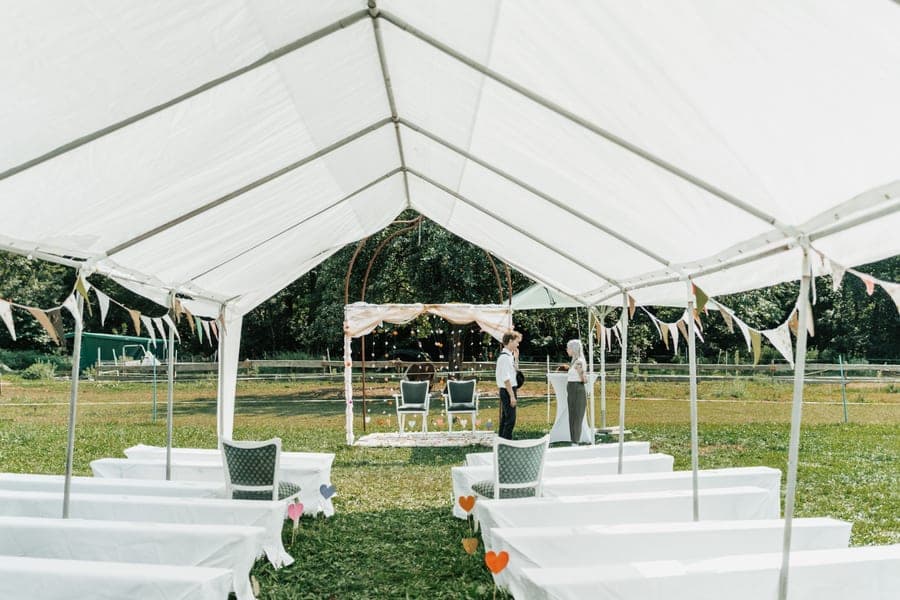 Eurmax Pro 10 x 10 Aluminum Pop-Up CanopyAn aluminum-framed commercial pop-up with a fire-certified 500-denier top — a shade structure you put away, not one you leave standing. | Best fabric in a portable shelter | Not published by manufacturer | Check price on Amazon |
The durability table
Every published figure we could source for these structures, in one place, with the manufacturer page each number came from. Where a cell reads "Not published by manufacturer", that figure does not exist in the manufacturer's own material — we do not estimate it and we do not copy one from another site.
| Model | Wind rating (mph) | Snow load | Frame | Roof | Anchoring required | Warranty | Spec source |
|---|---|---|---|---|---|---|---|
| Quictent Heavy Duty 10 x 20 Carport CanopyTop pick | 55 (tested) | 9 lb/ft² | 1.46 in. (38 mm) heavy-duty galvanized steel tubing with 12 cross steel cables | 16 mil / 180 g PE tarp, 100% UV block, triple-stitched seams | Ground nails and bungee cords supplied | 1 year on poles and tarp; lifetime on joints, ground nails and bungee cords | Quictent 10x20 carport product pageChecked 2026-09-26 |
| ABCCANOPY S1 Nova Base Heavy Duty Pop-Up Canopy | 85 km/h (roughly 53 mph) on the aluminum frame | Not published by manufacturer | Aluminum heavy-duty frame | Not published by manufacturer | Not published by manufacturer | Not published by manufacturer | ABCCANOPY S1 Nova Base product pageChecked 2026-09-26 |
| Eurmax Pro 10 x 10 Aluminum Pop-Up Canopy | Not published by manufacturer | Not published by manufacturer | Aluminum | 500D polyester with PU coating, seam-sealed, CPAI-84 fire retardant certified | Not published by manufacturer | Not published by manufacturer | Eurmax Pro 10x10 product pageChecked 2026-09-26 |
Every pick in full
Top pick, and effectively the only documented one
Quictent Heavy Duty 10 x 20 Carport Canopy
The only canopy on this site that publishes both a per-square-foot snow load and a tested wind speed — 9 lb/ft² and 55 mph.
- Wind rating
- 55 (tested)
- Snow load
- 9 lb/ft²
- Frame
- 1.46 in. (38 mm) heavy-duty galvanized steel tubing with 12 cross steel cables
- Roof
- 16 mil / 180 g PE tarp, 100% UV block, triple-stitched seams
- Anchoring
- Ground nails and bungee cords supplied
- Warranty
- 1 year on poles and tarp; lifetime on joints, ground nails and bungee cords
- Sizes
- 10 x 20 x 8.7 ft (H)
It wins because it publishes the figures a semi-permanent shelter actually needs, and almost nothing else in this category does.
A tested 55 mph wind speed and a 9 lb/ft² snow load — and note that the snow figure is per square foot, not a whole-structure total. That is the form building codes use and the form you can check against the ground snow load your building department holds for your address. It is more useful disclosure than most hardtop gazebos manage, on a product costing far less.
The frame is why the wind figure exists: 1.46 in. (38 mm) heavy-duty galvanized steel tubing with twelve cross steel cables. The cables are the load-bearing insight. An unbraced tube frame racks in wind — it parallelograms before any member fails — and diagonal cables triangulate it into something stiff. Quictent states they boost frame stability substantially, and the mechanism is textbook.
The cover: a 16 mil / 180 g PE tarp, 100% UV block, triple-stitched seams. Genuinely waterproof rather than water resistant, and the triple stitching matters because a sewn seam is a line of holes and the place a waterproof fabric leaks.
The warranty is unusually well thought out: one year on poles and tarp, lifetime on joints, ground nails and bungee cords. Read that as a reliability disclosure — the manufacturer is telling you that the consumables are the tarp and the poles, and that it will stand behind the connectors indefinitely. On a tube-frame shelter the joints are exactly what fails, so warranting them for life is a meaningful commitment.
10 x 20 x 8.7 ft, with roll-up zipper doors on the side panels as well as front and rear, and ground nails and bungee cords supplied.
Skip it if: Your region's ground snow load exceeds 9 lb/ft², or you need a footprint other than 10 x 20 ft with 8.7 ft of clearance.
#ad Price shown as of September 26, 2026. How this site is funded
Specifications from Quictent 10x20 carport product page, checked 2026-09-26.
The portable alternative
ABCCANOPY S1 Nova Base Heavy Duty Pop-Up Canopy
The only pop-up here whose manufacturer prints a wind figure at all — and it prints it in km/h, which is the sort of thing this site exists to translate.
- Wind rating
- 85 km/h (roughly 53 mph) on the aluminum frame
- Snow load
- Not published by manufacturer
- Frame
- Aluminum heavy-duty frame
- Roof
- Not published by manufacturer
- Anchoring
- Not published by manufacturer
- Warranty
- Not published by manufacturer
- Sizes
- 8 x 8 ft and 10 x 10 ft
Not a carport, and here as the honest alternative for anyone whose actual requirement is occasional vehicle or equipment cover rather than a standing shelter.
85 km/h on the aluminum frame — roughly 53 mph — which is the only wind figure published for any pop-up we track, and which converts to just below the Quictent's tested 55 mph. The unit is doing work in that comparison: 85 km/h reads larger than 53 mph and they are the same speed.
Aluminum heavy-duty frame, 8 x 8 and 10 x 10 ft. That is a considerably smaller footprint than a carport — enough for a motorcycle, a mower or a work area, not a car.
What it gets you is portability. Nothing is anchored, nothing stays up, nothing needs a permit conversation, and it goes in a bag. For a cover you want three weekends a year, that is the right product and a carport would be the wrong one.
What it costs you is everything about permanence. No snow figure, no fabric specification published for this model, and a folding frame that is designed to come down rather than stand.
Skip it if: You need to cover a car, or you need the cover to stay up. This is smaller and temporary by design.
#ad Price shown as of September 26, 2026. How this site is funded
Specifications from ABCCANOPY S1 Nova Base product page, checked 2026-09-26.
Best fabric in a portable shelter
Eurmax Pro 10 x 10 Aluminum Pop-Up Canopy
An aluminum-framed commercial pop-up with a fire-certified 500-denier top — a shade structure you put away, not one you leave standing.
- Wind rating
- Not published by manufacturer
- Snow load
- Not published by manufacturer
- Frame
- Aluminum
- Roof
- 500D polyester with PU coating, seam-sealed, CPAI-84 fire retardant certified
- Anchoring
- Not published by manufacturer
- Warranty
- Not published by manufacturer
- Sizes
- 10 x 10 ft, 11.1 ft peak height
The other portable option, and the one with the fabric specification the ABCCANOPY does not publish.
500D polyester with a PU coating, seam-sealed, CPAI-84 fire retardant certified, on an aluminum frame, 10 x 10 ft with an 11.1 ft peak height. That is a commercial event specification, and the fire certification in particular is not something consumer shelters carry.
The high peak is a genuine functional advantage for covering equipment, and not only for rain shedding: 11.1 ft of clearance at the peak means you can work under it and get taller items in, where a low-peak canopy is a headroom problem.
No wind rating is published, which is the correct disclosure for a folding frame — the wind strategy is to fold it down.
Where it fits against a carport: a workspace or equipment cover you deploy, in a better fabric than most, with no anchoring and no permanence. Where it does not fit: anything you want standing next week.
Skip it if: You want cover that stays up, or you need a car-sized footprint.
#ad Price shown as of September 26, 2026. How this site is funded
Specifications from Eurmax Pro 10x10 product page, checked 2026-09-26.
Why this list is one product long
It would have been easy to pad this page. Carport canopies are widely sold and a list of six would look more authoritative than a list of one with two alternatives.
But almost none of them publishes anything comparable. Working through the category, the pattern was consistent: no per-square-foot snow load, no tested wind figure, no tube diameter or gauge, no coating specification, and frequently no manufacturer site at all — just a marketplace listing with a footprint and the phrase "heavy duty".
Our methodology treats a retail listing as citable only when the manufacturer publishes nothing, and with no manufacturer of record there is no source to re-check next quarter — which is when we re-verify every specification on this site. A Durability Table row reading "not published" in every column is not a comparison.
And some of what is published cannot be used. Several carports state a snow capacity as a whole-structure total with no roof area, which cannot be converted into a comparable figure — the same problem that makes a 2,500 lb gazebo figure meaningless across a size range from 6 x 8 to 14 x 28 ft.
So the short list is the finding, and the useful thing this page can do beyond naming the one documented product is tell you what to ask about any other.
What to check on any carport canopy
If a seller cannot answer these, that is your answer.
- Snow load, per square foot. Not a whole-structure total unless the roof area is published alongside it. Quictent states 9 lb/ft². Compare it against the ground snow load your local building department holds for your address — and note that 9 lb/ft² is a modest figure that many regions exceed.
- A wind figure, and whether it is described as tested. Quictent states 55 mph, tested. A bare number with no stated basis is weaker, and no figure at all on a semi-permanent structure is a real gap.
- Frame tube diameter and material. 1.46 in. (38 mm) galvanized steel is a specification you can compare. "Heavy duty steel" is not.
- Bracing. This is the one people miss. A tube frame without diagonal bracing racks in wind, and cross cables or diagonal struts are what stop it. Quictent publishes twelve cross cables; count what you are being offered.
- Cover thickness and seam treatment. 16 mil, 180 g, triple-stitched seams. A sewn seam is a line of holes, so seam treatment is where a waterproof cover leaks.
- What anchoring is supplied and what surface it suits. Quictent supplies ground nails and bungee cords, which are soft-ground hardware. On a concrete driveway you will need expansion fixings, and that is a separate purchase.
- Warranty, split by component. One year on poles and tarp with lifetime on joints tells you where the manufacturer expects failure. A flat term tells you less.
What actually fails on a carport canopy
Three things, and the warranty structure of the one documented product maps onto them almost exactly.
The joints rack. On a tube frame the joints are the weak point in wind, because an unbraced rectangle has no resistance to being pushed into a parallelogram. That is why cross cables exist and why Quictent warrants joints for life while warranting poles for one year — it is confident about the connectors and realistic about the tubes.
The tarp abrades and tears. Fabric moving against a frame member wears through at the contact point, and a tear then propagates from that point — which is what triple-stitched seams and reinforced corners exist to resist. A loose cover accelerates all of it, which is why tension matters on a carport as much as on a shade sail.
Water pools in the top. A cover that has slackened collects water in the middle, the weight deepens the sag, and more water collects. On a 10 x 20 footprint a pool can be a very large amount of weight, and the failure is sudden rather than gradual.
And the fourth: it moves. Ground nails in soft ground are the intended hardware and they are the weakest anchoring in common use against uplift. On a hard surface you need expansion fixings and they are not supplied. Canopy wind ratings and weights covers what ballast can and cannot do.
Is a carport canopy the right product at all?
Worth asking, because the alternatives differ substantially and a carport canopy sits in an unusual position.
Against a permanent metal carport: the canopy is dramatically cheaper, needs no foundation, and is often treated as temporary rather than as a structure requiring a permit. What it gives up is everything — a permanent carport is closer to a building and will outlast several canopies.
Against a pop-up: the carport stays up and publishes figures, where a pop-up folds down and publishes almost nothing. If the cover is needed continuously, the carport is the right answer; if it is needed occasionally, the pop-up is.
Against a pergola or a gazebo: completely different jobs. A carport covers equipment and looks like it; a pergola or gazebo covers people and looks like architecture. Do not buy a carport for a patio, and do not buy a gazebo for a boat.
And the honest limitation to weigh: 9 lb/ft² is a modest snow figure. If your region's ground snow load is meaningfully above it, the answer is either clearing the roof diligently or a different category of structure — and clearing a 10 x 20 tarp roof is a real job. Snow load explained covers how to find the figure you need.
What we cut, and why
Every model below was a genuine candidate and did not make the list. The reason is stated in each case, because a shortlist with no visible rejections is not evidence of a selection process.
- The rest of the carport canopy market — and this is the finding
- We could document exactly one carport canopy properly. The category is large and most of it publishes no per-square-foot snow load, no tested wind figure, no frame tube diameter and no coating specification — often just "heavy duty galvanized steel" and a footprint. A one-product list here is not us running short of research; it is an accurate picture of how little this category publishes.
- Carports with snow capacity published as a whole-structure total
- Several publish a total weight with no roof area, which cannot be converted into anything comparable — the same problem that makes PURPLE LEAF's 2,500 lb gazebo figure unusable. If a manufacturer publishes a total, it has to publish the area too. [Snow load explained](/durability/snow-load-explained) covers the conversion.
- Metal-roof and permanent steel carports
- A genuinely better product for permanent vehicle cover and a different category — closer to a building than a canopy, often requiring a permit and sometimes engineered drawings. We have not built a registry for them and will not recommend one we have not researched to the standard we hold everything else to.
- Carports with no published frame tube diameter or gauge
- On a tube-frame shelter the tube diameter and the bracing are the structure. Quictent publishes 38 mm and twelve cross cables; where a manufacturer publishes neither, there is nothing to assess and the most likely failure — racking at the joints — is exactly what bracing addresses.
Questions people ask
What is the best carport canopy?
Why is there only one carport on this list?
What snow load can a carport canopy take?
How much wind can a carport canopy take?
Are carport canopies waterproof?
Do carport canopies need anchoring?
What fails first on a carport canopy?
Is a carport canopy better than a permanent carport?
Where these figures came from
- Quictent 10x20 carport — 55 mph tested wind, 9 lb/ft² snow load, 1.46 in. (38 mm) galvanized steel tubing with 12 cross cables, 16 mil / 180 g PE tarp, triple-stitched seams, 100% UV block, warranty split, ground nails and bungee cords supplied
- ABCCANOPY S1 Nova Base — 85 km/h figure on the aluminum frame, 8x8 and 10x10 ft sizes
- Eurmax Pro 10x10 — 500D PU-coated polyester, seam-sealed, CPAI-84 fire retardant certified, aluminum frame, 11.1 ft peak height
- PURPLE LEAF hardtop gazebo collection — 2,500 lb published without a roof area, cited as the unusable-total example
Found an error? Tell us and we will correct it within seven days and note the change on the page with a dated line — see our editorial policy.