How to winterize a gazebo
Winterizing a hardtop and winterizing a soft-top are different jobs. One is about clearing a load you can measure; the other is about getting the fabric off before the load arrives.
By Ryder M. · Published · Last updated
We compare published manufacturer specifications, warranty terms and owner-reported failure modes. We have not physically tested these structures. How we judge shade structures
Slat & Shade earns a commission on qualifying purchases made through links on this page. It costs you nothing extra and never changes what we recommend. Full disclosure
Part of Hardtop Gazebos
The short answer
Take off every soft component — canopy, netting, curtains — clean and dry the frame, clear the roof and gutters of debris, check every anchor bolt, and find out your model's published snow figure. A fabric roof should come down before winter; a hardtop stays up and gets cleared.
Our picks at a glance
| # | Structure | Best for | Wind rating | Price |
|---|---|---|---|---|
| 01 |  Backyard Discovery Norwood Cedar GazeboThe only gazebo we can find that publishes a 100 mph wind rating and a convertible snow figure — and it converts to roughly 56 lb/ft², several times any other hardtop here. | The one with a number to work to | 100 (Pro-Tect tested; product must be anchored per the manual) | Check price on Amazon |
| 02 | 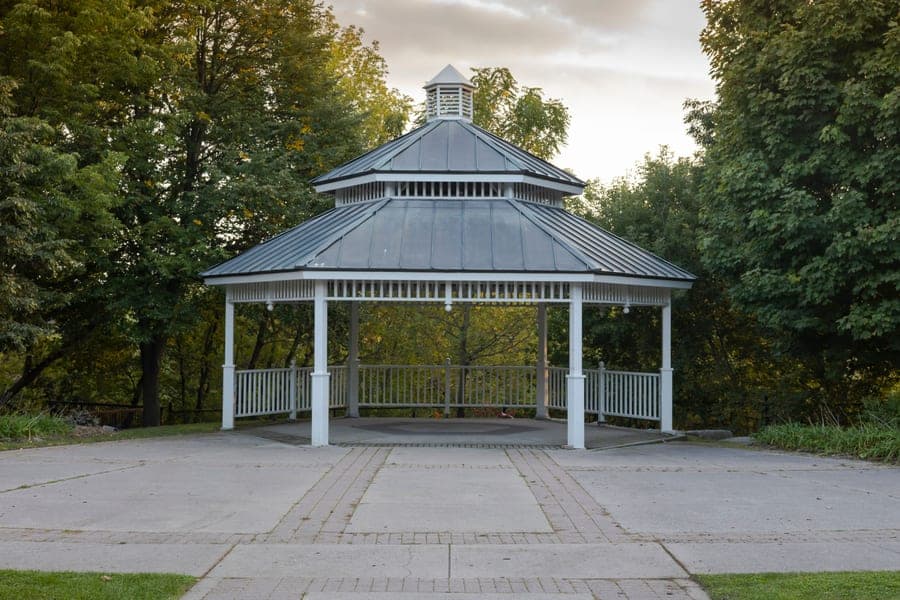 Sojag Messina Hardtop GazeboThe strongest warranty structure in the category — limited lifetime on the frame and 15 years on the finish — paired with wind and snow ratings the manufacturer describes but does not print. | Best finish to protect | Not published by manufacturer | Check price on Amazon |
| 03 |  SUNJOY 10 x 10 Soft Top Gazebo with Mosquito NettingNetting and curtains ride on a built-in dual rail rather than clipping to the frame, which is the difference between netting you use and netting that stays in the box. | The kind that must come down | Not published by manufacturer | Check price on Amazon |
The durability table
Every published figure we could source for these structures, in one place, with the manufacturer page each number came from. Where a cell reads "Not published by manufacturer", that figure does not exist in the manufacturer's own material — we do not estimate it and we do not copy one from another site.
| Model | Wind rating (mph) | Snow load | Frame | Roof | Anchoring required | Warranty | Spec source |
|---|---|---|---|---|---|---|---|
| Backyard Discovery Norwood Cedar GazeboTop pick | 100 (Pro-Tect tested; product must be anchored per the manual) | 6,700 lb across the roof, or up to 30 in. of snow (12 x 10 ft model — roughly 56 lb/ft²) | 100% cedar, 6 in. x 6 in. posts, galvanized steel hardware | 29-gauge galvanized steel peak roof, thermal insulated | Mandatory. Product must be anchored as specified in the instruction manual | 5 years | Backyard Discovery Norwood 12x10 product pageChecked 2026-09-26 |
| Sojag Messina Hardtop Gazebo | Not published by manufacturer | Not published by manufacturer | Powder-coated aluminum | Galvanized steel panels | Not published by manufacturer | 1 year limited on the gazebo; limited lifetime on the aluminum/steel frame; 15 years on the powder-coated finish | Sojag hardtop gazebo collectionChecked 2026-09-26 |
| SUNJOY 10 x 10 Soft Top Gazebo with Mosquito Netting | Not published by manufacturer | Not published by manufacturer | Powder-coated steel in grey, 0.98 in. x 0.98 in. posts, 26.45 lb | Ventilated two-tier weather-resistant fabric canopy; removable polyester mesh netting on a built-in dual rail system | Anchoring kit included | Not published by manufacturer | Sunjoy 10x10 soft top gazebo product pageChecked 2026-09-29 |
Every pick in full
The one with a number to work to
Backyard Discovery Norwood Cedar Gazebo
The only gazebo we can find that publishes a 100 mph wind rating and a convertible snow figure — and it converts to roughly 56 lb/ft², several times any other hardtop here.
- Wind rating
- 100 (Pro-Tect tested; product must be anchored per the manual)
- Snow load
- 6,700 lb across the roof, or up to 30 in. of snow (12 x 10 ft model — roughly 56 lb/ft²)
- Frame
- 100% cedar, 6 in. x 6 in. posts, galvanized steel hardware
- Roof
- 29-gauge galvanized steel peak roof, thermal insulated
- Anchoring
- Mandatory. Product must be anchored as specified in the instruction manual
- Warranty
- 5 years
- Sizes
- 10 x 10, 12 x 10, 14 x 10, 14 x 12, 16 x 12, 20 x 12 and 24 x 12 ft
Winterizing is much easier when you know what the roof carries, and this is the only gazebo here that tells you in a form you can actually use.
6,700 lb across the 12 x 10 ft roof, or up to 30 in. of snow — roughly 56 lb/ft². A depth figure is unusually practical: it means you can look at the roof, estimate the depth and know whether you are near the limit. Most listings give you nothing to compare against at all.
29-gauge galvanized steel in a peak roof, thermal insulated. A pitched metal panel is the best winter roof in the category because it sheds a wet load before it accumulates. Insulation also reduces the melt-and-refreeze cycle that builds ice at the eaves.
Anchoring is mandatory and winter is when that matters most. Winter storms bring the highest wind of the year onto a roof that may also be carrying snow. Re-check every anchor bolt in autumn — that is the single highest-value item on the whole winterizing list.
Skip it if: You want a structure you can take down for winter. A cedar-framed, permanently anchored gazebo is a year-round installation by design.
#ad Price shown as of September 26, 2026. How this site is funded
Specifications from Backyard Discovery Norwood 12x10 product page, checked 2026-09-26.
Best finish to protect
Sojag Messina Hardtop Gazebo
The strongest warranty structure in the category — limited lifetime on the frame and 15 years on the finish — paired with wind and snow ratings the manufacturer describes but does not print.
- Wind rating
- Not published by manufacturer
- Snow load
- Not published by manufacturer
- Frame
- Powder-coated aluminum
- Roof
- Galvanized steel panels
- Anchoring
- Not published by manufacturer
- Warranty
- 1 year limited on the gazebo; limited lifetime on the aluminum/steel frame; 15 years on the powder-coated finish
- Sizes
- 10 x 10 ft through 12 x 20 ft
On a hardtop that stays up all winter, the thing you are protecting is the coating — and this is the model that tells you how long it expects that coating to last.
Limited lifetime on the aluminum and steel frame, 15 years on the powder-coated finish. Read the second number as the maintenance target. The frame is not what winter attacks; the finish is, and once the finish fails the galvanizing starts being consumed.
Galvanized steel panels on a powder-coated aluminum frame. An aluminum frame is the easiest winter structure to own: it does not rot, and the salt and grit that get thrown around in winter do far less to it than to plated steel.
Sojag publishes neither a wind nor a snow figure for this model, which changes the winter plan rather than ruining it: with no number to work to, clear the roof earlier and more often than you would on a model that publishes one. Judging by eye is worse than judging by a figure, so be conservative.
Skip it if: You want a published snow figure to plan around. Sojag does not print one, so your clearing schedule has to be cautious rather than calculated.
#ad Price shown as of September 26, 2026. How this site is funded
Specifications from Sojag hardtop gazebo collection, checked 2026-09-26.
The kind that must come down
SUNJOY 10 x 10 Soft Top Gazebo with Mosquito Netting
Netting and curtains ride on a built-in dual rail rather than clipping to the frame, which is the difference between netting you use and netting that stays in the box.
- Wind rating
- Not published by manufacturer
- Snow load
- Not published by manufacturer
- Frame
- Powder-coated steel in grey, 0.98 in. x 0.98 in. posts, 26.45 lb
- Roof
- Ventilated two-tier weather-resistant fabric canopy; removable polyester mesh netting on a built-in dual rail system
- Anchoring
- Anchoring kit included
- Warranty
- Not published by manufacturer
- Sizes
- 9.84 x 9.84 ft, 9.02 ft high; 9.67 x 9.67 ft between posts, 6.64 ft entry height
Included to make the most important point on this page: if your gazebo has a fabric roof, winterizing means removing it, not protecting it.
A 10 x 10 soft-top gazebo with mosquito netting — 9.84 x 9.84 ft, 9.02 ft high, 9.67 x 9.67 ft between the posts. The canopy and the netting are both soft components, and both are consumables with a service life measured in seasons rather than decades.
A fabric roof holding wet snow is the worst load case in this category. Fabric has no stiffness, so it pockets: snow collects in the sag, the sag deepens, more snow collects, and the whole thing comes down on the frame. There is no published figure because there is no sensible figure to publish.
So take the canopy off, dry it completely, and store it indoors. A damp canopy folded in a shed grows mould all winter and comes out stained and weakened. The frame can stay up, anchored, with nothing for wind to push against. Replacement canopy guide covers what to do when the fabric has had enough.
Skip it if: You want year-round shelter. A soft-top is a three-season structure, and treating it as a four-season one is how the frame gets bent.
#ad Price shown as of September 26, 2026. How this site is funded
Specifications from Sunjoy 10x10 soft top gazebo product page, checked 2026-09-29.
Find out what your roof carries, first
Everything else on this page is routine. This is the step that decides whether you have a plan or a hope.
Look up your model's published snow figure, and check what form it is in. The figures in this category come in three incompatible shapes: a load per square foot (the comparable one), a whole-roof total in pounds (which means nothing until you divide by the roof area), and nothing at all.
Then compare it with your local ground snow load, which your building department publishes. That is the number winter will actually deliver. Snow load explained sets out how to make that comparison properly, including why a whole-roof total is not directly usable.
If your model publishes nothing, treat it as unknown rather than as adequate. That is not pessimism: a manufacturer that has not published a snow figure has not committed to one, and clearing the roof early costs you twenty minutes where guessing wrong costs you the gazebo.
And if the roof is fabric, the answer is that it carries nothing. Take it off. That is the entire snow plan for a soft-top.
The autumn checklist
Do this on a dry day before the first freeze. An hour, start to finish, on a typical hardtop.
- 01Remove every soft component. Canopy, netting, curtains, cushions. Wash what needs washing, dry everything fully, and store it indoors — not in the gazebo, and not damp.
- 02Clear the roof and the gutter line of debris. Wet leaves on a roof panel hold moisture against the finish all winter, and a blocked gutter or drainage channel is where ice forms first and does the most damage.
- 03Wash and dry the frame, and deal with any coating damage now. A scratch through powder coating is where corrosion starts. Winter is the worst time for an exposed scratch and autumn is the last chance to touch it in.
- 04Check every anchor bolt and tighten what has worked loose. Winter brings the highest winds of the year, sometimes onto a loaded roof. This is the most important item on the list — how to anchor a gazebo covers what each surface needs.
- 05Check the roof fixings specifically, not just the ground plates. Panel fixings loosen over a summer of thermal cycling, and a lifted panel edge in a winter gale is how a roof unzips.
- 06Look at what is overhead. A branch that is fine in July is a different proposition loaded with ice. This is the one winter hazard that is entirely preventable in autumn.
- 07Then plan your clearing access. Decide now how you will reach the roof safely in February, because improvising that in snow is how people get hurt.
Clearing snow without damaging the roof
The goal is removing load, not getting the roof clean, and the difference matters because most roof damage in winter is caused by the clearing rather than the snow.
- Clear early and often rather than once and thoroughly. Fresh snow is light and comes off easily; the same snow after a thaw and refreeze is dense, bonded to the panel and three times the weight.
- Push from below with a soft-edged roof rake, standing on the ground. Never climb onto a gazebo roof — these panels are rated for a distributed snow load, not for a person in one spot, and a polycarbonate panel will not hold you at all.
- Work from the eave upward, taking a layer at a time. Trying to shift the whole depth in one pull is how a rake catches a fixing or a panel edge.
- Never use a metal shovel, an ice pick or hot water. Metal gouges the coating on steel and cracks polycarbonate; hot water refreezes lower down and builds the ice dam you were trying to remove.
- Leave the last inch. A thin layer of snow weighs nothing and protects the finish from the tool. Scraping down to bare panel is where the scratches come from.
- Watch for pooling where snow has melted and refrozen at the drainage points. Standing water that freezes expands, and that is the mechanism that splits a drainage channel.
- And if it is a fabric roof you left up, take it down now even if there is snow on it. A pocketed canopy only gets worse.
What we would actually do
Soft components off in October, frame left standing and anchored. This is most of the job and the part people skip. A canopy stored dry indoors lasts years longer than one left to freeze, thaw and flap all winter.
On a hardtop with a published snow figure, work to it. Know your roof's limit and your local ground snow load, and clear when the depth gets close rather than when it looks dramatic.
On a hardtop with no published figure, clear earlier. No number means no commitment from the manufacturer, and the honest response to that is caution rather than optimism.
Re-check every anchor bolt in autumn and again in spring. Winter is when the highest loads arrive and the one maintenance item that matters most is also the quickest to do.
And do not store the patio furniture in the gazebo. It is tempting and it blocks exactly the access you will need when you have to clear the roof in a hurry.
Questions people ask
How do you winterize a gazebo?
Should you take a gazebo down for winter?
Do you need to remove snow from a hardtop gazebo?
How do you get snow off a gazebo roof safely?
Can you leave a soft-top gazebo up in winter?
How much snow can a gazebo hold?
Should I cover my gazebo for winter?
What damages a gazebo most in winter?
Where these figures came from
- Backyard Discovery Norwood 12x10 gazebo — 6,700 lb across the roof or up to 30 in. of snow (roughly 56 lb/ft²), 29-gauge insulated galvanized steel roof, mandatory anchoring
- Sojag hardtop gazebo collection — galvanized steel panels on a powder-coated aluminum frame, limited lifetime frame warranty, 15 years on the powder-coated finish
- SUNJOY 10x10 soft top gazebo with mosquito netting — 9.84 x 9.84 ft, 9.02 ft high, 9.67 x 9.67 ft between posts, fabric canopy and netting as soft components
- Sunjoy hardtop gazebo collection — whole-roof snow totals published in pounds rather than per square foot
Found an error? Tell us and we will correct it within seven days and note the change on the page with a dated line — see our editorial policy.