Motorized vs manual awning
Both of these retract to exactly the same published wind limit. The difference is how likely you are to do it — and, on the models here, what the fabric is made of.
By Ryder M. · Published · Last updated
We compare published manufacturer specifications, warranty terms and owner-reported failure modes. We have not physically tested these structures. How we judge shade structures
Slat & Shade earns a commission on qualifying purchases made through links on this page. It costs you nothing extra and never changes what we recommend. Full disclosure
Part of Canopies & Patio Covers
The short answer
A motorized awning is worth it mainly because you will actually retract it: both types share the same Beaufort 5 limit of roughly 19 to 24 mph, and a manual awning only survives if someone cranks it in. A manual awning has fewer parts to fail and works in a power cut. Check the fabric separately — it is the component that decides the lifespan.
Our picks at a glance
| # | Structure | Best for | Wind rating | Price |
|---|---|---|---|---|
| 01 | 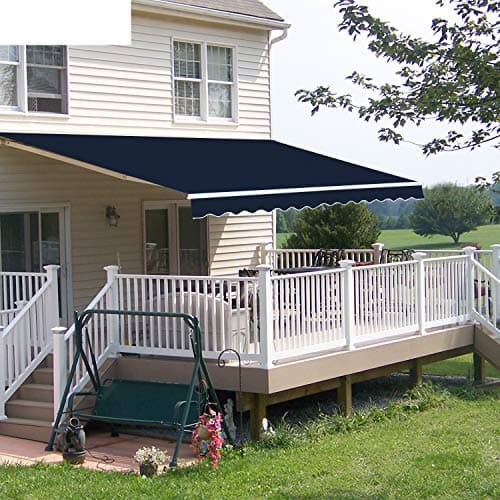 Diensweek P100 Manual Retractable AwningRetracts, which is the only wind strategy a fabric awning has. The published rating is a Beaufort number, not a mile-per-hour figure. | The manual case: fewer things to break | Beaufort 5 (roughly 19-24 mph) — retract above it | $859.99 · View on Amazon |
| 02 | 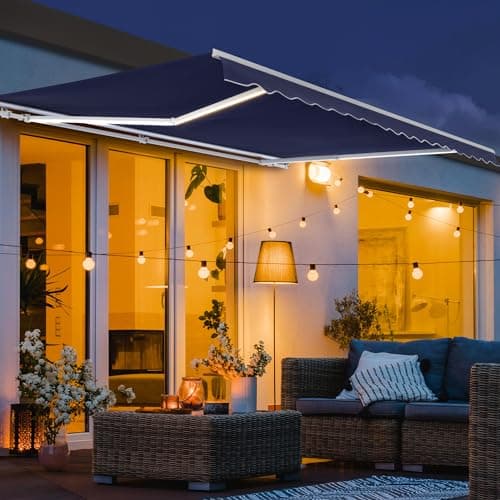 Diensweek Motorized Acrylic Retractable AwningSolution-dyed acrylic instead of coated polyester — the upgrade that decides whether the fabric still has its color in year six. | The motorized case: it actually gets retracted | Beaufort 5 (roughly 19-24 mph) — retract above it | $1,799.99 · View on Amazon |
The durability table
Every published figure we could source for these structures, in one place, with the manufacturer page each number came from. Where a cell reads "Not published by manufacturer", that figure does not exist in the manufacturer's own material — we do not estimate it and we do not copy one from another site.
| Model | Wind rating (mph) | Snow load | Frame | Roof | Anchoring required | Warranty | Spec source |
|---|---|---|---|---|---|---|---|
| Diensweek P100 Manual Retractable AwningTop pick | Beaufort 5 (roughly 19-24 mph) — retract above it | Not published by manufacturer | T5-grade aluminum with PVC-coated stainless steel arm cables and galvanized steel roller tube | 280 g/m² polyester with PU coating, water resistant, 50 UV+ | Not published by manufacturer | 1 year | Diensweek official siteChecked 2026-09-26 |
| Diensweek Motorized Acrylic Retractable Awning | Beaufort 5 (roughly 19-24 mph) — retract above it | Not published by manufacturer | Corrosion-resistant aluminum | 100% acrylic, fade-resistant, 80 UV+ | Not published by manufacturer | 1 year | Diensweek official siteChecked 2026-09-26 |
Every pick in full
The manual case: fewer things to break
Diensweek P100 Manual Retractable Awning
Retracts, which is the only wind strategy a fabric awning has. The published rating is a Beaufort number, not a mile-per-hour figure.
- Wind rating
- Beaufort 5 (roughly 19-24 mph) — retract above it
- Snow load
- Not published by manufacturer
- Frame
- T5-grade aluminum with PVC-coated stainless steel arm cables and galvanized steel roller tube
- Roof
- 280 g/m² polyester with PU coating, water resistant, 50 UV+
- Anchoring
- Not published by manufacturer
- Warranty
- 1 year
- Sizes
- 8 x 7 ft to 15 x 10 ft
A hand-cranked awning on a published frame specification, and the one to buy if you are the kind of person who winds things in.
Beaufort 5, roughly 19 to 24 mph — retract above it. The same published limit as the motorized version below. This is the fact that reframes the whole comparison: the motor does not raise the ceiling, it only makes reaching the ceiling less likely to end badly.
T5-grade aluminum with PVC-coated stainless steel arm cables and a galvanized steel roller tube. The arm cables are the part that fails on a cheap awning, and both the grade and the coating are published here. A manual awning's load path ends at a crank handle rather than at a gearbox, which is one fewer assembly in the chain.
280 g/m² polyester with a PU coating, water resistant, 50 UV+. This is the weak point relative to the motorized model, and it is about fabric rather than operation — a PU-coated polyester is a coated cloth, and coatings eventually craze and fade.
Sizes 8 x 7 ft to 15 x 10 ft. The second number is the projection, which is the dimension that decides whether the shade lands on your table. Ten feet of reach is the maximum here.
One year of warranty. Standard for the category, and in a manual awning the thing most likely to need it is the arm mechanism.
Skip it if: Nobody in the house will crank it in. An unretracted awning in a gust is the expensive failure this category has.
#ad Price shown as of November 11, 2026. How this site is funded
Specifications from Diensweek official site, checked 2026-09-26.
The motorized case: it actually gets retracted
Diensweek Motorized Acrylic Retractable Awning
Solution-dyed acrylic instead of coated polyester — the upgrade that decides whether the fabric still has its color in year six.
- Wind rating
- Beaufort 5 (roughly 19-24 mph) — retract above it
- Snow load
- Not published by manufacturer
- Frame
- Corrosion-resistant aluminum
- Roof
- 100% acrylic, fade-resistant, 80 UV+
- Anchoring
- Not published by manufacturer
- Warranty
- 1 year
- Sizes
- Up to 15 x 10 ft
The same manufacturer's motorized model, and the genuinely important difference is not the motor — it is the cloth that comes with it.
100% acrylic, fade-resistant, 80 UV+. Solution-dyed acrylic rather than coated polyester. The color is in the fibre instead of on it, which is the upgrade that decides whether the fabric still looks like itself in year six. 80 UV+ against 50 UV+ on the manual model is a real difference under a seating area.
Beaufort 5, roughly 19 to 24 mph — retract above it. Identical to the manual. Worth saying plainly because the usual assumption is that a motorized awning is sturdier, and the published figures say it is not.
Corrosion-resistant aluminum frame. Less detail published than on the manual model's frame, which is mildly frustrating — you get a better fabric spec and a thinner frame spec.
Up to 15 x 10 ft, one year of warranty. Same maximum projection.
And the motor is the real argument: retraction becomes a two-second decision. A gust warning, one button, done. Every awning failure in this category is a retraction that did not happen, and removing the friction is worth more than any frame upgrade.
Skip it if: There is no sensible power supply at the wall, or you want something that works in an outage. A manual crank does not care.
#ad Price shown as of November 11, 2026. How this site is funded
Specifications from Diensweek official site, checked 2026-09-26.
The specs that are identical, and the one that is not
Both models publish Beaufort 5 — roughly 19 to 24 mph — with the instruction to retract above it. Same manufacturer, same limit, manual and motorized. A retractable awning is a fabric arm cantilevered off a wall, and the limit comes from that geometry rather than from how it is driven.
So the motor does not buy you weather tolerance. It buys you compliance. The single most common way an awning dies is being left out in a gust, and the probability of that is a human-behavior problem. A button at the back door changes the behavior; a crank handle in the shed does not.
The fabric is where the real specification difference sits on these two models. 280 g/m² PU-coated polyester at 50 UV+ on the manual; 100% solution-dyed acrylic at 80 UV+ on the motorized. That is not a motor difference, it is a trim-level difference — but it is the one that decides what the awning looks like in a decade.
Which means the comparison to run is not "motor or crank" but "which package". Canopy fabric materials covers what each cloth survives, and on an awning the fabric is the component you cannot upgrade later without replacing the whole roller.
Side by side
Manufacturer figures for both models.
| Manual (P100) | Motorized acrylic | |
|---|---|---|
| Published wind limit | Beaufort 5 (about 19-24 mph), retract above | Beaufort 5 (about 19-24 mph), retract above |
| Fabric | 280 g/m² polyester, PU coated, water resistant | 100% acrylic, fade-resistant |
| UV rating | 50 UV+ | 80 UV+ |
| Frame | T5 aluminum, PVC-coated stainless arm cables, galvanized roller | Corrosion-resistant aluminum |
| Maximum size | 15 x 10 ft | Up to 15 x 10 ft |
| Works in a power cut | Yes | Only with a manual override |
| Parts that can fail | Crank, gearbox, arm cables | Motor, controller, wiring, arm cables |
| Warranty | 1 year | 1 year |
The first row being identical is the whole point of the page. Nobody should buy a motor expecting a higher wind limit, because there isn't one.
The UV row is the one that compounds. 80 UV+ on solution-dyed acrylic against 50 UV+ on coated polyester, on a product whose job is to stand in direct sun for twenty years. That is where the price difference actually goes.
Which one to buy
- You use the patio daily and the awning is in reach: manual is fine. A crank you pass twice a day gets used, and you have one fewer electrical assembly on an outside wall.
- The awning is above a first-floor balcony, or anywhere awkward: motorized. Every obstacle between you and the handle is a reason it stays out in weather.
- You travel, or the house is sometimes empty: motorized, ideally with a wind sensor. An awning left extended for a fortnight is a question of when rather than whether.
- You want the fabric to last: motorized, on these models — but check why. It is the acrylic you are buying, not the motor. If a manual version with solution-dyed acrylic is available, that is the better value package.
- Power is awkward at the wall: manual. Running a supply to an exterior wall for an awning motor is a real job, and a motorized awning with no manual override and no power is a fixed canopy.
- You already know you will not retract it: neither. Buy a fixed structure instead. Is a retractable awning worth it works through that honestly.
What we would actually do
Decide the fabric first, then the drive. Solution-dyed acrylic over coated polyester, every time, on a product that stands in sun for two decades. If the only acrylic option is the motorized one, that is a reason to buy the motorized one — but be clear that is what you are paying for.
Then measure the projection, not the width. Both models top out at 10 ft of reach. Stand where you actually sit at 4pm and measure back to the wall; if the answer is more than 10 ft, no awning here will shade you and a freestanding structure is the better answer.
Then find the structure behind the wall before you buy either. An awning at full extension puts a serious lever on its brackets, and the load has to reach framing or masonry. Siding and fascia board are not fixing points, and a lag screw biting into them tells you nothing.
Then agree the retraction rule with yourself in writing. Beaufort 5 is roughly 19 to 24 mph — a brisk breeze. Pick a wind speed you will act on and act on it, because the published limit is the entire maintenance plan for either version.
And if the honest answer is that it will never get retracted, buy a louvered pergola or a hardtop instead. Best retractable awnings covers the field if you do want one, and canopy vs awning covers the freestanding alternatives.
Questions people ask
Is a motorized awning better than a manual one?
Does a motorized awning handle more wind?
What happens to a motorized awning in a power cut?
Which awning fabric lasts longer, acrylic or polyester?
Are motorized awnings more likely to break?
Can you convert a manual awning to motorized?
How far out does a retractable awning reach?
Should I get a wind sensor with a motorized awning?
Where these figures came from
- Diensweek P100 manual retractable awning — Beaufort 5 (roughly 19-24 mph) with instruction to retract above it, T5-grade aluminum with PVC-coated stainless steel arm cables and galvanized steel roller tube, 280 g/m² PU-coated polyester at 50 UV+, sizes 8 x 7 ft to 15 x 10 ft, 1 year
- Diensweek motorized acrylic retractable awning — Beaufort 5 (roughly 19-24 mph) with instruction to retract above it, corrosion-resistant aluminum frame, 100% acrylic fade-resistant fabric at 80 UV+, up to 15 x 10 ft, 1 year
Found an error? Tell us and we will correct it within seven days and note the change on the page with a dated line — see our editorial policy.