Backyard Discovery wind and snow ratings
Backyard Discovery publishes more weather data than almost anyone in this category. Here is every figure we can source from the manufacturer, with the pounds converted into something you can compare.
By Ryder M. · Published · Last updated
We compare published manufacturer specifications, warranty terms and owner-reported failure modes. We have not physically tested these structures. How we judge shade structures
Slat & Shade earns a commission on qualifying purchases made through links on this page. It costs you nothing extra and never changes what we recommend. Full disclosure
Part of Hardtop Gazebos

The short answer
Backyard Discovery publishes winds up to 100 mph on every gazebo model we checked, with the product anchored as directed. Snow is published as a total weight on the roof, from 5,600 lb on the 10 x 10 Norwood to 12,700 lb on the 20 x 12 Barrington, each quoted as up to 30 inches of snow.
Our picks at a glance
| # | Structure | Best for | Snow load | Price |
|---|---|---|---|---|
| 01 | 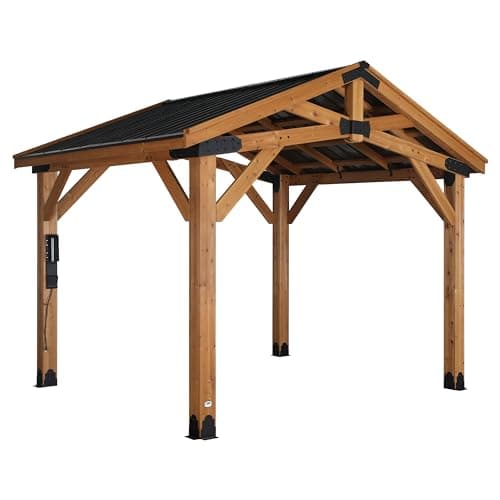 Backyard Discovery Norwood Cedar GazeboThe only gazebo we can find that publishes a 100 mph wind rating and a convertible snow figure — and it converts to roughly 56 lb/ft², several times any other hardtop here. | The model the published figures are built around | 6,700 lb across the roof, or up to 30 in. of snow (12 x 10 ft model — roughly 56 lb/ft²) | $1,999.00 · View on Amazon |
| 02 | 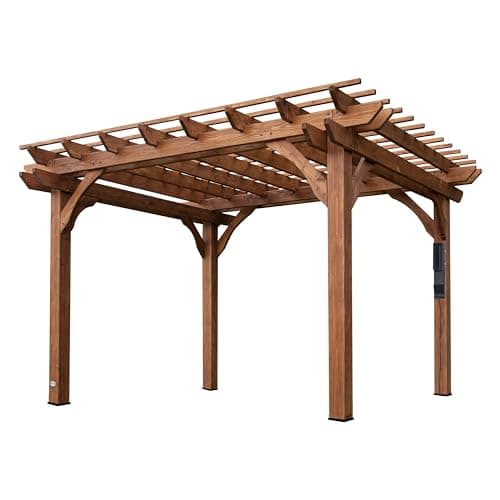 Backyard Discovery Beaumont Cedar PergolaThe highest published wind rating of any pergola on this site, and the only wood kit whose manufacturer makes anchoring a stated condition of the rating. | The same 100 mph figure, on an open roof | Not published by manufacturer | $1,199.00 · View on Amazon |
The durability table
Every published figure we could source for these structures, in one place, with the manufacturer page each number came from. Where a cell reads "Not published by manufacturer", that figure does not exist in the manufacturer's own material — we do not estimate it and we do not copy one from another site.
| Model | Wind rating (mph) | Snow load | Frame | Roof | Anchoring required | Warranty | Spec source |
|---|---|---|---|---|---|---|---|
| Backyard Discovery Norwood Cedar GazeboTop pick | 100 (Pro-Tect tested; product must be anchored per the manual) | 6,700 lb across the roof, or up to 30 in. of snow (12 x 10 ft model — roughly 56 lb/ft²) | 100% cedar, 6 in. x 6 in. posts, galvanized steel hardware | 29-gauge galvanized steel peak roof, thermal insulated | Mandatory. Product must be anchored as specified in the instruction manual | 5 years | Backyard Discovery Norwood 12x10 product pageChecked 2026-09-26 |
| Backyard Discovery Beaumont Cedar Pergola | 100 (when properly anchored) | Not published by manufacturer | 100% cedar, 5.5 in. x 5.5 in. posts | Multi-level cedar trellis roof with crossing rafters — open, not solid | Mandatory. Concealed concrete anchors, per the instruction manual | 5 years | Backyard Discovery Beaumont product pageChecked 2026-09-26 |
Every pick in full
The model the published figures are built around
Backyard Discovery Norwood Cedar Gazebo
The only gazebo we can find that publishes a 100 mph wind rating and a convertible snow figure — and it converts to roughly 56 lb/ft², several times any other hardtop here.
- Wind rating
- 100 (Pro-Tect tested; product must be anchored per the manual)
- Snow load
- 6,700 lb across the roof, or up to 30 in. of snow (12 x 10 ft model — roughly 56 lb/ft²)
- Frame
- 100% cedar, 6 in. x 6 in. posts, galvanized steel hardware
- Roof
- 29-gauge galvanized steel peak roof, thermal insulated
- Anchoring
- Mandatory. Product must be anchored as specified in the instruction manual
- Warranty
- 5 years
- Sizes
- 10 x 10, 12 x 10, 14 x 10, 14 x 12, 16 x 12, 20 x 12 and 24 x 12 ft
The Norwood is the range Backyard Discovery publishes most completely, and it is the one to look at if the ratings are why you are here.
100 mph, Pro-Tect tested, with the product anchored as specified in the instruction manual. The anchoring clause is not small print — it is the condition the figure is quoted under, and an unanchored Norwood is an unrated Norwood.
6,700 lb across the roof on the 12 x 10, or up to 30 inches of snow. Converted against the nominal 120 sq ft footprint, that is roughly 56 lb/ft² — several times what most hardtop gazebos in this category publish, when they publish anything at all.
100% cedar with 6 in. x 6 in. posts and galvanized steel hardware. The post section is doing the structural work here. Across Backyard Discovery's range the roof style changes and the wind number does not, which points at the frame rather than the roof.
29-gauge galvanized steel peak roof, thermal insulated. A solid steel roof rather than polycarbonate, which is why a snow figure exists at all.
Five-year warranty, which is the standard term across this manufacturer's gazebos and pergolas.
Skip it if: You want an aluminum-framed gazebo. This is a cedar kit, and cedar means a maintenance schedule — see [how long shade structures last](/durability/how-long-shade-structures-last).
#ad Price shown as of November 11, 2026. How this site is funded
Specifications from Backyard Discovery Norwood 12x10 product page, checked 2026-09-26.
The same 100 mph figure, on an open roof
Backyard Discovery Beaumont Cedar Pergola
The highest published wind rating of any pergola on this site, and the only wood kit whose manufacturer makes anchoring a stated condition of the rating.
- Wind rating
- 100 (when properly anchored)
- Snow load
- Not published by manufacturer
- Frame
- 100% cedar, 5.5 in. x 5.5 in. posts
- Roof
- Multi-level cedar trellis roof with crossing rafters — open, not solid
- Anchoring
- Mandatory. Concealed concrete anchors, per the instruction manual
- Warranty
- 5 years
- Sizes
- 10 x 10 ft, 12 x 10 ft, 14 x 10 ft, 14 x 12 ft, 16 x 12 ft, 20 x 12 ft
Worth including because it is the clearest evidence for what the 100 mph number is actually measuring.
100 mph when properly anchored, on a pergola with an open trellis roof. The same headline figure as the solid-roofed gazebos. An open roof passes wind through and a solid roof does not, so if the number were roof-driven these would differ. They do not.
100% cedar, 5.5 in. x 5.5 in. posts, with concealed concrete anchors specified in the manual. The anchoring is mandatory and named, which is the same pattern as the gazebo range.
No published snow load, and that is correct rather than an omission. An open trellis roof does not hold a snow load; there is no surface for snow to sit on. Do pergolas provide shade covers the same trade-off from the sun side.
Sizes from 10 x 10 ft to 20 x 12 ft, five-year warranty. The size range mirrors the gazebos, which makes the two ranges genuinely comparable on everything except the roof.
Skip it if: You need rain cover or a snow rating. An open-roof pergola publishes neither, by design.
#ad Price shown as of November 11, 2026. How this site is funded
Specifications from Backyard Discovery Beaumont product page, checked 2026-09-26.
The short answer, model by model
Every figure below is quoted from the manufacturer's own product page, checked on 14 October 2026. The pounds-per-square-foot column is our arithmetic on their published total, using the nominal footprint — it is not a figure Backyard Discovery publishes.
| Model | Published wind | Published snow load | Converted (nominal footprint) |
|---|---|---|---|
| Norwood 10 x 10 | Up to 100 mph | 5,600 lb, up to 30 in. of snow | About 56 lb/ft² |
| Norwood 12 x 10 | Up to 100 mph | 6,700 lb, up to 30 in. of snow | About 56 lb/ft² |
| Norwood 14 x 12 | Up to 100 mph | 9,000 lb, up to 30 in. of snow | About 54 lb/ft² |
| Norwood 16 x 12 | Up to 100 mph | 10,600 lb, up to 30 in. of snow | About 55 lb/ft² |
| Crosswind 14 x 10 | Up to 100 mph | 7,900 lb, 30 in. of snow | About 56 lb/ft² |
| Arcadia 14 x 12 | Up to 100 mph | 8,700 lb, up to 30 in. of snow | About 52 lb/ft² |
| Barrington 20 x 12 gazebo/carport | Up to 100 mph | 12,700 lb, up to 30 in. of snow | About 53 lb/ft² |
Every model publishes the same wind figure and a different snow figure. That is the pattern, and it is the most useful thing on this page.
The converted column lands between roughly 52 and 56 lb/ft² across every model. The total weight scales with roof area because the design is the same; the structure is not getting stronger as it gets bigger, it is getting larger.
Why the wind number never changes
100 mph appears on the 10 x 10 and on the 20 x 12, on peak roofs and on sloped roofs, and on an open-trellis pergola. A figure that does not move across roof types or footprints is telling you something: it is a frame-and-anchoring figure, not a roof figure.
Backyard Discovery states the condition every time — the product must be anchored as specified in the instruction manual, and the rating is quoted as winds up to 100 mph when anchored as directed. That clause is the whole rating. Wind lifts a roof rather than pushing it over, and the only thing resisting uplift is the connection to the ground.
6 in. x 6 in. cedar posts are doing the work. Within a frame material, roof type decides the snow number; across frame materials, the posts decide the wind number. That is consistent with the rest of the category, where slim-section aluminum frames publish far lower figures where they publish any.
It also means the number is a ceiling, not a promise about your yard. Wind ratings explained covers what a manufacturer's figure does and does not commit to, and gazebo wind ratings sets this against every other published figure we can find.
What "up to 30 inches of snow" actually assumes
Both halves of the snow claim are published together: a total weight in pounds, and a depth of 30 inches. Pairing them tells you the density the manufacturer is assuming, because weight divided by depth is density.
Run that arithmetic and it comes out around 22 lb per cubic foot. That is wet, compacted snow — not fresh powder, which is far lighter. Fresh snow is a fraction of that density, settled snow is somewhere between, and the heaviest wet snow is at the top of the range.
Which makes the 30-inch claim conservative in light snow and realistic in wet snow. If your 30 inches is powder it weighs a great deal less than the roof is rated for. If it is the February thaw-and-refreeze, you are much closer to the published limit than the depth suggests.
Depth is the wrong unit and weight is the right one, which is exactly why we convert. Gazebo snow load works through the conversion in detail, and snow load explained covers what your own region's ground snow load means next to a manufacturer's figure.
None of it is a reason to leave snow on a roof. A published rating is an engineering limit, not an operating plan, and clearing a roof is cheaper than testing the limit.
How these figures compare with the rest of the category
- Roughly 52 to 56 lb/ft² is at the top of what any hardtop gazebo publishes. Most of the category publishes no snow figure at all; among those that do, this range is unusually high.
- 100 mph is likewise at the top of the published wind range, and it is quoted on every model rather than on a flagship.
- The figures are conditional on anchoring, and the manufacturer says so in the same breath. Treat the anchor kit as part of the structure — best gazebo anchor kits covers what to buy for your substrate.
- A solid steel roof is why a snow figure exists. Polycarbonate-roofed gazebos rarely publish one, and an open-roof pergola correctly publishes none.
- Cedar is a maintenance commitment in exchange for section. You get 6 in. x 6 in. posts and a five-year warranty; you also get a timber structure that wants attention, unlike powder-coated aluminum.
- Published does not mean independently verified. Pro-Tect is the manufacturer's own testing program, and the figures are the manufacturer's own. That is still far more than most of this category offers — see best hardtop gazebo brands, which ranks the field on disclosure.
Reading a figure against your own site
- 01Find your region's design ground snow load. It is a published figure for your county and it is the number the manufacturer's rating has to clear.
- 02Convert the gazebo's published total to pounds per square foot by dividing by the nominal roof footprint — the table above does this for the models we could source.
- 03Compare the two. If the structure's converted figure comfortably exceeds the local ground snow load, snow is not your limiting factor.
- 04Check your exposure for wind rather than your region's headline figure. A gazebo on an open ridge sees a different wind than one in a sheltered side yard at the same postcode.
- 05Read the manual's anchoring section before you buy, and price the specified fixings as part of the structure.
- 06Decide your snow-clearing rule now, in writing, rather than in February with a roof rake and an opinion.
And if you are between models, the converted column is flat. Choosing a bigger Norwood does not buy you a stronger roof per square foot; it buys you more roof. Pick the footprint you need and anchor it properly.
What is not published
There is no published wind figure that is conditional on anything other than anchoring, which means no exposure categories, no gust-versus-sustained distinction and no terrain classes. A single headline number is the industry norm here, and it is worth knowing it is a single number.
There is no published snow figure for the pergola range, correctly, because an open trellis roof does not carry snow.
We have not found published figures for every model in the range. The table covers the models whose product pages state them; where a page does not publish a number, this site does not supply one. Several Backyard Discovery models — the Arlington, Stonebridge and Kingsport ranges among them — did not state wind or snow figures on the pages we checked.
And third-party listings disagree with each other. Retailer pages for the same model quote figures that differ from the manufacturer's by a few hundred pounds. We cite the manufacturer only, which is why a number here may not match a listing you have seen elsewhere.
Questions people ask
What is the wind rating on Backyard Discovery gazebos?
What snow load can a Backyard Discovery gazebo take?
How does that convert to pounds per square foot?
Is the 100 mph rating valid if I do not anchor the gazebo?
What does Pro-Tect tested mean?
Why do the bigger models have a higher snow number?
Do Backyard Discovery pergolas have a snow rating?
Is 30 inches of snow a realistic limit?
How long is the warranty?
Where these figures came from
- Backyard Discovery 10 x 10 Norwood gazebo — up to 5,600 lb or up to 30 in. of snow load, winds up to 100 mph, 29-gauge Tudor Brown galvanized steel roof, 6 in. x 6 in. cedar posts, 5-year warranty
- Backyard Discovery 12 x 10 Norwood gazebo — Pro-Tect tested to up to 6,700 lb or up to 30 in. of snow load and winds up to 100 mph; product must be anchored as specified in the instruction manual
- Backyard Discovery 14 x 12 Norwood gazebo — Pro-Tect tested to up to 9,000 lb or up to 30 in. of snow load and winds up to 100 mph, 29-gauge Tudor Brown galvanized steel roof, 6 in. x 6 in. cedar posts, 5-year warranty
- Backyard Discovery 16 x 12 Norwood gazebo — up to 10,600 lb or up to 30 in. of snow load, winds up to 100 mph when anchored as specified, 29-gauge Tudor Brown galvanized steel roof, 6 in. x 6 in. cedar posts, 5-year warranty
- Backyard Discovery 14 x 10 Crosswind gazebo — Pro-Tect tested to up to 7,900 lb of snow load (30 in.) and winds up to 100 mph, 29-gauge black galvanized steel roof, 6 in. x 6 in. cedar posts, 5-year warranty
- Backyard Discovery 14 x 12 Arcadia gazebo — Pro-Tect tested to up to 8,700 lb or up to 30 in. of snow load and winds up to 100 mph, 29-gauge black steel roof, 6 in. x 6 in. cedar posts, 5-year warranty
- Backyard Discovery 20 x 12 Barrington gazebo/carport — Pro-Tect tested to up to 12,700 lb or up to 30 in. of snow load and winds up to 100 mph when anchored as specified, 29-gauge Tudor Brown galvanized steel roof, 6 in. x 6 in. cedar posts, 5-year warranty
- Backyard Discovery gazebo range — Pro-Tect tested structures described as withstanding winds of up to 100 mph if anchored properly
- Backyard Discovery Beaumont cedar pergola — 100 mph when properly anchored, 100% cedar with 5.5 in. x 5.5 in. posts, concealed concrete anchors per the manual, 5-year warranty, no published snow load
Found an error? Tell us and we will correct it within seven days and note the change on the page with a dated line — see our editorial policy.